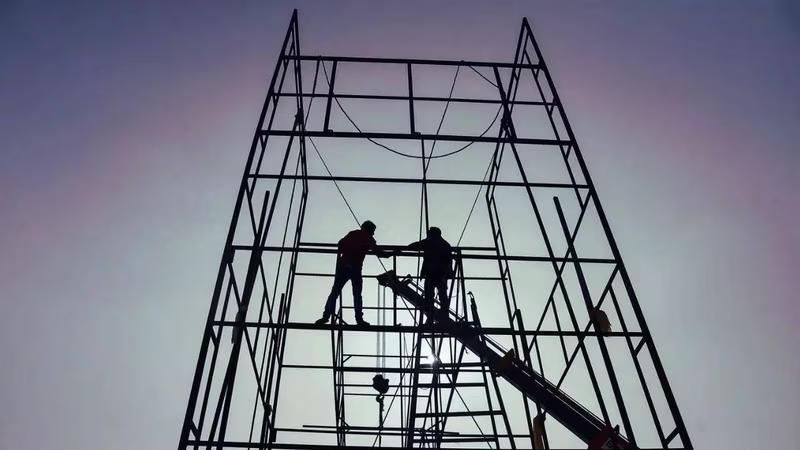
A fierce political and cultural storm is brewing in Kerala over what many are calling the state’s “Kumbh Mela”—the Mahamagha Mahotsavam on the sacred Bharatapuzha River. The event, which draws lakhs of devotees for a holy dip every 12 years, has been thrown into uncertainty after revenue authorities in Malappuram issued a stop memo halting all preparatory construction along the riverbanks. The reason? Alleged violations of the Kerala Protection of River Banks and Regulation of Sand Mining Act, 2020.
But organizers are fighting back. They insist they secured all necessary clearances and accuse officials of targeting a Hindu religious gathering under the guise of environmental regulation. The clash has now escalated into a heated debate: Is this about protecting Kerala’s fragile river ecosystems—or is it an overreach that infringes on constitutional rights to religious freedom?
Table of Contents
- What Is the Mahamagha Mahotsavam?
- The Stop Memo and Its Environmental Justification
- Organizers’ Response: Permissions and Allegations of Bias
- Legal and Constitutional Questions at Stake
- Political Reactions Across Party Lines
- Environmental Protection vs. Religious Rights: A National Dilemma
- What Happens Next?
- Conclusion: Balancing Faith and Ecology
- Sources
What Is the Mahamagha Mahotsavam?
Held once every 12 years at the confluence of the Bharatapuzha and Kannayi rivers near Thirunavaya in Malappuram, the Mahamagha Mahotsavam is one of Kerala’s largest Hindu religious gatherings. Often referred to as the “Kerala Kumbh Mela,” it involves ritual bathing, Vedic ceremonies, and cultural programs. The last edition in 2013 saw over 50 lakh devotees participate . For many, it’s not just a festival—it’s a spiritual pilgrimage deeply tied to Kerala’s cultural identity.
The Stop Memo and Its Environmental Justification
The Malappuram Revenue Divisional Officer (RDO) issued the stop memo after field inspections revealed that temporary structures—like bathing ghats, fencing, and viewing platforms—were being erected within the river’s protected buffer zone. Under the Kerala River Protection Act, any construction within 50 meters of the riverbank requires special clearance from the State Wetland Authority and the Pollution Control Board .
Officials argue that unregulated infrastructure can accelerate erosion, disrupt aquatic ecosystems, and increase flood risks—especially critical in a state like Kerala, which has faced devastating floods in recent years. “This isn’t about religion; it’s about enforcing the law equally,” stated a senior revenue official anonymously .
Organizers’ Response: Permissions and Allegations of Bias
The event’s organizing committee, led by local temple trusts and supported by the Hindu Religious Endowments Department, claims they submitted all required documents and received verbal assurances from local panchayat and district authorities. They argue that temporary, eco-friendly structures have been used in past editions without issue.
“We’ve done this for decades. Suddenly, now, there’s a problem?” asked a committee spokesperson. “This feels like a targeted move to disrupt Hindu religious practices under the cover of environmentalism.” Some right-wing groups have gone further, alleging “systematic discrimination” against Hindu festivals compared to other community events held near water bodies .
Legal and Constitutional Questions at Stake
This dispute sits at the intersection of two fundamental principles:
- Article 25 of the Indian Constitution: Guarantees the right to freely profess, practice, and propagate religion.
- Environmental Jurisprudence: The Supreme Court has repeatedly upheld that ecological protection can impose reasonable restrictions on religious activities if they cause irreversible harm .
The key question is whether the current preparations pose such a threat—and whether the state applied the law uniformly.
Political Reactions Across Party Lines
The controversy has split Kerala’s political spectrum. The BJP has vocally backed the organizers, framing it as an attack on Hindu traditions. The ruling CPI(M)-led LDF government, while defending its environmental stance, has urged calm and promised a review. Meanwhile, the Congress-led UDF has called for a “balanced approach” that respects both faith and nature .
Environmental Protection vs. Religious Rights: A National Dilemma
This isn’t unique to Kerala. Similar conflicts have arisen around the Ganga in Haridwar, the Yamuna in Delhi, and even during Ganesh Chaturthi immersions in Maharashtra. As noted by experts at the Centre for Science and Environment, sustainable religious tourism is possible—but it requires proactive planning, not last-minute enforcement .
What Happens Next?
The organizing committee is expected to approach the Kerala High Court seeking permission to proceed. In the meantime, the state government has formed a high-level committee to assess the environmental impact and explore alternatives—such as biodegradable materials or relocating structures outside the buffer zone. A final decision is expected within days, as the event date looms.
Conclusion: Balancing Faith and Ecology
The Kerala Kumbh Mela stop memo row is more than a bureaucratic tussle—it’s a microcosm of a national challenge. How do we honor deep-rooted religious traditions while safeguarding the natural resources that sustain us all? The answer lies not in confrontation, but in collaboration: involving religious leaders in environmental planning, adopting green protocols, and ensuring laws are applied fairly. Only then can festivals like the Mahamagha Mahotsavam thrive without compromising Kerala’s ecological future.
Sources
[1] Times of India: Row erupts in Kerala over stop memo on preparatory work for ‘Kumbh Mela’. https://timesofindia.indiatimes.com/city/kozhikode/authorities-issue-stop-memo-to-halt-prep-work-for-mahamagha-mahotsavam/articleshow/126512257.cms
[2] Web Search Results on Kerala River Protection Act, Mahamagha Mahotsavam history, and legal precedents on religious-environmental conflicts.