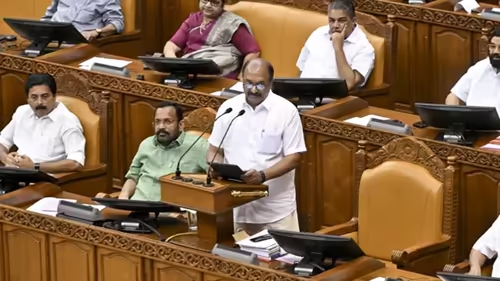
Kerala has once again doubled down on its reputation as India’s most welfare-driven state. In the Kerala Budget 2026, Finance Minister presented a people-first financial blueprint that pours a staggering ₹14,500 crore into social security and community welfare programs. But while the announcements—from a new pension guarantee to hefty pay hikes for frontline health workers—are being hailed by supporters, critics are sounding alarms about long-term fiscal strain.
Is this a bold investment in human capital or a risky gamble on borrowed time? Let’s unpack the details that matter to every Keralite—and every Indian watching how welfare economics plays out in real time.
Table of Contents
- Kerala Budget 2026: Key Highlights
- The 12th Pay Revision Commission: What It Means for Employees
- Assured Pension Scheme: Replacing NPS – A Game Changer?
- Boost for ASHA and Anganwadi Workers: Honorarium Hike
- Infrastructure Push: RAPIDS and the Rail-Based Rapid Transit System
- Fiscal Concerns: Can Kerala Afford This Welfare Spree?
- Conclusion: Balancing Compassion and Fiscal Prudence
- Sources
Kerala Budget 2026: Key Highlights
The Kerala Budget 2026 is built on a clear philosophy: prioritize people over balance sheets. With ₹14,500 crore earmarked specifically for social security and community welfare, the government is targeting vulnerable groups, government employees, and public infrastructure in one sweeping motion [[1]].
This isn’t just incremental spending—it’s a structural shift. The budget signals a return to defined-benefit pensions, a major uplift for grassroots health workers, and renewed momentum for urban mobility projects. For a state with high literacy, aging demographics, and strong labor unions, these moves are politically astute—but economically complex.
The 12th Pay Revision Commission: What It Means for Employees
One of the most anticipated announcements was the formation of the 12th Pay Revision Commission. This body will review and recommend salary structures for state government employees, following the pattern set by previous commissions that typically result in significant pay hikes and allowances [[2]].
For over 5 lakh state employees, this could mean not just better take-home pay but also improved retirement benefits—especially since it ties directly into the next big announcement: the new pension scheme.
Assured Pension Scheme: Replacing NPS – A Game Changer?
In a major policy reversal, the Kerala government announced the Assured Pension Scheme to replace the New Pension Scheme (NPS) for eligible employees. Under NPS, retirement benefits depended on market-linked returns, which many saw as uncertain and inadequate [[3]].
The new scheme promises a guaranteed monthly pension—essentially a return to the old defined-benefit model. While this offers security to employees, it also shifts long-term liabilities back onto the state exchequer. According to estimates from the Reserve Bank of India, such reversals can significantly increase future pension burdens for states already grappling with revenue constraints [[4]].
Boost for ASHA and Anganwadi Workers: Honorarium Hike
Recognizing the critical role of frontline health workers, the budget includes a substantial increase in honorariums for ASHA (Accredited Social Health Activists) and Anganwadi workers. These women, who form the backbone of rural healthcare and child nutrition programs, have long demanded better compensation [[5]].
While the exact figures weren’t detailed in initial reports, the move is seen as both a moral imperative and a strategic investment in public health outcomes—a domain where Kerala has historically led the nation.
Infrastructure Push: RAPIDS and the Rail-Based Rapid Transit System
Beyond welfare, the Kerala Budget 2026 also allocates significant funds for infrastructure, particularly the Rail-Based Regional Rapid Transit System (RRTS). This ambitious project aims to decongest cities like Thiruvananthapuram and Kochi by creating high-speed commuter rail corridors [[6]].
The initiative falls under the broader RAPIDS (Rail and Road Infrastructure Development for Sustainable Mobility) program, which seeks to integrate green, efficient transport into Kerala’s urban fabric. Given the state’s narrow geography and traffic congestion, this could be transformative—if executed without delays.
Fiscal Concerns: Can Kerala Afford This Welfare Spree?
Here’s where the debate heats up. Kerala’s debt-to-GSDP ratio already hovers around 35–40%, among the highest in India [[7]]. While the state boasts high remittance inflows and tax compliance, recurring welfare expenditures—especially pension liabilities—can create a fiscal trap.
Economists warn that replacing NPS with a defined-benefit pension could add thousands of crores to annual liabilities within a decade. As noted by the Comptroller and Auditor General (CAG), unchecked pension growth has already strained several state budgets [[8]].
That said, Kerala’s model argues that social investment yields long-term economic returns—through healthier, more educated citizens and reduced inequality. The question isn’t whether welfare matters, but whether the financing is sustainable.
Conclusion: Balancing Compassion and Fiscal Prudence
The Kerala Budget 2026 is a bold statement of values. It reaffirms the state’s commitment to social justice, worker dignity, and inclusive development. Yet, it also tests the limits of fiscal responsibility in an era of slowing revenue growth and rising obligations.
For citizens, the immediate benefits are clear: better pay, stronger pensions, and improved public services. For policymakers, the challenge is ensuring these promises don’t become tomorrow’s crisis. As Kerala walks this tightrope, the rest of India watches closely—because the outcome could shape the future of welfare economics in federal India.
For deeper insights into state fiscal health, refer to authoritative analyses from institutions like the Reserve Bank of India and the Department of Economic Affairs.
Sources
- [[1]] Times of India: Kerala Budget session: Rs 14,500 crore welfare boost—key points
- [[2]] The Hindu: Kerala govt announces 12th Pay Revision Commission
- [[3]] Indian Express: Kerala Budget 2026: Assured Pension Scheme to replace NPS
- [[4]] Reserve Bank of India: State Finances: A Study of Budgets (2025-26)
- [[5]] Deccan Herald: Kerala Budget 2026: ASHA, Anganwadi workers get honorarium hike
- [[6]] Mathrubhumi English: Kerala Budget 2026 allocates funds for RAPIDS rail project
- [[7]] PRS Legislative Research: Kerala Budget Analysis
- [[8]] Comptroller and Auditor General of India: Report on State Finances – Kerala