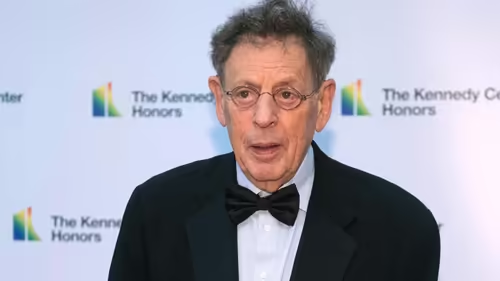
The hallowed halls of the John F. Kennedy Center for the Performing Arts, long a symbol of American cultural excellence, have become the epicenter of a fierce political and artistic battle. In a stunning move that has galvanized the creative community, world-renowned composer Philip Glass has pulled his new symphony from its scheduled premiere, declaring a personal and powerful Satyagraha—a non-violent resistance—against the Trump administration’s influence over the institution. This act has sparked a growing Kennedy Center boycott, with numerous artists and organizations following his lead in a collective stand for artistic independence.
The controversy stems from a series of administrative changes that many in the arts world perceive as a hostile takeover. Critics argue that the Trump administration has installed loyalists into key leadership roles, shifting the center’s mission from a neutral platform for the arts to a vehicle for political messaging [[2]]. For artists like Glass, this is an unacceptable erosion of a national treasure.
Table of Contents
- Philip Glass Takes a Stand: The ‘Satyagraha’ Begins
- The Kennedy Center Boycott Grows: A Cultural Exodus
- Why Artists Are Protesting: The Fear of a ‘Trump-Controlled’ Arts Center
- The Political Battle for the Arts: A Historical Context
- What Does This Mean for American Culture?
- Conclusion: Art as Resistance
- Sources
Philip Glass Takes a Stand: The ‘Satyagraha’ Begins
At 89 years old, Philip Glass, a titan of modern classical music, is no stranger to using his art for social commentary. His decision to cancel the premiere of his 15th symphony was not made lightly. He explicitly framed his action as a form of peaceful protest, invoking the spirit of Gandhi’s Satyagraha to resist what he sees as a fundamental threat to artistic freedom [[4]].
“This is not just about one performance,” Glass is reported to have stated. “It’s about the soul of our cultural institutions. When politics dictates the terms of art, we all lose.” By withdrawing his work—a piece that was highly anticipated by the classical music world—Glass sent an unambiguous message that he would not lend his prestige to an institution he believes has been compromised [[1]].
The Kennedy Center Boycott Grows: A Cultural Exodus
Glass’s bold stance has acted as a catalyst. His withdrawal is not an isolated incident but the most prominent in a widening wave of cancellations. Musicians, dance companies, and other performing arts groups have begun to pull out of scheduled events, creating a significant cultural and financial void at the center [[2]].
This collective action is being described as a full-fledged Kennedy Center boycott. The list of participating artists continues to grow, demonstrating a rare moment of unity within the often-fragmented arts community. Their shared goal is clear: to pressure the administration to restore the center’s independence and its original mission as a non-partisan home for the arts [[3]].
Why Artists Are Protesting: The Fear of a ‘Trump-Controlled’ Arts Center
The core of the artists’ anger lies in the perception of a direct political intrusion. Reports indicate that the Trump administration has restructured the center’s leadership, appointing figures known for their political allegiance rather than their arts expertise [[2]]. This has led to fears that programming decisions, funding allocations, and even the very definition of “American art” could be subject to political litmus tests.
For many, the Kennedy Center represents more than just a venue; it is a public trust. Its founding principle was to honor President Kennedy’s legacy by celebrating the best of American and international culture, free from government interference. The current situation, they argue, betrays that sacred trust. The term “Trump-controlled arts centre” has become a common refrain among protesters, encapsulating their deep concern [[6]].
The Political Battle for the Arts: A Historical Context
This conflict is not without precedent. Throughout history, authoritarian regimes have sought to control or co-opt cultural institutions for propaganda. From the Soviet Union’s Socialist Realism to Nazi Germany’s censorship of “degenerate art,” the pattern is clear: controlling the narrative of culture is a key tool of political control.
While the current situation in the U.S. is far from those extremes, the artists’ protest is a warning shot. They see the Kennedy Center’s restructuring as a dangerous first step down a slippery slope. Their Kennedy Center boycott is a preemptive defense of a principle they hold dear: that art must remain a space for free expression, critical thought, and diverse voices, not a mouthpiece for any administration. For a deeper look at this history, see our feature on [INTERNAL_LINK:politics-and-the-arts-through-history].
What Does This Mean for American Culture?
The implications of this standoff are profound. If the boycott continues to gain momentum, it could severely damage the Kennedy Center’s reputation as a world-class institution and its ability to attract top talent. It also raises a fundamental question for the American public: who owns our cultural heritage?
Is it a resource to be managed by the government of the day, or is it a commonwealth that belongs to all citizens, to be protected from political whims? The artists’ protest forces a national conversation about the role of government in the arts and the importance of maintaining a firewall between cultural expression and political power.
Conclusion: Art as Resistance
Philip Glass’s decision to stage his own Satyagraha at the Kennedy Center has transformed a single act of conscience into a powerful movement. The growing Kennedy Center boycott is a testament to the enduring belief that art and politics, while often intertwined, must maintain a critical distance to preserve the integrity of both. As this cultural battle unfolds, the world will be watching to see if the voice of artistic resistance can successfully defend one of America’s most cherished institutions.
Sources
- [[1]] WTOP, “Philip Glass cancels Kennedy Center symphony premiere in protest of Trump’s leadership”
- [[2]] The Fulcrum, “More Artists Boycott Trump-Renamed Kennedy Center”
- [[3]] Lincolnian, “Philip Glass Pulls His ‘Lincoln’ Symphony to Protest Trump”
- [[4]] AlterNet, “Iconic composer boycotts Kennedy Center as Trump fuels cultural war”
- [[5]] Pasadena Star-News, “Philip Glass cancels Kennedy Center symphony premiere”
- [[6]] Slipped Disc, “Philip Glass smashes into Trump’s Kennedy Center”