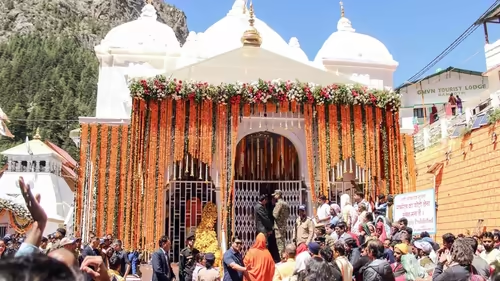
A quiet proposal from the Himalayas is now echoing across India’s socio-political landscape. The Badrinath Kedarnath Temple Committee (BKTC) is actively considering a ban on the entry of non-Hindus into its network of 49 temples, including the revered shrines of Kedarnath and Badrinath [[1]]. This potential policy shift—sparked by a similar proposal for Haridwar’s Kumbh Mela ghats—has reignited long-standing debates about religious identity, constitutional rights, and the balance between tradition and inclusivity in modern India. At the heart of the matter is a fundamental question: who has the right to access sacred spaces?
Table of Contents
- The Proposal: What Is Being Considered?
- Kedarnath Badrinath Non-Hindu Ban: The Committee’s Justification
- Historical Context: Temple Entry Rules in India
- Legal and Constitutional Implications
- Public Reaction: Support and Criticism
- Precedents: Other Temples with Similar Rules
- Conclusion: Balancing Faith and Inclusivity
- Sources
The Proposal: What Is Being Considered?
The BKTC, which manages some of Hinduism’s holiest sites in Uttarakhand, is deliberating a formal restriction that would bar individuals who do not identify as Hindu from entering its temples [[1]]. This includes not only foreign tourists but also Indian citizens of other faiths. The committee chairman, Narendra Singh Negi, clarified that the move is not about discrimination but about preserving the sanctity and specific rituals of these ancient places of worship. He emphasized that those who “respect our faith” are welcome, implying a desire for visitors to understand and honor the religious context of the space.
Kedarnath Badrinath Non-Hindu Ban: The Committee’s Justification
The primary argument from the BKTC rests on two pillars: tradition and constitutional law. First, they assert that these temples have been centers of Hindu worship for centuries, and their rituals are designed exclusively for Hindu devotees. Allowing non-practitioners, they argue, could disrupt the spiritual atmosphere and dilute the religious experience. Second, they point to Article 26 of the Indian Constitution, which grants religious denominations the right to manage their own affairs in matters of religion [[5]]. This legal provision has been used in the past to justify exclusive access policies at certain religious sites.
Historical Context: Temple Entry Rules in India
India’s history with temple access is complex and often fraught. The early 20th century saw massive social reform movements, most notably led by Dr. B.R. Ambedkar, fighting against the exclusion of Dalits from Hindu temples. The landmark Temple Entry Proclamation of 1936 in Travancore was a major victory for social justice. Today, the conversation has shifted from caste-based exclusion to faith-based access. While many major temples like Tirupati and Puri are open to all visitors regardless of religion, others, such as the Jagannath Temple in Puri (which bars non-Hindus), maintain strict entry rules based on faith [[7]].
Legal and Constitutional Implications
The proposed Kedarnath Badrinath non-Hindu ban sits at the intersection of two key constitutional articles. Article 25 guarantees the “freedom of conscience and free profession, practice and propagation of religion” to all citizens. However, Article 26(b) allows every religious denomination to “manage its own affairs in matters of religion.” The Supreme Court of India has historically interpreted these rights in a way that often prioritizes the autonomy of religious institutions over individual access, especially when it comes to internal religious practices. For a deeper understanding of this legal framework, the official resources on the [Supreme Court of India’s website][[10]] provide valuable context on past rulings.
Public Reaction: Support and Criticism
The proposal has drawn sharp reactions from both sides. Supporters, including many Hindu nationalist groups and local priests, hail it as a necessary step to protect the integrity of their faith from commercialization and cultural appropriation. They argue that just as mosques and churches have their own protocols, Hindu temples should have the same right. Critics, however, including secular activists, interfaith organizations, and tourism bodies, warn that such a ban could foster division, hurt India’s image as a pluralistic society, and negatively impact religious tourism in Uttarakhand—a key economic driver for the state.
Precedents: Other Temples with Similar Rules
This is not an isolated case. Several prominent temples in India already enforce faith-based entry restrictions:
- Jagannath Temple, Puri: Non-Hindus are not permitted beyond the main gate.
- Padmanabhaswamy Temple, Thiruvananthapuram: Entry is restricted to Hindus only.
- Mata Vaishno Devi Shrine, Jammu: While officially open to all, registration requires a declaration of faith, effectively limiting non-Hindu access.
These precedents suggest that the BKTC’s proposal, while controversial, is not without legal or cultural grounding in the current Indian context.
Conclusion: Balancing Faith and Inclusivity
The debate over the Kedarnath Badrinath non-Hindu ban is ultimately about more than just temple gates—it’s about the soul of modern India. Can a nation that prides itself on its ancient spiritual heritage also uphold its constitutional promise of equality and inclusivity? There are no easy answers. The BKTC’s final decision will set a significant precedent for how India navigates the delicate balance between protecting religious autonomy and fostering a truly pluralistic society. For more on the evolving nature of religious identity in India, see our feature on [INTERNAL_LINK:religion-and-identity-in-modern-india].
Sources
- Times of India: Kedarnath, Badrinath and 47 affiliated temples considering a ban on entry of non-Hindus
- The Hindu: Badrinath, Kedarnath temples may bar non-Hindus
- Constitution of India: Articles 25 and 26
- Supreme Court of India: Judgments on Religious Freedom
- Wikipedia: Temple Entry Proclamation
- Ministry of Tourism, Government of India: Religious Tourism Guidelines