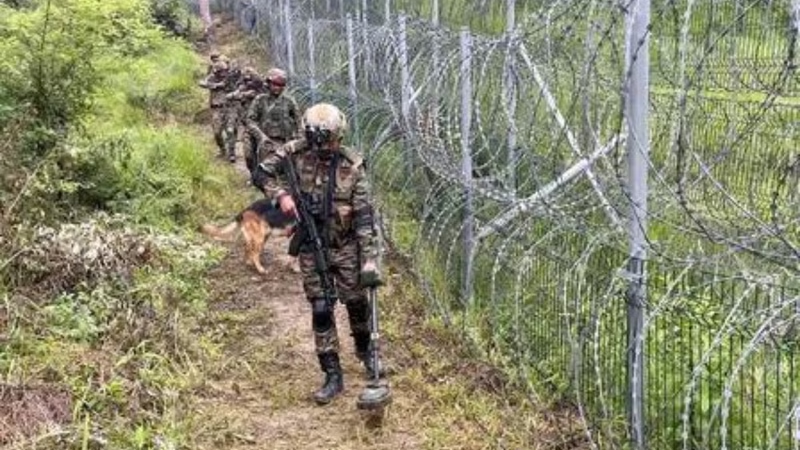
Early Wednesday morning, the quiet hills of Kathua were shattered by the sharp crack of gunfire. Simultaneously, just miles away in Rajouri, villagers reported seeing unfamiliar drones hovering near sensitive military installations. These twin developments—Kathua gunshots during a massive search operation and unexplained drone activity in Rajouri—have raised urgent questions about the security situation in the Jammu region.
While official sources have confirmed an ongoing anti-militancy drive, they’ve remained tight-lipped about casualties or arrests. But for locals, the sound of live fire and the sight of surveillance drones are more than just routine—they’re chilling reminders of a volatile past that many hoped was behind them.
So, what’s really happening on the ground? Is this a sign of renewed militant infiltration, a sophisticated reconnaissance effort from across the border, or simply a standard security sweep gone loud? Let’s break down the facts, the context, and what it could mean for one of India’s most strategically critical regions.
Table of Contents
- Kathua Gunshots: What We Know About the Search Operation
- Rajouri Drone Sightings: A New Frontier in Border Warfare
- Why Jammu Has Become a Militant Hotspot Again
- How Indian Security Forces Are Responding
- Impact on Local Civilians: Fear and Uncertainty
- Conclusion: Vigilance in a Fragile Peace
- Sources
Kathua Gunshots: What We Know About the Search Operation
According to local police and media reports, security forces launched a large-scale cordon-and-search operation (CASO) in the hilly forests of the Billawar sector in Kathua district early on January 14, 2026 . The operation, involving personnel from the Indian Army and Jammu and Kashmir Police, was based on “specific intelligence inputs” suggesting the presence of hiding militants.
During the operation, gunshots were heard intermittently for several hours, indicating an exchange of fire. While authorities have not confirmed whether the firing was between security forces and suspected militants—or merely warning shots—the intensity suggests a high-alert scenario.
As of now, no official casualty figures have been released, and the area remains under lockdown. This opacity is standard procedure during active ops but fuels speculation among residents already on edge.
Rajouri Drone Sightings: A New Frontier in Border Warfare
Just as the Kathua operation unfolded, multiple villages in the Nowshera and Sunderbani areas of Rajouri reported spotting small, quadcopter-style drones flying at low altitudes during the night . These sightings are deeply concerning for two reasons:
- Reconnaissance Use: Drones can be used to map military positions, patrol routes, and infrastructure—critical intel for planning attacks.
- Smuggling Potential: In recent years, drones have been used to drop weapons, ammunition, and narcotics across the India-Pakistan border in Punjab and Jammu .
The Indian Army has significantly ramped up its counter-drone capabilities since 2023, deploying radar systems, RF jammers, and even trained eagles in some sectors. Yet, the porous, forested terrain of Rajouri makes detection and interception extremely challenging.
For more on how drones are reshaping modern border security, see our deep dive on [INTERNAL_LINK:counter-drone-technology-india-pakistan-border].
Why Jammu Has Become a Militant Hotspot Again
Historically, militancy in Jammu and Kashmir was concentrated in the Kashmir Valley. But since 2021, there’s been a noticeable shift toward the Jammu region—particularly districts like Rajouri and Poonch. Experts attribute this to several factors:
- Thicker Forest Cover: The dense Shivalik ranges provide ideal cover for infiltrators to hide and regroup.
- Weaker Local Support Networks: Unlike the Valley, Jammu’s Hindu-majority population is largely unsupportive of militancy, making it harder for groups to blend in—which paradoxically makes them more desperate and violent.
- Strategic Diversion: Security analysts believe Pakistan-based handlers are deliberately shifting focus to Jammu to stretch Indian forces thin and create a perception of widespread instability .
This tactical pivot has turned once-peaceful districts into active conflict zones, with over 50 security personnel killed in Rajouri-Poonch alone in the past two years.
How Indian Security Forces Are Responding
The response has been multi-layered:
- Enhanced Grids: The Army has created smaller, more agile operational grids to respond faster to intelligence.
- Tech Integration: Thermal imagers, AI-powered surveillance, and drone swarms are being tested along vulnerable stretches.
- Civil-Military Coordination: Village defense committees are being reactivated to act as local eyes and ears.
Still, the challenge remains immense. As one retired Brigadier noted, “You can’t fence a forest. You have to win the intelligence war before the bullets fly.”
Impact on Local Civilians: Fear and Uncertainty
For ordinary citizens, these incidents aren’t just news headlines—they’re life-altering events. Schools in parts of Kathua and Rajouri were closed as a precaution. Farmers are afraid to tend their fields near forest fringes. And the constant hum of helicopters overhead has become the new normal.
“We thought the worst was over,” said a shopkeeper in Billawar. “Now we hear gunshots again. It feels like 2002 all over.”
This psychological toll is often overlooked in strategic discussions but is central to the long-term stability of the region.
Conclusion: Vigilance in a Fragile Peace
The Kathua gunshots and Rajouri drone sightings are not isolated blips. They are symptoms of a persistent, evolving threat along India’s western border. While the security forces are better equipped and more alert than ever, the enemy is also adapting—using technology, terrain, and terror to test India’s resolve.
For now, the situation remains under control. But as history has shown, complacency is the greatest enemy. The people of Jammu deserve not just protection, but lasting peace. And that will require more than just guns and drones—it will take intelligence, diplomacy, and unwavering national attention.
Sources
- Times of India. “Gunshots heard during search op in Kathua; drones spotted in Rajouri”. https://timesofindia.indiatimes.com/india/gunshots-heard-during-search-op-in-kathua-drones-spotted-in-rajouri/articleshow/126511704.cms
- Ministry of Defence, Government of India. “Counter-Drone Measures Along International Borders”. https://mod.gov.in/
- South Asia Terrorism Portal (SATP). “Militancy Trends in Jammu Region”. https://www.satp.org/