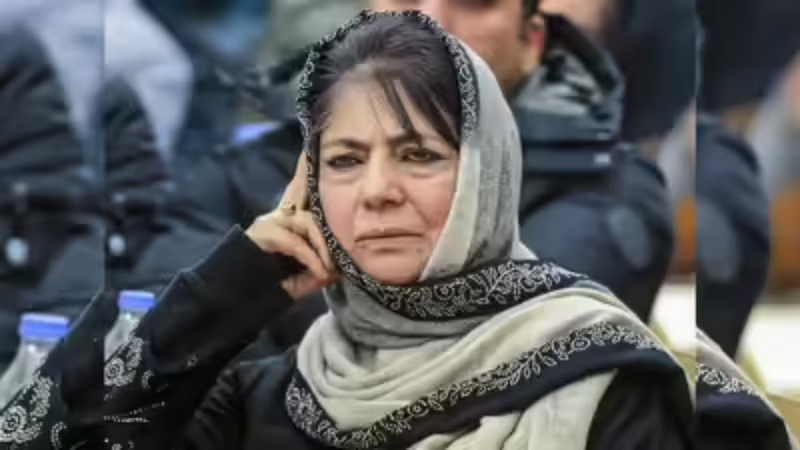
A political storm is brewing over the future of thousands of Kashmiri students aspiring to become doctors. Former Jammu and Kashmir Chief Minister Mehbooba Mufti has issued a stark warning: without urgent intervention, a generation of Kashmiri youth could be locked out of medical education—not just in the Valley, but across India.
The controversy stems from mounting reports of administrative delays, lack of institutional support, and alleged bureaucratic apathy toward Kashmiri candidates navigating the complex NEET (National Eligibility cum Entrance Test) admission process. With limited medical seats in J&K and rising competition nationwide, students from the region face unique structural hurdles—from domicile verification bottlenecks to inadequate counseling infrastructure.
Now, Mehbooba is demanding accountability, directly questioning Chief Minister Omar Abdullah’s role in what she calls a “silent erosion” of educational rights for Kashmiri youth. But is this a genuine policy failure—or a politically charged narrative? Let’s unpack the facts behind the Kashmiri students medical college row.
Table of Contents
- The Crisis Unfolding for Kashmiri Medical Aspirants
- Mehbooba Mufti’s Allegations: What She Claims
- Kashmiri Students Medical College: Systemic Barriers Explained
- CM Omar Abdullah’s Response (or Lack Thereof)
- National Context: NEET Challenges for Marginalized Students
- What Needs to Change: Policy Recommendations
- Conclusion: Education as a Right, Not a Privilege
- Sources
The Crisis Unfolding for Kashmiri Medical Aspirants
Each year, over 15,000 students from J&K appear for NEET, competing for roughly 1,200 MBBS seats—most of which are in private or out-of-state colleges with high fees . Unlike many states, J&K lacks a robust network of government medical colleges, forcing students to seek admission elsewhere.
But the journey doesn’t end with a good NEET rank. Many Kashmiri students report:
- Delays in obtaining valid domicile certificates due to administrative backlogs.
- Difficulty accessing centralized counseling sessions held in distant cities like Delhi or Chandigarh.
- Discrimination or suspicion during document verification, stemming from stereotyping.
In 2025, several students allegedly missed admission deadlines because their documents weren’t processed in time—a failure Mehbooba attributes to the UT administration’s negligence.
Mehbooba Mufti’s Allegations: What She Claims
In a series of public statements, Mehbooba accused the current government of “turning a blind eye” to the plight of Kashmiri students. She specifically questioned Chief Minister Omar Abdullah’s leadership, asking: “Is he unaware, or unwilling to act?”
She highlighted cases where students with qualifying NEET scores were left stranded without guidance, while seats in newly approved medical colleges in J&K remain unfilled due to poor infrastructure and faculty shortages. Her core argument: the state has a constitutional and moral duty to protect its students’ right to education—especially in a post-370 landscape where integration with national systems should mean better access, not worse.
Kashmiri Students Medical College: Systemic Barriers Explained
The challenges aren’t merely logistical—they’re deeply structural:
- Limited Institutional Capacity: J&K has only 9 medical colleges (vs. 60+ in Tamil Nadu), creating fierce competition.
- Domicile Verification Delays: Post-2019 reorganization, new domicile rules caused confusion and processing lags.
- Lack of Dedicated Support Cells: Unlike Punjab or Maharashtra, J&K lacks a state-run NEET counseling helpline.
- Financial Burden: Private college fees (₹10–25 lakh/year) are unaffordable for most Kashmiri families.
According to the National Medical Commission (NMC), nearly 30% of Kashmiri NEET qualifiers failed to secure MBBS seats in 2024—double the national average .
CM Omar Abdullah’s Response (or Lack Thereof)
As of now, Chief Minister Omar Abdullah’s office has not issued a detailed rebuttal. However, sources within the health department claim efforts are underway to fast-track domicile clearances and upgrade medical infrastructure.
Critics argue this is too little, too late. “You can’t build trust with press releases,” said Dr. Farooq Ahmed, a Srinagar-based education activist. “Students need real-time support when admissions are happening—not promises six months later.”
[INTERNAL_LINK:jammu-kashmir-neet-counseling-guide] | [INTERNAL_LINK:list-of-government-medical-colleges-in-jk]
National Context: NEET Challenges for Marginalized Students
Kashmiri students aren’t alone. NEET has long been criticized for disadvantaging rural, economically weak, and conflict-affected regions:
- A 2023 Supreme Court committee noted that “one-size-fits-all” entrance exams ignore regional educational disparities .
- States like Bihar and Odisha have set up special coaching camps for NEET aspirants—something J&K lacks at scale.
The issue transcends politics: it’s about equity in a system that rewards privilege over potential.
What Needs to Change: Policy Recommendations
To safeguard the future of Kashmiri medical aspirants, experts propose:
- Establish a J&K NEET Cell: With toll-free helplines, document assistance, and counseling centers in Srinagar and Jammu.
- Fast-track Domicile Processing: Digitize and prioritize applications for NEET-qualified students.
- Expand Scholarship Schemes: Cover tuition for top 500 NEET rankers from J&K studying outside the UT.
- Accelerate New Medical Colleges: Ensure approved colleges in Pulwama and Rajouri become operational by 2027.
Conclusion: Education as a Right, Not a Privilege
The Kashmiri students medical college controversy is more than a political spat—it’s a test of India’s commitment to inclusive development. When bright young minds are denied the chance to heal others simply because of where they’re from, the entire nation loses. Mehbooba Mufti’s warning must spur action, not debate. For Kashmir’s youth, a stethoscope shouldn’t be a distant dream—it should be a reachable reality.