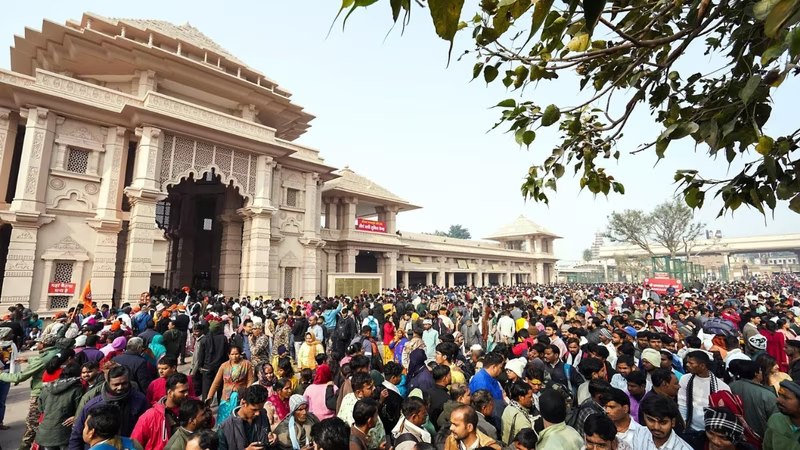
In a moment that fused faith, security, and human vulnerability, a 55-year-old man from Jammu and Kashmir was detained at the newly consecrated Ram Mandir in Ayodhya after allegedly attempting to offer namaz—the Islamic prayer—within the temple complex. The incident, which unfolded under the watchful eyes of tight security, has ignited a firestorm of reactions across social and political spectrums. But behind the headlines lies a more complex story: one of a family pleading that their loved one is mentally unwell, not malicious. This is the nuanced reality of the Kashmiri man detained at Ram Mandir .
Table of Contents
- What Happened at the Ram Mandir?
- Kashmiri Man Detained at Ram Mandir: Family Speaks Out
- Security Protocols and the Symbolism of Ayodhya
- Mental Health in the Spotlight
- Political and Social Reactions
- Conclusion: Balancing Security, Compassion, and Truth
- Sources
What Happened at the Ram Mandir?
According to police reports, the man entered the outer perimeter of the Ram Mandir complex in Ayodhya—a site of immense religious and national significance following its grand consecration in January 2024. Witnesses and security personnel observed him assuming a posture consistent with Islamic prayer. Before he could proceed further, Central Reserve Police Force (CRPF) and local police intervened immediately .
He was peacefully taken into custody and handed over to the Ayodhya police for questioning. No violence or damage was reported. Authorities have launched an investigation to determine whether the act was deliberate provocation or the result of impaired judgment.
Kashmiri Man Detained at Ram Mandir: Family Speaks Out
The man’s family, reached in Srinagar, has issued an emotional plea. They state he has a documented history of mental illness and has previously left home without warning, often disoriented and unaware of his surroundings. “He doesn’t understand religious boundaries,” his brother told reporters. “He once tried to enter a gurdwara in Jammu thinking it was a bus stop.”
The family claims they had filed missing person reports multiple times in the past and are devastated that this incident is being politicized. They urge authorities to treat him as a patient, not a perpetrator.
Security Protocols and the Symbolism of Ayodhya
Since its consecration, the Ram Mandir has been under round-the-clock, multi-layered security involving CRPF, UP Police, and intelligence units. Entry is strictly regulated, with metal detectors, facial recognition, and identity verification at every checkpoint .
How the man gained access to even the outer precincts is now under internal review. Experts note that while physical security is robust, human behavior—especially from individuals with cognitive impairments—can be unpredictable. As one former IPS officer noted, “Security can stop weapons, but it’s harder to assess intent in someone who may not comprehend their actions.”
Mental Health in the Spotlight
This case underscores a critical gap in India’s public safety infrastructure: the intersection of mental health and law enforcement. According to the National Mental Health Survey, nearly 15% of Indians suffer from some form of mental morbidity, yet stigma and lack of resources often leave families struggling in silence .
When individuals with untreated conditions wander into sensitive zones—be it religious sites, government buildings, or transport hubs—they are frequently treated as security threats rather than people in need of care. Advocates argue for better training for police and the integration of mental health professionals in crisis response teams, similar to models in the U.S. and U.K. [INTERNAL_LINK:mental-health-crisis-response-india].
Political and Social Reactions
Unsurprisingly, the incident was quickly weaponized online. Some groups labeled it a “deliberate insult” to Hindu sentiments, calling for harsh punishment. Others condemned the rush to judgment, highlighting the family’s account and urging empathy.
Political leaders have largely remained cautious, awaiting the investigation’s outcome. However, the episode reflects the fragile state of communal discourse in post-Mandir India, where even ambiguous acts can be magnified into national controversies. The real test will be whether institutions prioritize facts over frenzy.
Conclusion: Balancing Security, Compassion, and Truth
The detention of the Kashmiri man detained at Ram Mandir is not just a security incident—it’s a mirror held up to society. It forces us to ask: How do we protect sacred spaces without losing our humanity? How do we respond to ambiguity with patience, not panic? As the investigation continues, the hope is that justice will be served—not just legally, but with wisdom, compassion, and a commitment to truth over narrative.