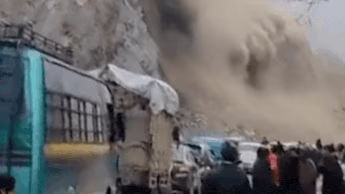
It was a scene straight out of a disaster movie, but this was terrifyingly real. On a frigid Friday morning in the heart of Kashmir’s brutal winter, massive rocks and debris came thundering down a mountainside, obliterating a stretch of the vital Srinagar-Baramulla-Uri National Highway (NH-1) near Baramulla .
The sudden **Kashmir landslide** sent a wave of panic through the area as motorists, caught completely off guard, were forced to abandon their vehicles and run for cover. Social media was quickly flooded with dramatic videos showing the chaotic aftermath, with cars and trucks stranded amidst a sea of rubble . This incident is a stark reminder of the deadly intersection between nature’s fury and the fragile infrastructure of the region, especially during the perilous winter months.
Table of Contents
- The NH-1 Horror: What Happened?
- Chilla-e-Kalan: The Deadly Winter Context
- A History of Peril on NH-1
- Immediate Response and Ongoing Risks
- What Travelers Need to Know
- Conclusion: A Fragile Lifeline
- Sources
The NH-1 Horror: What Happened?
The **Kashmir landslide** struck a section of NH-1 in the Khanpora area of Baramulla . This highway is not just a road; it’s a critical lifeline, connecting the Kashmir Valley to the rest of India and serving as the primary artery for both civilian and military traffic. The timing of the slide—early morning—likely prevented a far greater tragedy, as the volume of traffic was still building. However, the event has completely severed this crucial link, leaving hundreds of travelers stranded and local communities cut off.
Initial reports from authorities suggest the landslide was triggered by a combination of factors, including the natural instability of the mountainous terrain and the heavy moisture from recent snowfall and freezing rain during the ongoing cold wave . The visual evidence is chilling: massive boulders, some as large as small houses, now litter the highway, crushing anything in their path.
Chilla-e-Kalan: The Deadly Winter Context
This disaster didn’t happen in isolation. It occurred during Chilla-e-Kalan, the harshest 40-day period of winter in Kashmir, which began on December 21, 2025, and will last until January 31, 2026 [[10], [16]]. This period is infamous for its intense cold, heavy snowfall, and frequent avalanches and landslides.
During Chilla-e-Kalan, the ground is in a constant state of freeze-thaw cycles. Water seeps into cracks in the rock, freezes, expands, and then thaws. This process, repeated over weeks, acts like a natural jackhammer, relentlessly weakening the mountainsides and making them highly susceptible to sudden and catastrophic failures like the one witnessed on Friday .
A History of Peril on NH-1
Unfortunately, this stretch of highway is no stranger to such disasters. The Srinagar-Baramulla-Uri road has a long and tragic history of landslides, particularly in the Baramulla and Uri sectors . The geology of the region, combined with its seismic activity and the pressures of modern infrastructure development, creates a perfect storm for slope instability.
Past incidents have shown a recurring pattern:
- Seasonal Vulnerability: The road is most at risk during the spring thaw and the winter Chilla-e-Kalan period .
- Human Factors: In some past cases, illegal stone quarrying and deforestation have been cited as contributing factors that exacerbate the natural risk .
- Chronic Disruption: These events are not anomalies but a recurring challenge that disrupts the economy and daily life of the entire valley.
Immediate Response and Ongoing Risks
Emergency response teams, including personnel from the Border Roads Organisation (BRO) and local police, were immediately dispatched to the site. Their primary tasks are to clear the debris, rescue any trapped individuals, and assess the structural integrity of the remaining road. The BRO is renowned for its rapid response in such situations, but the sheer scale of this landslide and the ongoing adverse weather will make the operation slow and dangerous.
Compounding the danger is the fact that the area remains at high risk for secondary landslides. As rescue and recovery work continues, the ground above the slide zone is still unstable. Authorities have likely issued warnings for residents and travelers in the vicinity to remain vigilant.
What Travelers Need to Know
If you are planning to travel on the Srinagar-Baramulla-Uri highway, it is absolutely crucial to stay updated with the latest information. Here’s what you should do:
- Check Official Sources: Monitor traffic bulletins from the Jammu and Kashmir Police and the BRO before your journey.
- Have a Backup Plan: Identify alternative routes, even if they are significantly longer. The disruption on NH-1 can last for several days.
- Travel in Daylight: Avoid traveling on mountain roads during the night or in poor visibility, especially during Chilla-e-Kalan.
- Stay Informed: Follow local news outlets for real-time updates on road conditions. For more on travel safety in the region, see our guide on [INTERNAL_LINK:travel-in-kashmir-winter].
Conclusion: A Fragile Lifeline
The terrifying **Kashmir landslide** near Baramulla is a sobering reminder of the immense power of nature and the vulnerabilities of human infrastructure in one of the world’s most dramatic landscapes. It underscores the critical need for long-term investment in slope stabilization, advanced early-warning systems, and resilient road design. For the people of Kashmir, this event is not just a news story; it’s a disruption of their lifeline, a source of fear, and a call for greater attention to the region’s unique and dangerous environmental challenges.