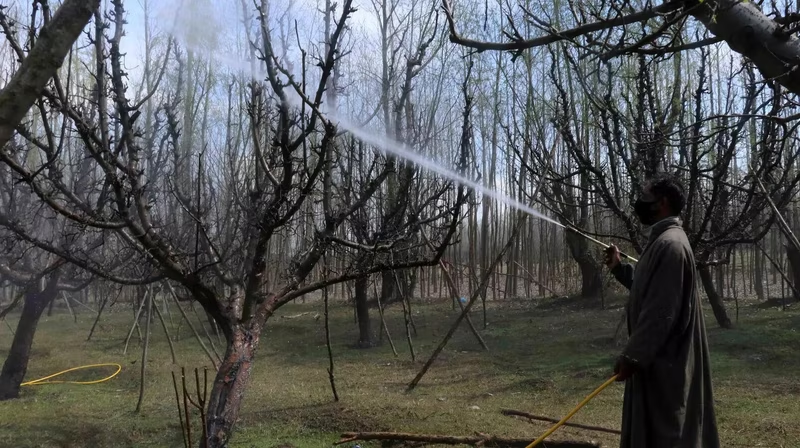
For generations, Kashmir’s rolling hills have been painted in the rich reds and greens of its legendary apple orchards—a symbol of prosperity and cultural pride. But behind the glossy skins of these beloved fruits lies a troubling reality. Lawmakers, doctors, and researchers are sounding the alarm: a surge in malignant brain tumours among orchard workers may be directly tied to decades of indiscriminate pesticide use. What once sustained livelihoods now threatens lives, igniting a Kashmir apple orchards health crisis that demands urgent attention.
Table of Contents
- The Human Toll Behind Kashmir’s Apple Boom
- Kashmir Apple Orchards Health Crisis: Evidence Mounts
- Why Pesticides Are So Heavily Used in Kashmir
- Medical Community Raises Red Flags
- Policy Failures and Regulatory Gaps
- Global Context: What Other Countries Do
- What Can Be Done? Solutions and Safeguards
- Conclusion: A Call for Sustainable and Safe Farming
- Sources
The Human Toll Behind Kashmir’s Apple Boom
Kashmir produces over 75% of India’s apples, with districts like Shopian, Pulwama, and Baramulla forming the heartland of this $1.5 billion industry . Yet, this agricultural success story has a dark underbelly. Farmworkers—often untrained, unprotected, and unaware—routinely handle and spray toxic agrochemicals without gloves, masks, or proper guidance. Over time, chronic exposure has begun to show devastating effects.
Hospitals in Srinagar report an unusual concentration of brain cancer cases among farmers and seasonal orchard laborers. Many are in their 30s and 40s—far younger than typical brain tumour patients. Families are devastated, and communities are fearful. As one local doctor put it, “We’re seeing patterns that can’t be ignored.”
Kashmir Apple Orchards Health Crisis: Evidence Mounts
Recent studies have begun to connect the dots. Researchers have detected high levels of organophosphates and synthetic pyrethroids—common in orchard pesticides—in the blood samples of affected workers . These chemicals are known neurotoxins, classified by the World Health Organization (WHO) as potential carcinogens with strong links to neurological disorders and cancers .
In Shopian, one of the worst-hit districts, oncologists note that brain tumour incidence is now three times higher than the national average . While correlation isn’t proof of causation, the geographic and occupational clustering of cases is deeply concerning to public health experts.
Why Pesticides Are So Heavily Used in Kashmir
The reliance on chemical pesticides in Kashmir’s apple farming stems from multiple factors:
- Pest Pressure: The region’s humid climate creates ideal conditions for codling moths, aphids, and apple scab—forcing farmers to spray weekly, sometimes multiple times a week.
- Lack of Alternatives: Organic or integrated pest management (IPM) techniques are rarely promoted or subsidized.
- Market Demands: Consumers expect blemish-free fruit, pushing growers toward aggressive chemical use to meet cosmetic standards.
- Easy Access: Pesticides are widely available over the counter, with little oversight on sales or usage.
Many farmers inherit these practices from their parents, unaware of the long-term health risks. As one orchard owner confessed, “We never thought about what it was doing to us—only how to protect the crop.”
Medical Community Raises Red Flags
Doctors at Sher-i-Kashmir Institute of Medical Sciences (SKIMS) in Srinagar have been at the forefront of documenting this trend. Neurosurgeons report treating an increasing number of young patients with aggressive glioblastomas—a type known for its poor prognosis .
Dr. Asif Iqbal, a neurologist at SKIMS, told reporters: “The majority of our brain tumour patients from rural apple-growing areas have histories of prolonged pesticide exposure without protective gear. This isn’t a coincidence.”
These clinical observations are now prompting calls for epidemiological studies to formally establish the link between pesticide exposure and brain cancer in the region.
Policy Failures and Regulatory Gaps
Despite India’s Insecticides Act of 1968, enforcement in Jammu and Kashmir remains weak. There’s no mandatory training for pesticide applicators, no health monitoring for agricultural workers, and minimal residue testing on produce .
The J&K Agriculture Department has yet to issue comprehensive safety guidelines for orchard workers. Meanwhile, lawmakers in the state assembly have begun demanding an inquiry, citing “a public health emergency in the making.” Without systemic intervention, the Kashmir apple orchards health crisis could worsen.
For more on India’s agricultural policies, see our analysis on [INTERNAL_LINK:sustainable-farming-india].
Global Context: What Other Countries Do
Many nations have taken decisive action to protect farmworkers. The European Union, for instance, has banned several high-risk pesticides and requires mandatory protective equipment, training, and health surveillance for agricultural workers . In the U.S., the Environmental Protection Agency (EPA) enforces strict re-entry intervals after spraying and mandates certified applicator programs.
These models offer valuable lessons. India could adopt similar measures—starting with banning the most hazardous pesticides used in Kashmir’s orchards and funding farmer education programs.
What Can Be Done? Solutions and Safeguards
Addressing this crisis requires a multi-pronged approach:
- Ban High-Risk Pesticides: Immediately restrict organophosphates and other WHO Class I chemicals.
- Promote IPM: Invest in biocontrol agents, pheromone traps, and resistant apple varieties.
- Worker Protection: Mandate PPE distribution and training for all orchard laborers.
- Health Surveillance: Launch a state-funded cancer screening and registry program for agricultural workers.
- Consumer Awareness: Encourage support for certified organic or low-spray Kashmiri apples.
NGOs like the Centre for Science and Environment (CSE) have already proposed such frameworks . The question is whether policymakers will act before more lives are lost.
Conclusion: A Call for Sustainable and Safe Farming
The idyllic image of Kashmir’s apple orchards masks a growing public health emergency. The Kashmir apple orchards health crisis is not just a regional issue—it’s a national wake-up call about the hidden costs of chemical-intensive agriculture. Protecting the people who feed the nation must be as important as protecting the crop itself. With coordinated action from government, medical institutions, and farming communities, Kashmir can transition to a safer, more sustainable apple industry—one where “an apple a day” doesn’t come at the cost of a worker’s life.
Sources
- Times of India: “‘An apple a day’ — but at what cost? Kashmir’s orchards raise health alarm”
- Down To Earth: “Pesticide regulation in India: Gaps and challenges”
- Journal of Environmental Science and Health: “Pesticide residues in agricultural communities of Kashmir Valley”
- SKIMS Medical Journal: “Epidemiological trends of CNS tumours in South Kashmir”
- The Hindu: “Doctors in Srinagar link brain tumours to pesticide exposure in apple belt”
- World Health Organization (WHO): “Public health impact of pesticides used in agriculture” (https://www.who.int/publications/i/item/9241561379)
- European Food Safety Authority (EFSA): “Pesticide risk assessment and regulation in the EU”
- Centre for Science and Environment (CSE): “Status of pesticide use and regulation in India”