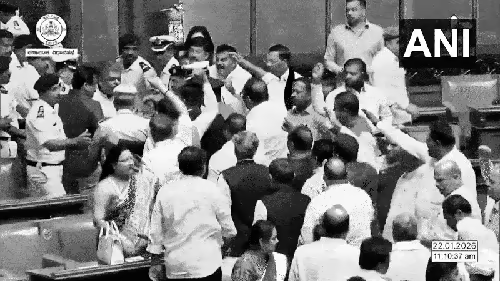
It was supposed to be a routine ceremonial address. Instead, it became a flashpoint for a full-blown constitutional crisis. In a dramatic and historic moment at the Karnataka Legislative Assembly, Governor Thawarchand Gehlot read only two lines of his customary speech before abruptly walking off the dais—refusing to utter paragraphs approved by the state cabinet that criticized the Union government’s stance on the controversial VB-G RAM G bill. The Karnataka Governor walkout has since ignited a fierce political storm, with the ruling Congress accusing the BJP of orchestrating the snub from New Delhi, while the opposition claims the state government is misusing the Governor’s office for partisan attacks.
Table of Contents
- The Walkout: What Happened in the Karnataka Assembly?
- The VB-G RAM G Bill: Why Is It So Controversial?
- Constitutional Protocol: Who Has the Final Say on the Governor’s Speech?
- Political Fallout: Congress Cries Breach, BJP Counters
- Precedents and Parallels: Has This Happened Before?
- What Next for Karnataka—and Indian Federalism?
- Conclusion: A Dangerous New Normal?
- Sources
The Walkout: What Happened in the Karnataka Assembly?
The joint sitting of the Karnataka legislature began with all the usual pomp—until it didn’t. Governor Thawarchand Gehlot, a former Union minister and senior BJP leader, took the podium to deliver the customary address outlining the state government’s agenda. But after reading just two introductory lines, he paused, declared the remaining text “not acceptable,” and walked off without further explanation .
The omitted sections reportedly contained sharp criticisms of the Central government’s alleged delay in granting approvals for the VB-G RAM G project—a major infrastructure initiative championed by the Karnataka government. By refusing to read the cabinet-approved speech, the Governor not only broke with decades of precedent but also triggered chaos in the House, with opposition BJP MLAs cheering and Congress members shouting “breach of Constitution!” .
The VB-G RAM G Bill: Why Is It So Controversial?
While official details remain sparse, the VB-G RAM G bill appears to be a state-level proposal aimed at fast-tracking development or resource allocation—possibly related to water, land, or urban infrastructure (the acronym may refer to key locations or leaders). The core dispute lies in the Centre’s perceived reluctance to clear the proposal, which the Karnataka government frames as federal overreach or political vendetta .
For the Congress-led state administration, the Governor’s refusal to voice their concerns publicly is seen as proof that unelected appointees are being used as tools by the ruling party at the Centre to stifle dissenting state governments—a pattern observed in several non-BJP ruled states like Tamil Nadu, West Bengal, and Kerala in recent years .
Constitutional Protocol: Who Has the Final Say on the Governor’s Speech?
This is where things get legally thorny. Article 176(2) of the Indian Constitution clearly states that the Governor “shall address” both Houses and that the speech “shall be prepared by the Cabinet.” Legal experts, including former Attorney General Soli Sorabjee, have consistently held that the Governor has no discretion to alter or omit parts of the speech—it is a formal conveyance of the elected government’s position, not a personal statement .
However, Governors have occasionally pushed back, citing “moral” or “political” objections. The Supreme Court, in multiple rulings (including the landmark Nabam Rebia case), has emphasized that the Governor must act on the aid and advice of the Council of Ministers, except in rare, constitutionally specified circumstances .
Key Constitutional Principles at Stake
- Article 176(2): Mandates the Governor to read the cabinet-approved address.
- Article 163: Requires the Governor to act on ministerial advice in most matters.
- Federal Balance: The incident tests the autonomy of state governments vs. Centre-appointed Governors.
- Convention vs. Law: While Governors are ceremonial, their actions can have real political consequences.
Political Fallout: Congress Cries Breach, BJP Counters
The Karnataka Congress wasted no time in framing the walkout as a “direct assault on democracy.” Chief Minister Siddaramaiah called it “unconstitutional and undemocratic,” demanding an apology and threatening legal action . Meanwhile, the BJP defended the Governor, arguing that the speech contained “false allegations” against the Centre and that Gehlot acted with “dignity” by refusing to be a “mouthpiece for propaganda” .
The incident has further polarized an already tense political environment in the state, with protests erupting outside Raj Bhavan and rival parties trading barbs on social media. [INTERNAL_LINK:karnataka-politics-analysis] [INTERNAL_LINK:indian-federalism-crisis]
Precedents and Parallels: Has This Happened Before?
While rare, this isn’t the first time a Governor has clashed with a state government over the address. In 2023, Tamil Nadu Governor R.N. Ravi similarly refused to read parts of the speech critical of the Centre, leading to a prolonged standoff . The Supreme Court is currently hearing petitions on that case, and its eventual ruling could set a binding precedent for Karnataka and other states.
These recurring conflicts highlight a growing trend: the politicization of gubernatorial offices, turning what should be neutral constitutional posts into extensions of the ruling party at the Centre.
What Next for Karnataka—and Indian Federalism?
The immediate fallout will likely include a formal protest from the state government, possible legal challenges, and intense scrutiny from the Election Commission and the President’s office. But the long-term implications are more profound. If Governors can unilaterally reject cabinet-approved content, it undermines the very foundation of parliamentary democracy in India’s federal structure.
As political scientist Dr. Pratap Bhanu Mehta notes, “When constitutional offices become partisan weapons, democracy itself becomes collateral damage” .
Conclusion: A Dangerous New Normal?
The Karnataka Governor walkout is more than a political spat—it’s a stress test for India’s federal democracy. At stake is not just one speech or one bill, but the principle that elected state governments have the right to govern without interference from unelected appointees loyal to a rival party in Delhi. How this crisis is resolved will send a powerful signal about the future balance of power between the Centre and the states.
Sources
- Times of India. “Governor Thawar Gehlot walks out mid-address in Karnataka assembly.” https://timesofindia.indiatimes.com/city/bengaluru/governors-walkout-sparks-karnataka-showdown-thawar-gehlot-exits-joint-sitting-mid-address-congress-cries-breach-bjp-counters/articleshow/127110574.cms
- The Hindu. “Chaos in Karnataka assembly as Governor refuses to read full speech.”
- Deccan Herald. “Siddaramaiah calls Governor’s act ‘unconstitutional’; demands apology.”
- India Today. “What is the VB-G RAM G bill? Explaining Karnataka’s controversial proposal.”
- NDTV. “BJP defends Governor Gehlot: ‘Won’t be a mouthpiece for false propaganda.’”
- The Wire. “Pattern of Governor-State clashes in non-BJP ruled states intensifies.”
- Constitution of India, Article 176(2).
- Supreme Court of India, Nabam Rebia vs Deputy Speaker (2016).
- BBC News. “Tamil Nadu Governor row: A recurring constitutional crisis.”
- Livemint. “Opinion: When Governors become political actors, federalism suffers.”