Table of Contents
- A Shocking Allegation Rocks Karnataka Police
- Home Minister Parameshwara Takes a Stand
- Who Is DGP K. Ramachandra Rao?
- Political Reactions and Opposition Criticism
- Precedents in Indian Police Accountability
- What Happens Next in the Investigation?
- Conclusion: A Test for Karnataka’s Institutions
- Sources
A Shocking Allegation Rocks Karnataka Police
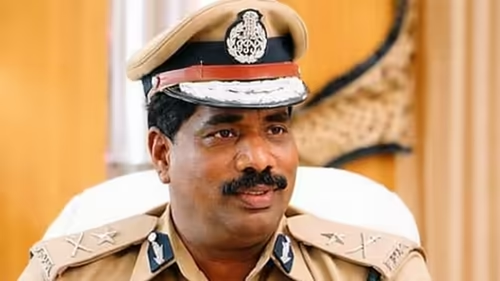
In a development that has sent shockwaves through Karnataka’s political and administrative corridors, Director General of Police (DGP) K. Ramachandra Rao has been placed under immediate suspension following the circulation of unverified “sleaze” videos allegedly involving him . The videos, whose authenticity remains under investigation, surfaced on social media earlier this week, triggering public outrage and urgent action from the state government.
What makes this case particularly significant is not just the rank of the accused—but the swiftness and severity of the state’s response. In a clear signal that no one is above scrutiny, the Karnataka government acted within hours, suspending its topmost police officer pending a full inquiry. This move underscores a growing demand for accountability at the highest levels of public service.
Home Minister Parameshwara Takes a Stand
Karnataka Home Minister G. Parameshwara left no room for ambiguity in his official statement. Calling the alleged conduct “unacceptable,” he emphasized that disciplinary action was initiated irrespective of the officer’s seniority or position .
“Such behavior, if proven true, cannot be tolerated in any public servant—least of all the state’s chief law enforcement officer,” Parameshwara stated. He further clarified that while the videos remain unverified, the mere gravity of the allegations warranted immediate administrative action to preserve public trust in the police force.
Critically, the minister warned that dismissal remains a real possibility should the charges be substantiated. “The law will take its course,” he asserted, adding that the government would not interfere in the investigative process but would uphold due process and institutional integrity.
Who Is DGP K. Ramachandra Rao?
K. Ramachandra Rao, a 1989-batch IPS officer, has held several high-profile positions in the Karnataka cadre, including Commissioner of Police in Bengaluru and Director of the State Crime Records Bureau. Appointed as DGP in 2023, he was widely seen as a seasoned administrator with decades of experience in maintaining law and order.
His sudden suspension marks a dramatic fall from grace and raises questions about oversight mechanisms within the police hierarchy. While Rao has not yet made a public statement, sources close to him claim he denies any wrongdoing and is cooperating fully with the probe.
Political Reactions and Opposition Criticism
The opposition BJP quickly seized on the incident, accusing the ruling Congress government of either negligence in appointing Rao or of using the scandal for political optics. “How could such conduct go unnoticed until now?” questioned a senior BJP leader, demanding a judicial inquiry into systemic failures within the police department.
In response, Home Minister Parameshwara dismissed these claims as “diversionary tactics,” stressing that the government’s priority is transparency, not political point-scoring. He also pointed out that the suspension demonstrates the administration’s commitment to zero tolerance for misconduct—even among its own appointees.
[INTERNAL_LINK:karnataka-political-scandals-history] This episode adds to a long list of controversies that have tested Karnataka’s governance framework, but it may also mark a turning point in how the state handles allegations against powerful officials.
Precedents in Indian Police Accountability
While suspensions of senior officers are rare, they are not unprecedented. In 2020, Tamil Nadu’s DGP was removed following public outcry over handling of a high-profile murder case. Similarly, in 2017, a Maharashtra ADGP was forced to resign after audio leaks suggested unethical conduct.
However, what sets the Karnataka case apart is the nature of the allegation—personal misconduct rather than professional failure—and the fact that action was taken before formal charges were filed. This reflects a shift toward **preventive accountability**, where reputational risk alone can trigger administrative consequences.
According to a report by the Commonwealth Human Rights Initiative, only 12% of complaints against senior Indian police officers result in disciplinary action . Karnataka’s decisive move could set a new benchmark—if consistently applied.
What Happens Next in the Investigation?
A three-member internal committee has been constituted to examine the authenticity of the videos and gather testimonial evidence. Additionally, the state’s cybercrime cell is conducting a forensic analysis to determine if the footage was doctored or misrepresented.
Possible outcomes include:
- Exoneration: If the videos are proven fake or unrelated to Rao, he may be reinstated with full honors.
- Minor penalty: If misconduct is confirmed but deemed non-criminal, he could face demotion or compulsory retirement.
- Dismissal and criminal charges: If the content is verified and involves illegal activity, termination and prosecution are likely.
Regardless of the outcome, the case has already ignited a broader conversation about ethics, privacy, and digital evidence in public life.
Conclusion: A Test for Karnataka’s Institutions
The Karnataka DGP suspension is more than a personnel matter—it’s a litmus test for the state’s commitment to ethical governance. By acting swiftly and publicly, the government has signaled that power does not grant immunity. Yet, true accountability will be measured not by the suspension itself, but by the fairness, transparency, and finality of the investigation. As citizens watch closely, Karnataka’s institutions now bear the responsibility of proving that justice applies equally—from the streets to the top office in the police headquarters.