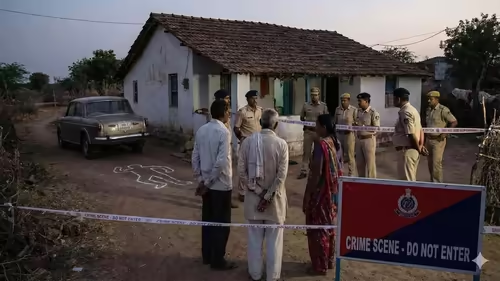
In the quiet lanes of a village under Kanpur’s Bilhaur police station, a horrific crime has shattered a family and reignited a city-wide debate on child safety. A 13-year-old girl was allegedly kidnapped and gang-raped by two local youths, an incident that has sent shockwaves through the community and drawn national attention to the persistent issue of violence against children in Uttar Pradesh .
This is not an isolated event. Just weeks before, another teenager in Kanpur was allegedly abducted and gang-raped, with a YouTuber and a police official among the accused . The recurring nature of these crimes demands a deeper look into the systemic failures and the legal framework designed to protect our most vulnerable.
Table of Contents
- The Incident: A Night of Terror
- Kanpur Gang Rape and the Alarming Trend of Child Crimes
- The POCSO Act: India’s Legal Shield for Children
- What Parents and Communities Can Do to Protect Children
- Conclusion: A Call for Urgent Action
- Sources
The Incident: A Night of Terror
The nightmare began on a seemingly ordinary Monday night. The young victim had stepped out to use an outdoor washroom near her home. In a matter of moments, she was allegedly abducted by two youths and taken to a nearby house where she was held captive and subjected to a brutal gang rape .
Displaying incredible courage, the girl managed to escape at dawn and returned home, where she immediately informed her distraught family. A formal complaint was swiftly filed with the Bilhaur police, who have since launched a manhunt for the accused. The case has been registered under the stringent provisions of the Protection of Children from Sexual Offences (POCSO) Act, which promises severe punishment for such heinous crimes.
Kanpur Gang Rape and the Alarming Trend of Child Crimes
This latest Kanpur gang rape is a grim reminder of the city’s troubling safety record, particularly concerning women and children. While some recent reports suggest a general decline in overall crime rates in Uttar Pradesh , Kanpur continues to be a hotspot for violent crimes against women and minors .
The recurrence of such brutal attacks—often involving minors as victims—paints a disturbing picture. It points to a potential gap between legislative intent and ground-level enforcement. Are our communities safe? Are our children protected? These are the urgent questions on everyone’s mind following this tragedy.
The POCSO Act: India’s Legal Shield for Children
In response to the growing menace of child sexual abuse, India enacted the Protection of Children from Sexual Offences (POCSO) Act in 2012. This gender-neutral legislation is specifically designed to provide a robust legal framework for the protection of children below 18 years of age .
For the specific crime of aggravated penetrative sexual assault on a child below 16 years—the category under which this Kanpur gang rape likely falls—the law mandates a minimum punishment of 20 years of rigorous imprisonment, which can extend to life imprisonment or even the death penalty in the “rarest of rare” cases .
Here’s a quick breakdown of key POCSO provisions relevant to this case:
- Aggravated Penetrative Sexual Assault: Minimum 20 years to life imprisonment, plus a fine .
- Child-Friendly Procedures: The Act mandates that the child’s statement be recorded at their residence or a place of their choice, preferably by a woman police officer not below the rank of sub-inspector.
- Speedy Trial: The law stipulates that the case should be completed within one year from the date of taking cognizance.
While the law is strong on paper, its effectiveness hinges entirely on its implementation. For more on how to navigate legal resources, see our guide on [INTERNAL_LINK:understanding-your-legal-rights-in-india].
What Parents and Communities Can Do to Protect Children
Beyond the courts and the police, the first line of defense for any child is their immediate environment. Here are some practical steps families and communities can take:
- Open Communication: Create a safe space where children feel comfortable talking about their fears and experiences without judgment.
- Safety Education: Teach children about personal boundaries, safe and unsafe touch, and who to trust in an emergency.
- Community Vigilance: Neighbourhood watch groups can be a powerful deterrent. Keep an eye out for suspicious activity and report it immediately.
- Secure Home Environment: Where possible, ensure that outdoor facilities like washrooms are well-lit and secure, minimizing opportunities for predators.
Resources for parents and guardians are available through national helplines and NGOs dedicated to child welfare. For authoritative information on child safety protocols, you can refer to the guidelines provided by the National Commission for Protection of Child Rights (NCPCR).
Conclusion: A Call for Urgent Action
The alleged kidnapping and gang rape of a 13-year-old in Kanpur is more than just a news story; it is a national emergency. It underscores a critical failure in our collective duty to protect children. While the POCSO Act provides a formidable legal weapon, its power is only as strong as the will of the system to enforce it swiftly and fairly.
Justice for this young victim must be served, but true justice will also mean ensuring that no other child in Bilhaur, Kanpur, or anywhere else in India has to endure such a trauma. It requires a concerted effort from law enforcement, the judiciary, local communities, and every single citizen. The time for outrage is now; the time for action is immediate.
Sources
- Times of India: 13-yr-old kidnapped, gang-raped in Kanpur village
- India Today: Kanpur gang-rape case: YouTuber arrested, police official accused
- National Commission for Protection of Child Rights (NCPCR): Official Website
- Legal Service India: A Complete Guide to POCSO Act 2012, India
- Ministry of Women and Child Development: Protection of Children from Sexual Offences Act, 2012