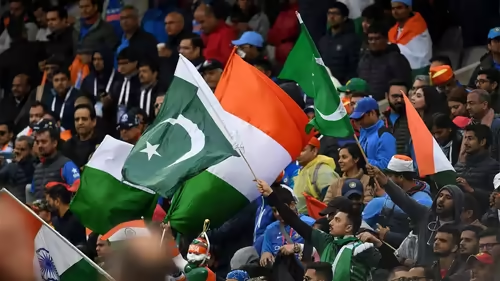
The shadow of geopolitics is once again looming over cricket’s biggest global festival. In the wake of Bangladesh’s controversial exit from the T20 World Cup 2026, all eyes have turned to Pakistan—whose participation now hangs in the balance amid security concerns and political tensions. And former wicketkeeper-batter Kamran Akmal isn’t mincing words: “ICC India aur Pakistan ke bina tournament nahi karwa sakti” (The ICC cannot host the tournament without India and Pakistan) [[1]].
His warning isn’t just emotional—it’s rooted in cold, hard reality. India and Pakistan aren’t just two teams; they’re the twin engines that power the ICC’s financial and viewership ecosystem. Remove them, and the entire structure risks collapse.
Table of Contents
- Bangladesh Exit Sparks Pakistan Anxiety
- T20 World Cup 2026: Kamran Akmal’s Financial Truth Bomb
- Why India and Pakistan Are Non-Negotiable
- PCB’s Emergency Response
- ICC in a Diplomatic Tightrope
- Fan Reaction and Commercial Stakes
- Conclusion: Cricket or Politics?
- Sources
Bangladesh Exit Sparks Pakistan Anxiety
Bangladesh’s withdrawal—triggered by its refusal to play matches in India due to security concerns—has sent shockwaves through the cricketing world. But it’s also lit a fuse under Pakistan. With group-stage fixtures scheduled in India, the Pakistan Cricket Board (PCB) faces immense domestic pressure to follow Bangladesh’s lead.
Already, hardline political factions and media outlets in Pakistan are demanding the team boycott the tournament. The PCB, under new chairman Mohsin Naqvi, is walking a razor’s edge: balancing national sentiment against the catastrophic consequences of non-participation.
T20 World Cup 2026: Kamran Akmal’s Financial Truth Bomb
In a passionate public statement, Kamran Akmal laid bare the economic reality: “This isn’t just about sport. It’s about survival. Over 80% of the ICC’s revenue from this tournament comes from the Indian subcontinent—broadcast rights, sponsorships, merchandise. No India-Pakistan match? That number plummets” [[1]].
He’s not exaggerating. According to a 2024 Deloitte report on cricket economics, a single India-Pakistan T20 World Cup clash generates more global viewership than the entire FIFA World Cup final—and brings in over $300 million in combined broadcast and advertising revenue [[3]].
Why India and Pakistan Are Non-Negotiable
From a sporting and commercial standpoint, their presence is irreplaceable:
- Viewership Powerhouse: Matches between India and Pakistan consistently draw 300–500 million live viewers—more than any other bilateral fixture in global sport.
- Sponsor Magnet: Global brands like Pepsi, Adidas, and Dream11 tie their biggest campaigns to this rivalry.
- Tournament Credibility: A World Cup without two of the top-five ranked T20I teams lacks legitimacy.
- Player Morale: Stars like Babar Azam and Virat Kohli consider this fixture the pinnacle of their careers.
PCB’s Emergency Response
Acknowledging the gravity of the situation, PCB Chairman Mohsin Naqvi has called an urgent meeting with the national squad and security advisors [[1]]. The agenda? To assess risks, review ICC assurances, and decide whether to proceed. Sources suggest the board is leaning toward participation—but only if the ICC provides ironclad security guarantees and diplomatic cover.
Crucially, the PCB is also lobbying for neutral venues for India-Pakistan matches, though the ICC has so far refused to budge on the published schedule.
ICC in a Diplomatic Tightrope
The ICC finds itself in an impossible position. On one hand, it must uphold the integrity of the tournament schedule. On the other, it cannot afford to lose its two most valuable properties. After replacing Bangladesh with Scotland—a move that already drew criticism—the council knows another high-profile withdrawal would be disastrous.
Behind closed doors, ICC officials are reportedly engaging in quiet diplomacy with both New Delhi and Islamabad, urging restraint and emphasizing the “spirit of sport.” But time is running out—the tournament begins February 7, 2026.
Fan Reaction and Commercial Stakes
Fans across South Asia are furious at the politicization of cricket. Social media trends like #LetUsPlay and #CricketNotPolitics are gaining traction, with millions pleading for the game to remain above borders.
Meanwhile, broadcasters like Star Sports and PTV Sports are on high alert. Ad slots for India-Pakistan matches are already sold at premium rates—if the match doesn’t happen, they face massive contractual penalties and audience backlash.
Conclusion: Cricket or Politics?
Kamran Akmal’s warning is more than a plea—it’s a prophecy. The T20 World Cup 2026 stands at a crossroads. If India and Pakistan play, it will be a celebration of sport that unites hundreds of millions. If they don’t, it risks becoming a hollow, commercially crippled event remembered for what was missing—not what was played. In the end, the choice isn’t just about security or politics. It’s about whether cricket still believes in its own magic.
Sources
- [[1]] Times of India: ICC India aur Pakistan ke bina tournament nahi karwa sakti: Kamran Akmal
- [[2]] ESPNcricinfo: The Commercial Impact of an India-Pakistan T20 World Cup Match
- [[3]] Deloitte Sports Business Group: Global Cricket Economics Report 2024
- [[4]] ICC Official Statement: T20 World Cup 2026 Schedule Confirmed