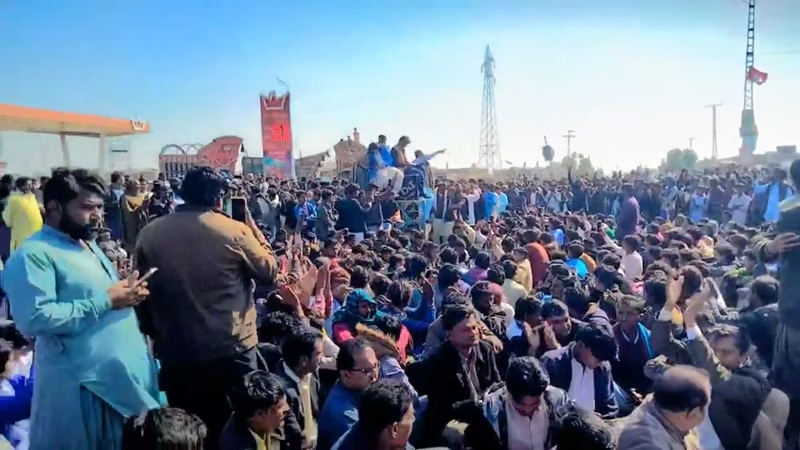
The quiet fields of Badin, in Pakistan’s Sindh province, were shattered by gunfire—a sound that has become a grim punctuation mark in the lives of its most vulnerable residents. The victim was Kailash Kolhi, a young Hindu tenant farmer, shot dead in broad daylight by his own landlord, Sarfaraz Nizamani, following a dispute . His death wasn’t just a personal tragedy; it was a spark that ignited a firestorm of protest, exposing the deep-seated, systemic injustices faced by Pakistan’s Hindu minority.
This isn’t an isolated incident. It’s a symptom of a much larger, festering wound in Pakistani society—a reality where religious minorities, particularly the impoverished Hindu community in Sindh, live under constant threat of violence, forced conversions, and economic exploitation. The Kailash Kolhi killing has become a rallying cry, a “cry of a wounded conscience” that demands to be heard.
Table of Contents
- The Crime and the Accused
- Protests Erupt Across Sindh
- A Pattern of Persecution in Sindh
- The Feudal System: A Shield for Violence
- What’s Next for Justice?
The Crime and the Accused
According to local reports, Kailash Kolhi was gunned down with two bullets to the chest by his landlord, Sarfaraz Nizamani, near the Talhar area of Badin district [[3], [9]]. The dispute appears to have been over land or tenancy rights—a common flashpoint in a region dominated by powerful feudal lords. Kolhi, described as a poor laborer, was left to die while his children witnessed the horror .
The immediate aftermath was telling. Despite the brazen nature of the crime, the arrest of the accused was not swift, fueling public outrage. The Sindh government spokesman, Sukhdev Hemnani, was quick to condemn the murder, but condemnation without concrete action is often just political theater for the marginalized communities who live in fear .
Protests Erupt Across Sindh
The people of Sindh, led by prominent minority rights activist Shiva Kachhi, refused to stay silent. They took to the streets, staging a sit-in protest at Pir Chowk in Badin that stretched into its second day and beyond [[1], [13]]. Their demands were simple yet profound: immediate arrest of the killer and justice for Kailash Kolhi.
Shiva Kachhi, the Chairman of Pakistan Darawar, has been a vocal advocate for the Hindu community, often at great personal risk. He and other protesters vowed to continue their demonstration until their demands were met, turning a local tragedy into a provincial movement [[2], [13]]. These protests are not just about one man; they are a collective scream against a system that has failed them repeatedly.
A Pattern of Persecution in Sindh
The Kailash Kolhi killing cannot be viewed in a vacuum. It is part of a disturbing and well-documented pattern of persecution against Hindus in Sindh. Human rights organizations have long reported on the vulnerabilities of this community.
- Forced Conversions: Reports suggest that over 1,000 minority girls, mostly from Sindh’s Dalit Hindu communities, are forcibly converted to Islam each year .
- Targeted Killings: From the 2022 killing of Pooja Kumari for resisting abduction to the recent spate of kidnappings of teenagers, the threat is constant [[18], [26]].
- Economic Exploitation: Many Hindu families are trapped in cycles of debt bondage and landlessness, making them easy targets for powerful landlords .
A recent fact-finding report by the Human Rights Commission of Pakistan (HRCP) titled “Exodus: Is the Hindu Community Leaving Sindh?” paints a bleak picture of a community on the brink, with many choosing to flee their ancestral homes out of fear . This context makes the protests over Kolhi’s death not just a demand for justice, but a desperate plea for survival.
The Feudal System: A Shield for Violence
At the heart of this crisis lies Pakistan’s entrenched feudal system, particularly dominant in rural Sindh. Landlords like the accused, Sarfaraz Nizamani, often wield immense power—economic, social, and even judicial—over their tenants. This power imbalance creates an environment where violence against the poor and marginalized can occur with impunity.
The police, often influenced by these local power structures, can be slow to act or even complicit in covering up crimes. This “police insensitivity,” as some have called it, is a key reason why the initial response to Kolhi’s murder was so inadequate . For a poor Hindu farmer, challenging a landlord is not just a legal battle; it’s a life-threatening gamble.
What’s Next for Justice?
The sustained pressure from the protests led by Shiva Kachhi has forced authorities to take notice. While the wheels of justice in such cases are notoriously slow, the public outcry has made this a high-profile case that cannot be easily swept under the rug.
However, true justice will require more than just the conviction of one man. It demands systemic reform—dismantling the feudal power structures that enable such violence, strengthening the protection of minority rights enshrined in Pakistan’s own constitution , and ensuring that law enforcement serves all citizens equally, not just the powerful.
For now, the people of Sindh remain on the streets, their voices echoing the “cry of a wounded conscience.” Their fight is for Kailash Kolhi, but it is also for every member of their community who lives in fear.
Conclusion
The brutal Kailash Kolhi killing is a stark reminder of the precarious existence of religious minorities in parts of Pakistan. The widespread protests in Sindh are a powerful testament to a community’s refusal to be silenced. While the immediate demand is for the arrest and prosecution of his killer, the larger struggle is for dignity, security, and equal rights. The world is watching to see if Pakistan’s promise of fundamental rights for all its citizens is more than just words on paper.
Sources
- Times of India: ‘Cry of a wounded conscience’: Hindu man killed in Pakistan; sparks widespread protests in Sindh
- Human Rights Commission of Pakistan (HRCP): Exodus: Is the Hindu Community Leaving Sindh?
- Local Media Reports on the Killing and Protests [[1], [3], [7], [9], [10], [13]]
- Reports on Minority Persecution in Sindh [[18], [20], [26]]