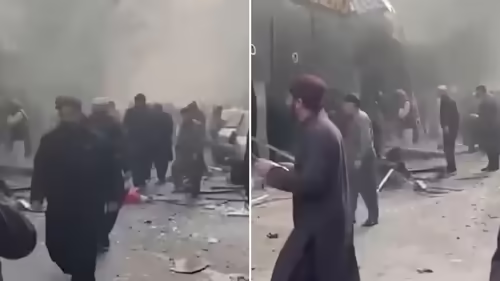
A devastating explosion has once again shattered the fragile calm of Kabul. On Monday, January 19, 2026, a massive blast tore through a popular Chinese restaurant in the city’s upscale Shahr-e-Naw district, leaving at least seven people dead and many more injured. Early reports from Afghan officials and Chinese state media strongly suggest that the attack was a deliberate act of terrorism specifically designed to target Chinese citizens—a chilling development that threatens to destabilize the already tense geopolitical landscape of the region .
Table of Contents
- What Happened in the Kabul Blast?
- Casualties and Victims: A Focus on Chinese Nationals
- Who Is Behind the Attack? The ISIS-K Threat
- Why Target Chinese Citizens in Afghanistan?
- China’s Response and Diplomatic Fallout
- The Security Situation in Taliban-Ruled Afghanistan
- What Happens Next?
What Happened in the Kabul Blast?
The explosion occurred in the early evening hours at a well-known Chinese restaurant in Shahr-e-Naw, an area historically home to diplomats, NGOs, and foreign workers . The force of the blast was so immense that it reduced much of the building to rubble and shattered windows in nearby structures. Emergency services rushed to the scene, but the narrow streets and chaos hampered rescue efforts. The Taliban, who now govern Afghanistan, have confirmed they are investigating the incident as a potential suicide bombing or a vehicle-borne improvised explosive device (VBIED) .
Casualties and Victims: A Focus on Chinese Nationals
Initial reports from the Taliban’s interior ministry stated that at least seven people were killed, with over a dozen others wounded . However, the true toll is feared to be much higher as rescue operations continue under the rubble.
Critically, Chinese state broadcaster CCTV reported that “several” of its citizens were among the dead . This was later corroborated by a statement from China’s Ministry of Foreign Affairs, which expressed “deep shock and sorrow” over the loss of its nationals . The fact that the victims were gathered at a Chinese restaurant strongly supports the theory that this was a targeted strike, not a random act of violence.
Who Is Behind the Attack? The ISIS-K Threat
While no group has officially claimed responsibility yet, all signs point to the Islamic State Khorasan Province (ISIS-K). This regional offshoot of the Islamic State has been waging a relentless insurgency against the Taliban regime since its takeover in 2021. More importantly, ISIS-K has a documented history of targeting foreign interests, particularly those of China and Russia, whom they view as propping up the Taliban government .
In recent months, ISIS-K has stepped up its rhetoric against China, condemning its Belt and Road Initiative (BRI) projects in the region and its close ties with the Taliban. A successful attack on Chinese civilians would be a major propaganda victory for the group and a direct challenge to both Beijing and its de facto allies in Kabul .
Why Target Chinese Citizens in Afghanistan?
The targeting of Chinese nationals is not random; it’s deeply strategic. Over the past few years, China has emerged as one of the most important international partners for the Taliban-led government. Beijing has provided significant humanitarian aid and is heavily invested in future mining and infrastructure projects across Afghanistan, seeing it as a key node in its global BRI network .
For ISIS-K, attacking Chinese citizens serves multiple purposes:
- Undermine Taliban Authority: It exposes the Taliban’s inability to provide basic security, even in the capital.
- Disrupt Foreign Investment: It scares away the very foreign investment the Taliban desperately needs to rebuild the country’s economy.
- <Global Attention:/strong> It garners international media attention and reinforces their narrative as a global jihadist force.
China’s Response and Diplomatic Fallout
China’s reaction has been swift and severe. The Foreign Ministry has demanded that the Taliban “take immediate and effective measures to ensure the safety of Chinese citizens and institutions in Afghanistan” . This puts the Taliban in an extremely difficult position. They are reliant on Chinese goodwill for economic survival, yet they are struggling to contain the ISIS-K threat.
This attack could force Beijing to re-evaluate its entire engagement strategy with Afghanistan. Future projects may be put on hold, and the security of the small but growing number of Chinese workers in the country will now be a top priority. This incident marks a significant escalation in the risks associated with China’s ambitious plans for the region .
The Security Situation in Taliban-Ruled Afghanistan
Despite the Taliban’s promises of a more secure and stable Afghanistan, the reality on the ground tells a different story. While they have largely eliminated the presence of the former Afghan National Security Forces, they have failed to quell the ISIS-K insurgency. Attacks on minority groups, foreign embassies, and now foreign nationals have become disturbingly frequent .
The Kabul blast is a stark reminder that the Taliban’s control is far from absolute. Their ability to protect international interests—a key requirement for any government seeking legitimacy—is now in serious doubt. This event will likely lead to increased scrutiny from the international community and further isolation for the regime .
What Happens Next?
The immediate aftermath will focus on rescue, recovery, and a thorough investigation. The Taliban will be under immense pressure to identify and apprehend the perpetrators quickly. For China, the priority will be the repatriation of its citizens and a comprehensive security review of all its personnel in the country.
In the longer term, this attack could be a turning point. It may accelerate a shift in China’s policy from cautious engagement to a more security-focused, risk-averse approach. For the people of Afghanistan, it’s another tragic chapter in a long saga of violence that shows no sign of ending.
Summary
The Kabul blast in Shahr-e-Naw was a horrific, targeted terrorist attack that has claimed the lives of at least seven people, including multiple Chinese nationals. With ISIS-K as the prime suspect, the attack is a direct challenge to both the Taliban’s authority and China’s growing influence in Afghanistan. The diplomatic and security repercussions of this event will be felt for months, if not years, to come.
Sources
- Times of India – Kabul Blast Live Updates
- Reuters – Taliban Statement on Blast
- BBC News – Casualty Figures
- CCTV – Chinese Citizen Deaths
- China Ministry of Foreign Affairs – Official Statement
- CSIS – ISIS-K Threat Assessment
- Long War Journal – ISIS-K Propaganda
- South China Morning Post – China-Afghanistan BRI
- Al Jazeera – China’s Security Concerns
- Human Rights Watch – Afghanistan Security Situation
- The Guardian – Taliban Security Failures