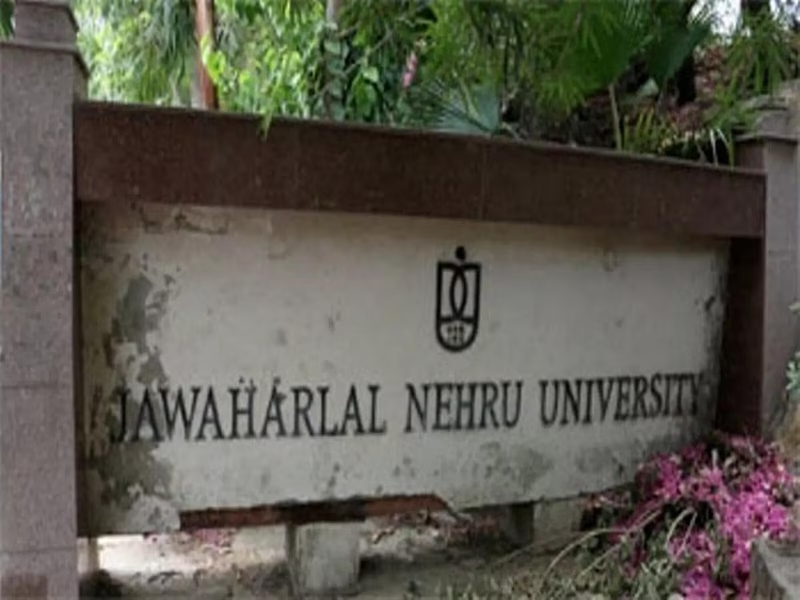
The storied corridors of Jawaharlal Nehru University (JNU) are once again at the center of a national firestorm. On January 6, 2026, the university administration took the extraordinary step of formally requesting the Delhi Police to register an FIR against a group of students for allegedly raising “objectionable and provocative” slogans against Prime Minister Narendra Modi and Home Minister Amit Shah . This incident, tied to a protest marking the anniversary of the 2020 campus violence, has sparked intense debate about free speech, institutional authority, and political boundaries on university campuses.
Table of Contents
- The Incident Unfolds: What Happened at JNU?
- Why JNU Seeks FIR: The Official Stance
- The Legal Labyrinth: What Happens After an FIR?
- JNU: A History of Protest and Controversy
- Political Reactions and Public Debate
- Conclusion: Navigating the Tensions
- Sources
The Incident Unfolds: What Happened at JNU?
According to multiple reports, the controversy stems from an event held on the JNU campus on January 5, 2026 . The gathering was reportedly organized by student groups to commemorate the anniversary of the violent attack that took place on the same date in 2020, an incident that left many students and faculty injured . During this event, videos began circulating on social media showing students chanting slogans that were deemed highly critical of the central government, including phrases like “Modi Sarkar Murdabad” (“Down with Modi Government”) .
The university’s Chief Security Officer (CSO) flagged these videos as a serious breach of the institution’s code of conduct and a potential threat to public order . The administration’s swift response was to initiate formal proceedings against the students involved.
Why JNU Seeks FIR: The Official Stance
The phrase “JNU seeks FIR” is more than just a news headline; it represents a formal, legal escalation by the university. In a letter to the Delhi Police, the JNU administration explicitly described the slogans as “provocative” and argued that such actions were not just a violation of internal university norms but also constituted a potential breach of the law, warranting a criminal investigation .
The university’s primary concerns appear to be two-fold:
- Maintaining Campus Discipline: The administration views the sloganeering as a direct challenge to its authority and an act that could incite further unrest on campus.
- Upholding Public Order: By invoking the police, JNU is framing the issue as one that extends beyond its gates, suggesting the slogans could have wider societal implications and threaten public peace .
This move has put the university in a complex position, acting as both an educational institution and a complainant in a potential criminal case against its own students.
The Legal Labyrinth: What Happens After an FIR?
An FIR, or First Information Report, is the official document that sets the criminal justice system in motion in India . If the Delhi Police accept JNU’s request and register the FIR, it will trigger a formal investigation.
The potential legal consequences for the students named in the complaint could be severe, depending on the specific charges filed. These could range from charges related to promoting enmity between groups to more serious accusations under the Indian Penal Code (IPC) . The process would involve:
- A formal police investigation to collect evidence and record statements.
- Possible summoning or questioning of the accused students.
- A final report submitted to a magistrate, who will then decide on the course of legal action .
It’s a high-stakes situation that could have long-term implications for the students’ academic and personal lives.
JNU: A History of Protest and Controversy
This is far from the first time JNU has found itself in the national spotlight for student protests. The university has a long and complex legacy of political activism, often serving as a barometer for national political sentiment.
One of the most significant recent flashpoints was the 2016 sedition row, where students were arrested for allegedly raising anti-India slogans during a protest against the execution of Afzal Guru . This event polarized the nation and cemented JNU’s image as a hub of radical student politics for many.
Subsequent years have seen protests against a hostel fee hike in 2019 , and of course, the violent attack on campus in January 2020 . Each of these events has contributed to a deep-seated narrative on both sides of the political spectrum, making any new incident, like the current one, instantly charged with historical and ideological significance. Understanding this context is crucial to grasping the full weight of the current “JNU seeks FIR” development.
Political Reactions and Public Debate
As expected, the news of the university seeking an FIR has drawn sharp reactions across the political divide. The ruling BJP has reportedly condemned the slogans as “anti-India” and has supported the university’s decision to involve law enforcement .
Conversely, opposition parties and various student and civil society groups have rallied in defense of the students, framing the administration’s actions as an assault on the fundamental right to free speech and peaceful dissent. They argue that universities must remain spaces for critical thinking and political expression, even if that expression is uncomfortable for those in power.
This incident has once again turned JNU into a battleground for the larger national conversation about the limits of dissent in a democracy.
Conclusion: Navigating the Tensions
The decision by JNU to formally seek an FIR against its students for their sloganeering is a pivotal moment that sits at the intersection of law, politics, and academic freedom. On one hand, the university administration has a responsibility to maintain order and ensure a safe environment for all its members. On the other, the students’ right to protest and express their political views is a cornerstone of a healthy democratic society.
As the legal process unfolds, the case will be watched closely as a test of how India balances these often-competing interests. The outcome could set a significant precedent for student activism not just at JNU, but in universities across the nation. For now, the campus remains on edge, a microcosm of the larger tensions playing out in the country.
Sources
- Times of India. “JNU seeks FIR as students raise slogans against Modi, Shah.” https://timesofindia.indiatimes.com/india/jnu-seeks-fir-against-students-over-anti-govt-slogans-during-protest/articleshow/126371999.cms
- The Hindu. “‘Wilful Disrespect’: JNU seeks FIR against students over objectionable slogans during campus event.”
- India Today. “JNU erupts with ‘Modi Sarkar Murdabad’ chants after SC bail denial; BJP slams ‘Anti-India’ protest.”
- Wikipedia. “Jawaharlal Nehru University sedition row.” https://en.wikipedia.org/wiki/Jawaharlal_Nehru_University_sedition_row
- Live Law. “What Is an FIR? How to File or Quash an FIR in India.”