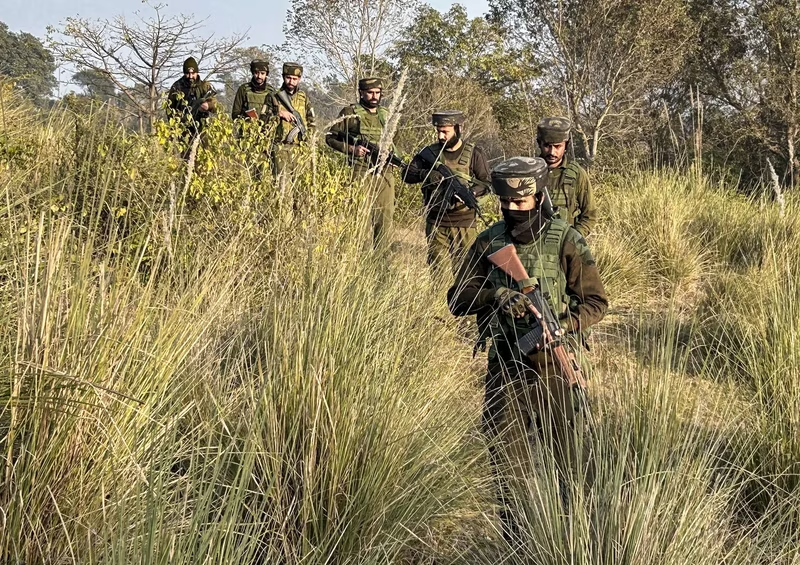
In a stark reminder that the battle against terror isn’t just fought on the frontlines but also within the system itself, the Jammu and Kashmir administration has once again taken a decisive stand. On Tuesday, January 13, 2026, Lieutenant Governor Manoj Sinha ordered the termination of five more government employees over their suspected connections to terrorist outfits . This latest action brings the total number of dismissals in this ongoing purge to a staggering 85 since 2021 .
But what does this mean for the region’s governance, security, and the very concept of public service? Let’s dive deep into the heart of this controversial and critical issue.
Table of Contents
- The Latest Crackdown: Who Were They?
- Why ‘J&K Govt Employees Sacked’ Is a National Security Issue
- The Legal Backbone: Article 311 and Its Exceptions
- LG Manoj Sinha’s Zero-Tolerance Policy
- What This Means for J&K and India
- Conclusion
- Sources
The Latest Crackdown: Who Were They?
According to official sources, the five individuals who lost their jobs were found to be covertly associated with proscribed terrorist organizations . Their government positions weren’t just a source of income; they were allegedly used as a cover to actively aid militant activities. Reports suggest they were involved in everything from arms smuggling to providing logistical support and intelligence to terror groups .
One particularly alarming case involved an employee whose terror link emerged during a State Investigation Agency (SIA) probe into the escape of a Hizbul Mujahideen terrorist, highlighting how deeply these networks can penetrate official structures .
Why ‘J&K Govt Employees Sacked’ Is a National Security Issue
This isn’t just about firing a few bad apples. It’s about dismantling a terror support network embedded inside the J&K government . When government employees—paid by the state they are sworn to serve—work against it, they create a dangerous fifth column.
The implications are severe:
- Intelligence Leaks: Insiders can pass on sensitive information about security operations, troop movements, and informants.
- Resource Diversion: Government resources, including communication channels and official documents, can be misused for illicit purposes.
- Erosion of Public Trust: Citizens lose faith in the very institutions meant to protect them when they are infiltrated by hostile elements.
This systematic effort to root out such elements is a crucial part of restoring stability and ensuring that public offices serve the public good, not a hidden, destructive agenda.
The Legal Backbone: Article 311 and Its Exceptions
Terminating a government servant in India isn’t a simple administrative decision. It’s governed by Article 311 of the Constitution, which provides strong safeguards against arbitrary dismissal. Normally, a civil servant cannot be dismissed without a formal inquiry where they are informed of the charges and given a chance to defend themselves .
However, the law also recognizes extreme circumstances. There are specific exceptions under Article 311(2) where an inquiry can be bypassed, such as when the individual’s conduct has led to their conviction on a criminal charge or when it is deemed “not reasonably practicable” to hold an inquiry, often in cases involving national security .
The fact that the J&K administration has been able to terminate 85 employees suggests they are leveraging these critical exceptions, building their cases on solid intelligence from agencies like the SIA and central intelligence bodies, to act swiftly and decisively.
LG Manoj Sinha’s Zero-Tolerance Policy
Lieutenant Governor Manoj Sinha has made this crackdown a cornerstone of his administration. His policy is clear: there will be no place for anyone with separatist or anti-national connections within the government machinery . This isn’t a new development but a sustained campaign that has seen multiple waves of dismissals over the past few years .
This relentless approach sends a powerful message both internally and externally. Internally, it instills discipline and loyalty among the remaining workforce. Externally, it signals to terror outfits that their attempts to infiltrate the state apparatus have been recognized and are being systematically dismantled. It’s a strategic move aimed at cutting off a vital lifeline for these groups.
What This Means for J&K and India
The long-term impact of this purge could be transformative for Jammu and Kashmir. A cleaner, more loyal, and efficient administration is fundamental to any successful development or peace initiative. You can’t build a stable future on a foundation riddled with betrayal.
For India, this represents a robust internal security strategy. By tackling the problem at its roots within the bureaucracy, the government is addressing a complex, hybrid threat that blends terrorism with institutional subversion. This proactive stance is a model that could have implications for handling similar challenges elsewhere. It underscores a shift from merely reacting to terror attacks to proactively degrading the infrastructure that enables them, even when that infrastructure wears a government badge.
Conclusion
The sacking of these five employees is more than just a personnel decision; it’s a significant event in the ongoing narrative of J&K’s journey towards peace and normalcy. The figure of 85 dismissed since 2021 is a sobering testament to the depth of the challenge and the resolve of the current administration to meet it head-on. As this crackdown continues, it will be crucial to balance firm action with due process, ensuring that justice is not just swift but also fair. For now, the message from Raj Bhavan in Srinagar is unequivocal: the era of government employees serving two masters is over.