Table of Contents
- The Deadly Rampage of a Rogue Elephant
- Who is the Single-Tusked Tusker?
- The Tragic Loss of Forest Guard Sukhlal Behera
- Why is This Rogue Elephant So Hard to Stop?
- The Broader Crisis of Human-Wildlife Conflict in India
- What Happens Next? The Hunt Continues
The Deadly Rampage of a Rogue Elephant
The peaceful villages of West Singhbhum in Jharkhand have been transformed into a zone of fear and tragedy. Since January 1, 2026, a lone male rogue elephant has been on a terrifying spree, claiming the lives of at least 20 innocent people . Its path of destruction has cut through the Chaibasa and Kolhan forest areas, leaving families shattered and communities on high alert .
The violence escalated dramatically on January 6th, when the elephant killed seven villagers in a single day across Babadia and Sialjoda villages, marking one of the most horrific episodes in the region’s recent history . This isn’t just an isolated incident; it’s a full-blown crisis that has exposed the dangerous complexities of human-wildlife coexistence.
Who is the Single-Tusked Tusker?
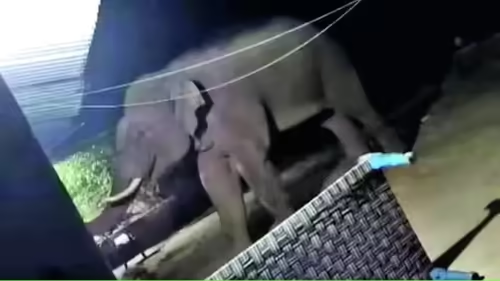
This particular elephant is not just any wild animal. It’s easily identifiable by a distinctive feature: it has only one tusk . This physical characteristic has made it a focal point for terrified locals and desperate forest officials alike. The tusker is described as being highly aggressive and seemingly unafraid of traditional deterrents.
Reports from the ground paint a chilling picture. The elephant appears to be “outpacing us, not afraid of crackers and torches,” according to local officials who have been struggling to contain the situation . Its ability to evade capture and its apparent disregard for human presence have turned it into a symbol of a terrifying, uncontrollable force of nature.
The Tragic Loss of Forest Guard Sukhlal Behera
The danger of this operation was tragically underscored by the death of a brave forest guard, Sukhlal Behera. During a critical attempt to tranquilize the animal, the enraged elephant charged at the team . While others managed to flee, Behera was fatally injured in the attack. He succumbed to his injuries on January 10th, becoming the latest and perhaps most poignant victim of this crisis .
His death is a stark reminder of the immense personal risk faced by the men and women on the front lines of wildlife management. Their job is not just to protect animals, but also to protect people, often placing themselves directly in harm’s way.
Why is This Rogue Elephant So Hard to Stop?
Several factors have combined to make this a uniquely challenging operation for the Jharkhand Forest Department:
- Terrain and Mobility: The elephant is operating in dense, forested areas along the Jharkhand-Odisha border, a landscape that offers it ample cover and escape routes .
- Fearless Behavior: Unlike many elephants that can be deterred by noise or fire, this individual has shown a complete lack of fear, rendering standard crowd-control tactics useless .
- Failed Tranquilization: The tragic attack on the forest team has likely complicated future attempts to use dart guns, as the operation requires getting dangerously close to the animal .
Seventy forest guards are now on high alert along the state border with Odisha, trying to prevent the killer elephant from returning to Jharkhand after it retreated into neighboring territory .
The Broader Crisis of Human-Wildlife Conflict in India
While this specific rogue elephant is an extreme case, it is a symptom of a much larger, nationwide problem. As human settlements expand and natural habitats shrink, encounters between people and wildlife are becoming increasingly common and often deadly. According to the Ministry of Environment, Forest and Climate Change, over 500 people are killed by elephants in India every year.
This ongoing conflict demands more than just reactive measures like hunting a single problematic animal. It requires long-term, sustainable solutions such as creating effective wildlife corridors, implementing early warning systems for villages, and fostering community-based conservation efforts. For a deeper look at this national challenge, see our related coverage on [INTERNAL_LINK:india-human-wildlife-conflict].
What Happens Next? The Hunt Continues
Authorities have not given up. A massive search and capture operation is underway, with plans to finally tranquilize the elephant and relocate it to a safe, secure location far from human habitation . The primary goal now is prevention—stopping the animal from re-entering Jharkhand and claiming more lives.
The people of West Singhbhum are living in a state of suspended fear, hoping that the forest department can succeed where previous attempts have failed. The story of this single-tusked tusker has become a grim testament to the fragile balance between humans and the natural world.
Conclusion
The crisis in Jharkhand is a heart-wrenching tragedy that has claimed over 20 lives and left a community in mourning. The hunt for the rogue elephant is not just about capturing a dangerous animal; it’s about restoring a sense of safety and addressing the deep-rooted issues of habitat loss and human encroachment that fuel such conflicts. The world watches as India grapples with this urgent and complex challenge.
Sources
- Tusker claims 2 more lives in Jharkhand’s West Singhbhum. Times of India, January 9, 2026.
- Rogue jumbo outpacing us, not afraid of crackers and torches. Times of India.
- Elephant kills 20 people in days-long rampage before… Reuters.
- The lone male elephant has trampled to death at least 20 people between 1 and 9 January in the Chaibasa and Kolhan forest areas…
- Enraged, this elephant charged at the crowd… Seeing him coming, the men ran for cover, but Sukhlal Behera…
- Dart guns, cranes fail as killer elephant in West Singhbhum…
- The victim, Sukhlal Behera, who was grievously injured by the elephant, died on Jan 10…
- Elephant spreads terror on Jharkhand-Odisha border, 22 die so far…
- Seventy forest guards are on high alert along Jharkhand’s border with Odisha…
- One-Tusked Elephant Rampage Kills 22 and Counting.