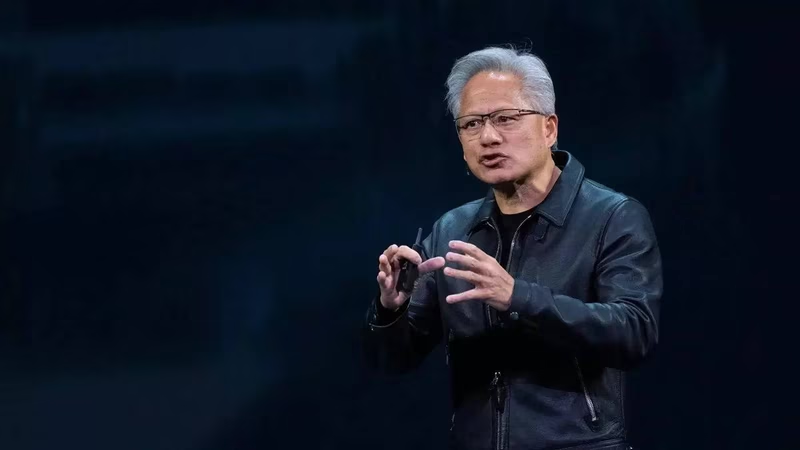
Imagine a world where the most brilliant software engineers at one of the world’s most valuable tech companies aren’t typing a single line of code. It sounds like science fiction, but for Nvidia, it’s the new reality. CEO Jensen Huang has issued a radical directive to his team: stop coding. This isn’t a call for laziness; it’s a strategic pivot towards a future where artificial intelligence handles the mundane, freeing humans to tackle the universe’s most complex and undiscovered problems.
Table of Contents
- The Zero-Percent Coding Mandate
- Jensen Huang, Stop Coding, and the ‘Purpose vs. Task’ Philosophy
- Cursor AI: The Engineer’s New Best Friend
- A Historical Parallel: The Evolution of Radiology
- Cautionary Tales and Industry Response
- Conclusion: The Future is Human-Centered
- Sources
The Zero-Percent Coding Mandate
Jensen Huang’s message is clear and unambiguous. He wants his engineers to spend “exactly zero percent of their time writing code” . This shocking statement is not a dismissal of the engineering profession but a redefinition of it. At Nvidia, every single software engineer is now using an AI coding assistant called Cursor, which Huang has personally endorsed as his “favorite enterprise AI service” . The goal is to offload the mechanical, repetitive task of writing syntax to an AI partner, thereby supercharging human productivity and creativity .
Jensen Huang stop coding and the ‘Purpose vs. Task’ Philosophy
The core of Huang’s argument lies in a powerful framework he calls “Purpose vs. Task.” He explains that the true purpose of a software engineer is not to write code, but to “solve known problems and identify new problems to solve” . Coding, in this view, is merely a task—a means to an end. By automating the task, engineers can focus entirely on the purpose. “Nothing would give me more joy than if none of my engineers were coding at all,” Huang stated, emphasizing that their role should be to think, strategize, and innovate . This philosophy aligns with his broader leadership principle of avoiding “commodity work” and focusing on what has never been done before .
Cursor AI: The Engineer’s New Best Friend
The tool enabling this revolution at Nvidia is Cursor. Huang has revealed that 100% of his engineering team uses this AI-powered coding assistant . Cursor acts as a “programming partner,” generating code, suggesting improvements, and handling boilerplate work, which allows engineers to refine their workflows and focus on the logic and architecture of their systems [[4], [7]]. Huang believes that even if these AI tools are imperfect, engineers should use them relentlessly, as this real-world application is what drives their improvement . This hands-on approach ensures that the AI evolves alongside the needs of its human collaborators.
A Historical Parallel: The Evolution of Radiology
To illustrate his point, Huang often draws a parallel to the field of radiology. When Wilhelm Röntgen discovered X-rays in 1895, the field was born out of a simple, manual task: capturing images of the body’s interior [[28], [33]]. Over the decades, radiology has evolved far beyond just taking pictures. Today, radiologists are highly trained physicians who interpret complex data from a suite of advanced imaging technologies like MRI and CT scans to diagnose disease and guide treatment . The task (taking the image) was automated and refined, allowing the professional to focus on their true purpose: medical diagnosis and patient care. Huang sees a similar trajectory for software engineering, where AI will handle the “image-taking” (coding), so engineers can become master diagnosticians of complex system problems.
Cautionary Tales and Industry Response
While Huang’s vision is compelling, it’s not without its critics. Even the CEO of Cursor has reportedly cautioned against the unchecked development and deployment of AI, highlighting potential risks and ethical considerations . The tech industry is grappling with the balance between rapid innovation and responsible stewardship. However, Huang remains steadfastly confident in a human-centric future. He argues that AI won’t replace engineers; instead, it will elevate their role, ensuring they have “work to do” that is far more meaningful and impactful than ever before .
Conclusion: The Future is Human-Centered
Jensen Huang’s call for engineers to stop coding is a provocative challenge to the status quo. It’s a declaration that the future of technology belongs not to those who can write the most lines of code, but to those who can ask the most profound questions and design the most elegant solutions. By embracing AI as a powerful assistant, engineers can transcend the limitations of their tools and step into a new era of purpose-driven innovation. For more on the future of work in the AI age, see our deep dive on [INTERNAL_LINK:future_of_work_ai].
Sources
- “Nvidia CEO Jensen Huang to engineers: I want you to stop”, Web Search Result.
- “Jensen Huang personally endorses NVIDIA’s programming”, Web Search Result.
- “NVIDIA CEO: AI coders boost productivity for engineers”, Web Search Result.
- “💼 Nvidia’s Jensen Huang told staff to use AI for every task.”, Web Search Result.
- “The purpose of an engineer is to think, not to code”, Web Search Result.
- “Nvidia CEO Jensen Huang explains that the fundamental”, Web Search Result.
- “The Leadership Philosophy of Jensen Huang”, Web Search Result.
- “‘Are you insane?’: Billionaire CEO Jensen Huang blasts”, Web Search Result.
- “NVIDIA CEO endorses Cursor: ‘100% of our engineers”, Web Search Result.
- “Jensen Huang urges Nvidia to automate everything with AI”, Web Search Result.
- “Nvidia CEO Jensen Huang to engineers: I want you to stop”, Web Search Result.
- “History of radiology”, Web Search Result.
- “History of radiology | Radiology Reference Article”, Web Search Result.
- “Radiology”, Web Search Result.