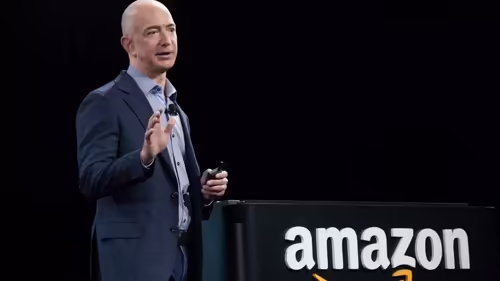
In a stunning turn of events that has sent shockwaves through the retail and tech worlds, **Jeff Bezos** has reclaimed his spot as the world’s third-richest person. This remarkable comeback isn’t just a story of market fluctuations; it’s the direct result of a ruthless and highly strategic pivot by his brainchild, Amazon. The catalyst? A sweeping decision to shutter its entire network of experimental physical stores—Amazon Go and Amazon Fresh—while simultaneously pushing hard on its core online strengths and expanding its Whole Foods empire.
This isn’t just a business adjustment; it’s a declaration of war on inefficiency and a full-throttle bet on the future of e-commerce. Let’s dive into the details of this high-stakes gamble and how it’s reshaping Bezos’s fortune and Amazon’s destiny.
Table of Contents
- Bezos’s Billionaire Bounce-Back
- The End of the Experiment: Amazon Go & Fresh Shut Down
- Amazon Layoffs: Building a Leaner Corporate Machine
- The New Frontier: Same-Day Delivery & Whole Foods Expansion
- Conclusion: What This Means for Bezos and Amazon
- Sources
How Jeff Bezos Net Worth Soared Back to #3
The numbers speak volumes. As of late January 2026, Jeff Bezos’s net worth is estimated at a staggering $255 billion [[7]]. This immense wealth surge is almost entirely tied to Amazon’s stock performance, which has seen a significant jump in early 2026, trading around the $243 mark [[5]].
This stock rally has been enough to propel Bezos past other tech titans in the latest Bloomberg Billionaires Index rankings [[37]]. While sources vary slightly on the exact order of the top five, with some placing him behind Larry Page and Sergey Brin but ahead of Larry Ellison [[38]], the consensus is clear: Bezos is firmly back in the global top three. This dramatic climb is a direct investor endorsement of Amazon’s new, more focused strategy—a strategy that involves cutting its losses on physical retail experiments.
The End of the Experiment: Amazon Go & Fresh Shut Down
On January 27, 2026, Amazon made a bombshell announcement: it will close all of its remaining Amazon Go and Amazon Fresh grocery stores [[11]]. This move effectively ends a nearly decade-long experiment in cashier-less convenience and full-scale grocery retail.
The plan is starkly definitive:
- 57 Amazon Fresh stores will be closed.
- 15 Amazon Go stores will be shuttered.
- Some of these locations may be converted into new Whole Foods Market stores, but the Amazon-branded physical grocery concept is dead [[10]].
The reason is simple economics. Despite the technological marvel of the “Just Walk Out” system, these stores failed to achieve the scale and profitability Amazon needed. They were expensive to operate and couldn’t compete with the established efficiency of its online model or the strong brand loyalty of Whole Foods. By killing this experiment, Amazon is sending a powerful message to investors: it’s doubling down on what it does best.
Amazon Layoffs: Building a Leaner Corporate Machine
This strategic refocusing isn’t happening in a vacuum. It’s accompanied by a painful but necessary corporate purge. In a major organizational restructuring, Amazon has announced plans to cut approximately 16,000 corporate jobs worldwide [[21]].
These Amazon layoffs 2026 are not random. They are laser-focused on areas that have become bloated or are no longer central to the company’s streamlined vision:
- Amazon Web Services (AWS): Even the cash-cow cloud division is seeing cuts as the company aims to reduce bureaucracy and improve margins [[19]].
- Retail Division: With the physical store experiment over, many supporting roles in the retail arm are now redundant [[23]].
- Prime Video and HR: Other divisions are also feeling the squeeze as Amazon pushes to become a more agile organization [[26]].
This move is a classic Bezos-era tactic: cut deep to remove layers of management and inefficiency, allowing the company to move faster and innovate more effectively in its core markets.
The New Frontier: Same-Day Delivery & Whole Foods Expansion
So, where is Amazon pouring its energy and resources instead? The answer lies in two key areas that leverage its existing, dominant infrastructure.
First, Amazon is aggressively expanding its same-day delivery service for fresh groceries. The company has already rolled out this service to over 2,300 cities and towns across the U.S. and has ambitious plans to reach thousands more rural communities by the end of 2026 [[29], [34]]. This is a direct assault on traditional grocers, offering the ultimate convenience without the overhead of running physical stores.
Second, Amazon is strategically investing in its Whole Foods Market chain. By converting some former Amazon Fresh locations into Whole Foods stores, Amazon is strengthening a brand that already has a loyal customer base and a reputation for quality [[15]]. This allows them to maintain a physical presence in the grocery sector without the burden of an unproven, proprietary brand.
This dual-pronged approach—dominating online grocery delivery while fortifying its premium in-store brand—is a far more capital-efficient and scalable strategy than trying to build a new grocery chain from scratch.
Conclusion: What This Means for Bezos and Amazon
Jeff Bezos’s return to the top three of the world’s richest is more than a personal victory; it’s a validation of Amazon’s ability to make brutal, data-driven decisions. By shutting down the underperforming Amazon Go and Fresh stores, executing significant layoffs, and refocusing on its core competencies of logistics and its trusted Whole Foods brand, Amazon is positioning itself for a more profitable and efficient future.
For investors, this clarity of vision is a welcome sign. For consumers, it means even faster and more convenient grocery delivery options are on the horizon. And for the retail landscape, it’s another stark reminder that in the age of e-commerce, only the most adaptable and efficient survive. The era of Amazon’s physical retail experiment is over, and a new, more focused chapter has begun—one that is already making its founder immensely richer.
Sources
[INTERNAL_LINK:amazon-stock-analysis-2026]
[INTERNAL_LINK:future-of-grocery-retail]
Top 10 Richest People in the World – January 2026
Amazon – 29 Year Stock Price History | AMZN
Goodbye Amazon Fresh and Go: All 72 stores closing
When are Amazon Fresh stores closing?
Amazon to cut 16000 jobs worldwide
Amazon Same-Day Delivery for fresh groceries expands
Bloomberg Billionaires Index Methodology