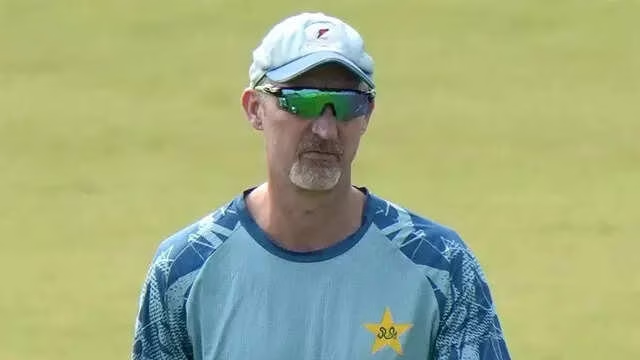
When former Australian pace legend Jason Gillespie took the reins as Pakistan’s Test coach, fans and pundits alike saw it as a masterstroke—a world-class coach to guide a mercurial but immensely talented side. But just nine months later, that dream has soured into what Gillespie himself describes as a feeling of being “completely humiliated.” His abrupt and acrimonious departure has laid bare deep-seated issues within the Pakistan Cricket Board (PCB), sparking a firestorm of controversy that’s now spilling into legal territory .
Table of Contents
- The Final Straw: Tim Nielsen’s Shock Sacking
- Jason Gillespie Pakistan Coach: A Relationship Eroded
- The Financial Fallout: Unpaid Dues and Legal Action
- A Soured Experience: Gillespie’s Love for Coaching Tarnished
- Conclusion: A Cautionary Tale for International Cricket
- Sources
The Final Straw: Tim Nielsen’s Shock Sacking
The immediate catalyst for Gillespie’s resignation was a decision made by the PCB that left him utterly blindsided. His long-time friend, trusted collaborator, and senior assistant coach, Tim Nielsen, was summarily sacked without a single word of consultation or warning to Gillespie himself .
In his own words, Gillespie was unequivocal: “I was coaching the Pakistan Test side. The PCB sacked our senior assistant coach with ZERO communication with me about it,” he revealed, highlighting a stunning lack of respect for his position as head coach .
This unilateral move wasn’t just a personnel change; it was a clear signal that the PCB did not view Gillespie as a true leader of the program. For a coach of his stature, whose entire philosophy is built on trust and a unified team structure, this act was the ultimate betrayal. He felt his authority was completely undermined, and his professional judgment was disregarded .
Jason Gillespie Pakistan Coach: A Relationship Eroded
The sacking of Nielsen was merely the tip of the iceberg. Gillespie’s tenure was reportedly plagued by a series of frustrating incidents that made him feel increasingly marginalized. He has alluded to a toxic environment where “politics and egos got in the way” of on-field success .
Reports suggest a significant point of tension was over team selection. There were claims, though not directly confirmed by Gillespie in his main interviews, that he was pressured to drop star batter Babar Azam, a move he reportedly resisted . This kind of interference from the board’s hierarchy is a classic red flag for any international coach, eroding their autonomy and making their job almost impossible.
This feeling of being a mere figurehead, rather than a decision-maker, created a chasm of mistrust between the coach and his employers. His passion for the role, which was initially high, began to wane in the face of constant bureaucratic hurdles and a lack of genuine partnership from the PCB.
The Financial Fallout: Unpaid Dues and Legal Action
Adding financial insult to professional injury, a major dispute has erupted over unpaid dues. Jason Gillespie has formally accused the PCB of failing to pay him for a significant portion of his contract, with some reports citing a figure of nine months’ worth of salary .
In response, the PCB has issued a strong rebuttal, claiming that Gillespie “abruptly left his duties” and “failed to adhere to key contractual obligations,” thus voiding his claim for the remaining payments [[8], [11]]. This tit-for-tat exchange has now escalated beyond press statements.
The situation has reached a critical juncture:
- Gillespie has reportedly launched legal proceedings against the PCB to recover his claimed unpaid dues .
- The PCB, standing its ground, continues to publicly refute his claims and defend its own actions .
- This legal battle threatens to become a long, messy, and public spectacle that could further damage the PCB’s already fragile reputation on the global stage.
A Soured Experience: Gillespie’s Love for Coaching Tarnished
Perhaps the most heartbreaking aspect of this entire saga is the personal toll it has taken on Jason Gillespie. Known for his affable nature and deep love for the game, this experience has left a profound scar.
He has openly admitted that the ordeal in Pakistan has “soured his love for coaching,” a statement that carries immense weight coming from someone so dedicated to the craft [[16], [22]]. For a man who once thrived in high-pressure environments, the combination of professional humiliation, broken trust, and financial dispute has created a level of disillusionment that is hard to overcome.
Conclusion: A Cautionary Tale for International Cricket
The chaotic and humiliating exit of Jason Gillespie as Pakistan coach is more than just a personnel change; it’s a stark cautionary tale. It underscores the critical importance of mutual respect, clear communication, and a unified vision between a national cricket board and its coaching staff. When a board chooses to operate in silos and make unilateral, disrespectful decisions, it not only loses a world-class coach but also jeopardizes the future of its own team. For the PCB, the task now is to rebuild trust, both internationally with potential future hires and domestically with its fanbase, who deserve better than this constant cycle of chaos. Check out our deep dive into [INTERNAL_LINK:pakistan-cricket-board-reforms] to see what’s next for the beleaguered board.