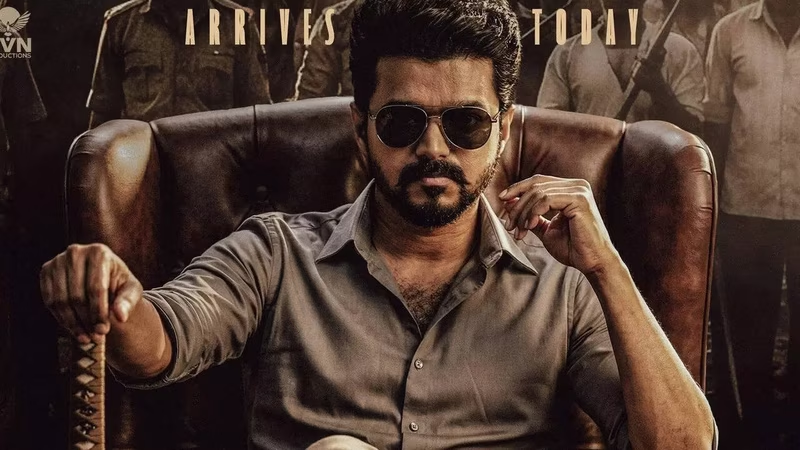
The buzz around Thalapathy Vijay’s *Jana Nayagan* has taken a sharp turn—from box office anticipation to legal limbo. In a major blow to fans and producers alike, the film’s theatrical release has been **indefinitely postponed** due to a storm of censorship mandates, political sensitivities, and judicial delays .
The Central Board of Film Certification (CBFC) reportedly demanded extensive edits: **over 50 politically charged dialogues were muted**, and multiple scenes depicting violence were either heavily trimmed or fully blacked out. The filmmakers argue these cuts compromise the film’s narrative integrity and thematic core—prompting them to challenge the decision in court. But with the Pongal holidays shutting down the judiciary until mid-January 2026, any swift resolution is now off the table, forcing producers to pull the plug on the planned release .
Table of Contents
- Why Was Jana Nayagan Postponed? The Full Breakdown
- Inside the CBFC’s Controversial Edits
- The Legal Battle: Can the Cuts Be Reversed?
- Impact on Fans, Box Office, and Tamil Cinema
- What’s Next for Jana Nayagan?
- Conclusion: Art, Censorship, and the Price of Political Speech
- Sources
Why Was Jana Nayagan Postponed? The Full Breakdown
At its heart, the Jana Nayagan postponed saga is a clash between creative expression and regulatory caution. The film—directed by M. Manikandan (*Kaaka Muttai*, *Kadaisi Vivasayi*)—reportedly features sharp socio-political commentary, a hallmark of Vijay’s recent roles that often blur the line between cinema and public discourse .
Given Vijay’s massive fan following and his rumored political ambitions, the CBFC exercised extreme caution. Sources indicate examiners flagged dialogues perceived as critical of state institutions, electoral processes, or law enforcement—deeming them “likely to incite unrest” or “undermine public order” .
Rather than accept a version they felt diluted the film’s message, the production team—led by AGS Entertainment—chose to file a formal appeal with the Film Certification Appellate Tribunal (FCAT). But timing worked against them: the appeal was filed just before the Tamil Nadu judiciary’s annual Pongal recess, which runs through January 15, 2026 . With courts closed, no hearing can be scheduled, making a pre-February release impossible.
Inside the CBFC’s Controversial Edits
The censorship demands go beyond typical content warnings. According to industry insiders, the CBFC’s requirements included:
- Muting over 50 dialogues—not just deleting them, but replacing audio with silence or ambient noise, leaving characters visibly speaking but inaudible.
- Blacking out entire sequences involving protest scenes or confrontations with authorities, rendering key plot points confusing.
- Altering subtitles in non-Tamil-speaking regions to further neutralize perceived inflammatory language.
This approach has drawn criticism from filmmakers and free speech advocates. “Muting dialogue is a form of erasure—not just of words, but of intent,” says Chennai-based film critic Meena Raman. “It tells the audience, ‘This idea is too dangerous to hear,’ which often amplifies its perceived power” .
The Legal Battle: Can the Cuts Be Reversed?
The producers’ legal strategy hinges on precedent. In 2023, the Madras High Court ruled in favor of director Pa. Ranjith in a similar censorship dispute, stating that “reasonable fictionalized critique of governance is protected under Article 19(1)(a) of the Constitution” .
However, outcomes are never guaranteed. The CBFC operates under the Cinematograph Act, 1952, which grants it broad powers to “prevent the exhibition of films that are against public interest.” The key question for the court will be whether *Jana Nayagan*’s content crosses from political commentary into incitement—a fine line that’s often subject to interpretation.
Until the courts reopen post-Pongal, the film remains in certification purgatory. As noted by legal experts at the LiveLaw portal, such delays can cost producers crores in lost marketing momentum and pre-booked theatre rentals .
Impact on Fans, Box Office, and Tamil Cinema
For Vijay’s legion of fans—many of whom booked advance tickets and planned travel for opening day—the postponement is a bitter disappointment. Social media has erupted with hashtags like #ReleaseJanaNayaganAsIs and #CensorshipIsSilence.
From an industry standpoint, the delay disrupts the lucrative Pongal 2026 box office window, where Tamil films routinely earn 30–40% of their total revenue. Competing releases like Ajith’s *Vidaamuyarchi* may now dominate screens unchallenged [INTERNAL_LINK:pongal-2026-movie-lineup].
What’s Next for Jana Nayagan?
Possible scenarios include:
- Victory in court: The FCAT or High Court orders the CBFC to grant certification with minimal or no cuts. Release could follow by late January or February.
- Negotiated compromise: Producers accept partial cuts in exchange for a faster release, though this risks fan backlash.
- Direct OTT release: If theatrical prospects dim, a digital premiere on a platform like Netflix or Amazon Prime becomes an option—but this would be a major financial downgrade for a big-budget Vijay film.
Conclusion: Art, Censorship, and the Price of Political Speech
The Jana Nayagan postponed crisis is more than a scheduling hiccup—it’s a flashpoint in the ongoing tension between artistic freedom and state oversight in India. As Thalapathy Vijay’s roles grow increasingly intertwined with real-world discourse, his films will inevitably face heightened scrutiny. The outcome of this legal fight won’t just decide when *Jana Nayagan* releases—it could set a precedent for how political cinema is treated in India for years to come.
Sources
Times of India: Jana Nayagan postponed – Censor cuts and legal options explained
Central Board of Film Certification (CBFC) – Official Guidelines
LiveLaw – Indian Legal News & Analysis
[INTERNAL_LINK:vijay-political-ambitions-2026]
[INTERNAL_LINK:cbfc-censorship-controversies-tamil-cinema]