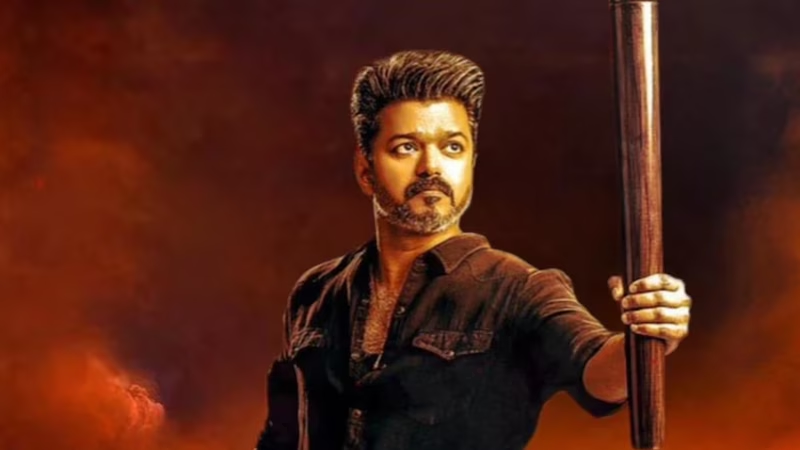
Why Can’t ‘Jana Nayagan’ Hit Theatres? The Legal Maze Explained
One of the most eagerly awaited Tamil films of 2026, Jana Nayagan, starring megastar Thalapathy Vijay, remains in limbo—not because of production delays or box office fears, but due to a tangled legal battle over its certification. In a significant development, the Supreme Court of India has refused to intervene directly in the Jana Nayagan censor row, instead ordering the film’s producers to return to the Madras High Court for resolution .
This decision effectively stalls the film’s theatrical release once again, leaving millions of fans frustrated and industry insiders questioning the pace of India’s film certification appeals process. But what exactly triggered this judicial back-and-forth—and why won’t the apex court step in?
Table of Contents
- Timeline of the Jana Nayagan Censor Row
- What the Supreme Court Actually Said
- Why CBFC Clearance Is So Contentious
- What This Means for Jana Nayagan’s Release Date
- Broader Implications for Tamil and Indian Cinema
- What Happens Next?
- Conclusion: Art vs. Regulation in the Spotlight
- Sources
Timeline of the Jana Nayagan Censor Row
The controversy began when the film’s makers approached the Central Board of Film Certification (CBFC) for a standard UA certificate. However, reports suggest certain dialogues, visuals, or thematic elements raised concerns—possibly related to political messaging, given the film’s title (“People’s Leader”) and Vijay’s real-life political stature .
Here’s how the legal saga unfolded:
- Initial Application: Producers submit Jana Nayagan to CBFC for certification.
- Single Judge Order: A single judge at the Madras High Court directs CBFC to grant certification within a stipulated time, siding with the filmmakers.
- Stay by Division Bench: The CBFC or an opposing party appeals, prompting a division bench of the same High Court to stay the single judge’s order, halting certification.
- Supreme Court Appeal: Filmmakers approach the SC, seeking urgent intervention to override the stay.
- SC’s Verdict (Jan 15, 2026): Apex court refuses to interfere, stating the matter must be heard fully by the Madras HC division bench .
What the Supreme Court Actually Said
In its brief but firm ruling, the Supreme Court emphasized judicial protocol. The bench noted that since the Madras High Court’s division bench had already assumed jurisdiction over the case, it would be inappropriate for the SC to bypass that process unless there was a clear constitutional violation or irreparable harm—which, in their view, wasn’t demonstrated .
Essentially, the Court upheld the principle of “judicial hierarchy”: lower courts must be given the first full opportunity to resolve disputes before the apex court steps in. This isn’t a judgment on the film’s content—it’s a procedural reset.
Jana Nayagan censor row: Why Certification Is So Sensitive
For decades, CBFC certification has been a flashpoint in Indian cinema, especially for films featuring politically active stars like Vijay, Rajinikanth, or Pawan Kalyan. The board often scrutinizes such projects for “objectionable” content that could incite unrest or distort public discourse.
While the exact objections to Jana Nayagan remain undisclosed (as hearings are ongoing), industry analysts speculate they may involve:
- Dialogues perceived as critical of current governance structures.
- Scenes depicting mass protests or civil disobedience.
- Symbolism that aligns too closely with Vijay’s own political movement, Tamilaga Vetri Kazhagam (TVK).
It’s worth noting that CBFC guidelines prohibit content that “threatens national sovereignty” or “promotes anti-social behavior”—broad terms that leave room for subjective interpretation .
What This Means for Jana Nayagan’s Release Date
Originally slated for a summer 2026 premiere, Jana Nayagan now faces indefinite postponement. Every week spent in legal limbo increases financial pressure on the producers and risks audience fatigue. Competing big-ticket releases may also force a reshuffle in the Tamil film calendar.
Moreover, delays can impact overseas distribution deals, satellite rights, and digital streaming agreements—all of which are typically locked in based on confirmed release windows. For a film with an estimated ₹250 crore budget, timing is everything.
Broader Implications for Tamil and Indian Cinema
This case highlights a systemic issue: the lack of a fast-track appellate mechanism for film certification disputes. While the Film Certification Appellate Tribunal (FCAT) was abolished in 2021, no effective replacement exists, forcing filmmakers into lengthy High Court battles .
As a result, creative expression is increasingly held hostage to bureaucratic and judicial delays—a concern echoed by the Indian Film & Television Directors’ Association (IFTDA). Without reform, more high-profile projects could face similar fates.
What Happens Next?
The ball is now back in the Madras High Court’s court. The division bench is expected to schedule a detailed hearing soon. Possible outcomes include:
- Upholding the stay, requiring edits before certification.
- Overturning the stay and directing CBFC to certify the film as-is.
- Ordering a fresh review by a different CBFC committee.
Until then, fans will have to wait. For updates on Vijay’s political journey and its intersection with cinema, see our feature on [INTERNAL_LINK:thalapathy-vijay-political-career].
Conclusion: Art vs. Regulation in the Spotlight
The Jana Nayagan censor row is more than a legal hiccup—it’s a microcosm of the tension between artistic freedom and state regulation in modern India. While the Supreme Court’s decision respects judicial process, it also underscores the urgent need for a transparent, efficient certification appeals system. Until then, even the biggest stars aren’t immune to the slow wheels of bureaucracy.
Sources
- Times of India: Original Article
- CBFC Guidelines: Central Board of Film Certification
- Ministry of Information & Broadcasting: Film Policy Updates
- Indian Express: Why FCAT Was Scrapped