Table of Contents
- More Than a Movie: A Moment of Truth
- Jana Nayagan Censor Row: The Facts Behind the Delay
- Kamal Haasan Sounds the Alarm on Creative Freedom
- Pa Ranjith and the Film Fraternity Fight Back
- Political Parties Weigh In on the Cultural Crisis
- Why This Is About Democracy, Not Just Cinema
- Conclusion: Will Art Bow to Bureaucracy?
- Sources
When Thalapathy Vijay’s political drama Jana Nayagan was announced, it was hailed as more than a cinematic event—it was seen as a cultural milestone. But now, its release is indefinitely stalled, not by box office fears or production woes, but by a bureaucratic bottleneck at the Central Board of Film Certification (CBFC). What began as a certification delay has exploded into a national debate, with living legends like Kamal Haasan issuing stark warnings: we are entering a “dark age” for creative freedom in India.
This isn’t just about Vijay’s fans waiting for his potential swan song. It’s about whether artists can still speak truth to power without fear of censorship.
More Than a Movie: A Moment of Truth
Jana Nayagan, directed by H. Vinoth, is widely interpreted as a narrative that mirrors Vijay’s own rumored political ambitions. Its themes of justice, systemic corruption, and grassroots leadership have made it a lightning rod for both anticipation and anxiety—especially among those in power. The CBFC’s hesitation, followed by a Madras High Court interim stay on certification, has created a perfect storm of legal, artistic, and political tension .
For many, the board’s actions signal a troubling trend: films with political undertones are being treated not as art, but as threats.
Jana Nayagan Censor Row: The Facts Behind the Delay
The official reason for the hold-up remains vague, but sources close to the production suggest the CBFC demanded significant cuts, particularly around scenes perceived as critical of state institutions or evocative of real-life political movements. The producers refused, arguing that such edits would gut the film’s message.
Before an appeal could be resolved, a third party filed a petition in the Madras High Court, leading to an interim order that effectively froze the certification process. As of now, Jana Nayagan cannot be legally released anywhere in India—a devastating blow for a film with a planned global rollout .
Kamal Haasan Sounds the Alarm on Creative Freedom
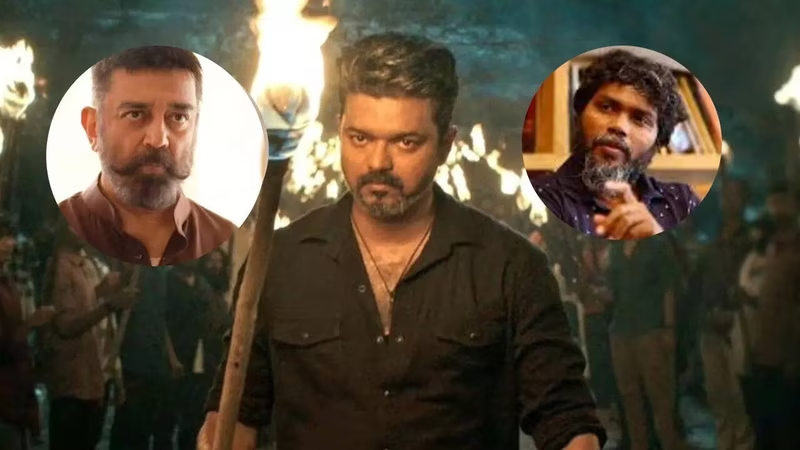
In a powerful public statement, actor-politician Kamal Haasan did not mince words. He described the Jana Nayagan censor row as “a direct assault on the soul of democracy.” Drawing from his own decades-long battles with censors—from Vishwaroopam to Indian 2—he warned that “when dissent is edited out of cinema, it’s only a matter of time before it’s erased from public life.”
Haasan emphasized that certification should inform audiences (e.g., through age ratings), not dictate content. “We are not asking for license to offend,” he clarified. “We are demanding the right to reflect reality—even when it’s uncomfortable.”
Pa Ranjith and the Film Fraternity Fight Back
Filmmaker Pa Ranjith, known for his socially conscious cinema, echoed Haasan’s concerns. He slammed the CBFC as an “instrument of suppression” that disproportionately targets films addressing caste, inequality, or state power. “Why is a love story never ‘delayed for review,’ but a film about people’s rights is?” he asked pointedly .
Ranjith’s critique resonated across the industry. Directors, writers, and actors from Tamil, Telugu, Malayalam, and Hindi cinema have issued joint statements condemning the delay. Even international filmmakers have expressed solidarity, calling the move “chilling” for global creative communities.
Political Parties Weigh In on the Cultural Crisis
The controversy has spilled into the political arena. While the ruling AIADMK and BJP have remained largely silent, opposition parties—including the DMK and Congress—have rallied behind Vijay and the filmmakers. DMK leaders called the CBFC’s actions “politically motivated censorship,” while Congress figures framed it as part of a broader pattern of silencing alternative voices .
Notably, Vijay’s own fan clubs—often seen as proto-political organizations—have organized peaceful protests outside CBFC offices, holding placards that read “Certify, Don’t Censor” and “Art Is Not a Crime.”
Why This Is About Democracy, Not Just Cinema
At its core, the Jana Nayagan censor row raises fundamental questions about India’s democratic health. In a vibrant democracy, art serves as a mirror, a critic, and sometimes a catalyst for change. When that mirror is cracked by bureaucratic fiat, society loses a vital feedback loop.
Compare this to other democracies: in the U.S., the MPAA rates films but cannot ban them; in France, the CNC supports artistic risk-taking. Even in countries with stricter norms, judicial oversight—not executive boards—handles content disputes. The Indian system, by contrast, grants unelected officials immense discretionary power.
For deeper insight into global standards, the UNESCO Convention on the Protection and Promotion of the Diversity of Cultural Expressions affirms that states must protect artistic freedom as a human right.
Conclusion: Will Art Bow to Bureaucracy?
The fate of Jana Nayagan has become a litmus test. If the CBFC and courts uphold creative autonomy, it could mark a turning point toward a more mature, rights-based certification model. But if the film is mutilated or shelved, it will send a chilling message to every storyteller in India: tread carefully, or be silenced.
As Kamal Haasan so poignantly warned, this isn’t just about one movie. It’s about whether India’s democracy still has room for uncomfortable truths—and the artists brave enough to tell them.
Sources
- Times of India: Jana Nayagan censor row: Kamal Haasan flags threat to creative freedom
- Statements from Kamal Haasan and Pa Ranjith .
- Details on Madras High Court interim stay and CBFC delays [[8], [9]].
- Political reactions from DMK and Congress leaders .
- UNESCO Convention on Cultural Diversity: https://www.unesco.org/en/culture/