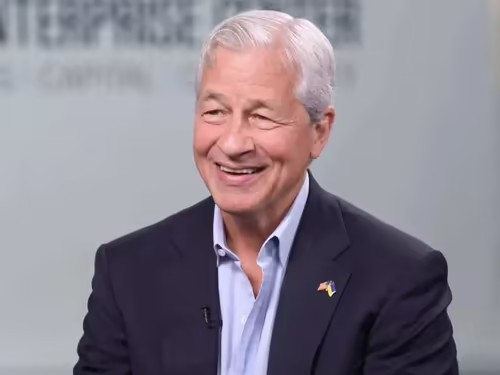
When Jamie Dimon speaks, markets listen—and now, so does Washington. The longtime CEO of JPMorgan Chase, often dubbed “America’s Banker,” has made his most definitive statement yet about his political future: he will not run the Federal Reserve, but he might just run the U.S. Treasury. In a candid interview that blends pragmatism with ambition, Dimon shut the door on one of the world’s most powerful central banking roles while leaving another wide open—a move that could reshape U.S. economic policy if a new administration comes calling .
Table of Contents
- Jamie Dimon Shuts Down Fed Chair Rumors
- Why the Treasury Secretary Role Appeals to Dimon
- The Trump-Dimon Feud and Fed Independence
- Could a Wall Street CEO Lead the Treasury?
- Historical Precedents: Dimon in Context
- Market and Political Reactions
- What This Means for JPMorgan and U.S. Policy
- Conclusion: A Statesman or a Banker?
- Sources
Jamie Dimon Shuts Down Fed Chair Rumors
For years, speculation has swirled that Jamie Dimon could be a natural fit for the Federal Reserve chairmanship—especially given his deep understanding of global finance, crisis management during the 2008 meltdown, and frequent commentary on monetary policy. But in no uncertain terms, Dimon has ended that conversation.
“No chance, no way, no how,” he declared when asked about succeeding Jerome Powell or Lael Brainard. His reasoning? “The Fed must be independent, and I’m too entangled in the system to credibly lead it.” This self-awareness is rare among financial titans—and reflects Dimon’s long-standing respect for institutional boundaries .
Why the Treasury Secretary Role Appeals to Dimon
Unlike the Fed—which requires strict neutrality—the Treasury Secretary is a political appointee who shapes fiscal policy, tax reform, and international economic strategy. For Dimon, this role aligns with his vision of “pragmatic capitalism” and national service.
“If my country called, and I believed I could help fix real problems—like debt sustainability, infrastructure funding, or financial inclusion—I’d consider it,” he said. Notably, he emphasized that such a role would require bipartisan support and a clear mandate, not just a ceremonial title.
The Trump-Dimon Feud and Fed Independence
This stance comes amid lingering tensions from Dimon’s very public clash with former President Donald Trump. In 2019, Trump repeatedly attacked the Fed for raising interest rates and suggested Dimon should replace Powell. Dimon swiftly rejected the idea, stating, “I don’t want that job, and the president shouldn’t be pressuring the Fed.”
That episode cemented Dimon’s reputation as a defender of central bank independence—a principle now under renewed scrutiny as election-year politics heat up. His recent comments reinforce that he sees the Fed as sacrosanct, but the Treasury as a legitimate arena for executive leadership .
Could a Wall Street CEO Lead the Treasury?
Critics argue that appointing a mega-bank CEO to Treasury would deepen the “revolving door” between Wall Street and Washington. Yet history shows precedent:
- Robert Rubin (Goldman Sachs co-CEO) served as Treasury Secretary under Bill Clinton.
- Henry Paulson (Goldman CEO) led Treasury during the 2008 crisis under George W. Bush.
- Steven Mnuchin (former Goldman banker) was Trump’s Treasury chief.
What sets Dimon apart is his consistent advocacy for stronger bank regulation—even supporting parts of Dodd-Frank—making him a more palatable choice for moderates on both sides.
Historical Precedents: Dimon in Context
Dimon’s potential shift from boardroom to cabinet echoes a broader American tradition: business leaders stepping into public service during times of crisis. His blend of operational discipline, global credibility, and centrist economics could appeal to a future administration seeking stability over ideology—especially if the U.S. faces a debt ceiling showdown or banking sector stress.
For deeper insights into financial leadership in government, see our analysis on [INTERNAL_LINK:wall-street-to-washington-career-paths].
Market and Political Reactions
Reactions have been mixed:
- Wall Street: JPMorgan shares rose slightly on investor confidence in Dimon’s continued leadership—but concerns linger about succession planning.
- Progressives: Senators like Elizabeth Warren warned against “putting a banker in charge of Main Street’s finances.”
- Centrists: Many see Dimon as a stabilizing force who could bridge partisan divides on economic policy.
What This Means for JPMorgan and U.S. Policy
If Dimon were to take the Treasury post, he would likely step down as CEO—a move that would trigger one of the most watched leadership transitions in corporate America. More broadly, his involvement could signal a return to technocratic governance, prioritizing data-driven solutions over populist rhetoric.
However, it also raises questions: Can someone who built a $500 billion bank truly represent the interests of average Americans? Or would his tenure further entrench elite financial thinking in public policy?
Conclusion: A Statesman or a Banker?
Jamie Dimon’s openness to the Treasury Secretary role isn’t just personal ambition—it’s a reflection of a deeper belief that experienced leaders have a duty to serve beyond profit. Whether that translates into effective public service remains to be seen. But one thing is certain: in an era of economic uncertainty, the line between Wall Street and Washington continues to blur—and Dimon may be the man best positioned to walk it.
Sources
- Times of India: What makes JPMorgan CEO Jamie Dimon draw the line at about his future career?
- U.S. Department of the Treasury: Historical Secretaries & Roles
- Federal Reserve History: Past Chairs and Independence Doctrine
- The Brookings Institution: Analysis of Financial Regulation and Public Service