“Remove your perfume. Tie your hair. Or they will come after you.”
These were the chilling words whispered to historian **Eric Chopra** as he approached one of Delhi’s most mysterious monuments: the **Jamali and Kamali tomb** in Mehrauli Archaeological Park. Locals speak of djinns—supernatural beings from Islamic folklore—that guard the site, angered by strong scents or loose hair. Many avoid it after sunset. Some refuse to enter at all.
But Chopra, a scholar of South Asian urban history, didn’t come for ghosts. He came for truth. And what he found inside wasn’t terror—but tenderness. A profound sense of peace. A love so powerful it seemed to linger in the very stones. His experience challenges the spooky myths and reveals something far more human: a bond that defied death itself.
Table of Contents
- The Mystery of the Jamali and Kamali Tomb
- Eric Chopra’s Unexpected Experience
- Who Were Jamali and Kamali? The Love Story Behind the Legend
- Delhi’s Culture of Djinns and Spiritual Geographies
- Visiting the Tomb: Respectful Tourism Tips
- Why This Story Matters Today
The Mystery of the Jamali and Kamali Tomb
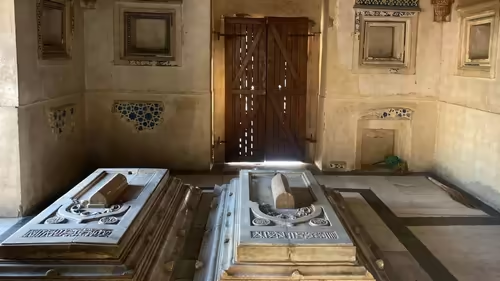
Nestled among crumbling ruins in south Delhi, the **Jamali and Kamali tomb** stands out for its striking red sandstone and intricate frescoes. Built around 1536 CE during the reign of Humayun, it’s unique in Mughal architecture: it houses two graves side by side—one for the celebrated Sufi poet **Shaikh Jamali**, and another, unnamed, for **Kamali**.
Who was Kamali? That’s the enduring question. Official records are silent. No inscriptions. No titles. Just a nameless companion buried beside a literary giant. This absence has fueled centuries of speculation—was Kamali a disciple? A brother? Or something more intimate?
Over time, the ambiguity gave rise to supernatural tales. Locals began attributing strange occurrences—whispers, cold spots, sudden unease—to protective djinns. The warnings about perfume and hair likely stem from Islamic traditions that associate strong fragrances and uncovered hair with worldly vanity—disrespectful in sacred spaces [[1]].
Eric Chopra’s Unexpected Experience
When Chopra stepped inside, he expected silence. Maybe even dread. Instead, he was overwhelmed by “a deep, calming sense of love,” as he recounted in his recent talk on Delhi’s spiritual landscapes [[2]].
“There was no fear,” he said. “Just an atmosphere of devotion and companionship. It felt like walking into a room where two people had shared their entire lives—and continued to do so, even in death.”
He noted the symmetry of the graves, the care in their placement, and the poetic verses of Jamali etched on the walls—many speaking of divine union and eternal longing. To him, the evidence pointed not to horror, but to **profound emotional intimacy**.
Who Were Jamali and Kamali? The Love Story Behind the Legend
Shaikh Jamali (1457–1536) was a real historical figure—a poet, scholar, and Sufi mystic who served under Sikandar Lodi and later Babur. His poetry, written under the pen name *Jamali*, blends Persian elegance with Indian spiritual thought.
Kamali, however, remains a ghost in the archives. But historians like Chopra suggest the relationship may have been deeply personal. In pre-modern South Asia, intense same-sex bonds—spiritual, emotional, or romantic—were often expressed through poetry and shared burial, especially within Sufi traditions that valued union over separation [[3]].
As Chopra puts it: “The tomb isn’t haunted by djinns. It’s haunted by love.”
Delhi’s Culture of Djinns and Spiritual Geographies
Delhi is a city layered with belief. From ancient Yakshas to Islamic djinns to Hindu bhoots, its spiritual geography is rich and complex. Sites like Feroz Shah Kotla, Nizamuddin Dargah, and yes—the **Jamali and Kamali tomb**—are seen as liminal spaces where the veil between worlds is thin.
Anthropologist Dr. Anand Vivek Taneja notes that djinn lore in Delhi often serves as a way for communities to assert moral order and respect for sacred spaces [[4]]. The warnings aren’t just superstition—they’re a form of cultural preservation.
Visiting the Tomb: Respectful Tourism Tips
If you plan to visit, keep these guidelines in mind:
- Dress modestly: Cover shoulders and knees as a sign of respect.
- Avoid strong perfumes: Not just for djinns—but to preserve the site’s integrity.
- Visit during daylight: The Archaeological Survey of India (ASI) opens the site from sunrise to sunset.
- Be silent and observant: This is a place of contemplation, not photo ops.
- Explore Mehrauli: Combine your visit with nearby Qutub Minar and Adham Khan’s Tomb for a full historical circuit.
[INTERNAL_LINK:delhi-hidden-heritage-sites] offers more offbeat gems for culturally curious travelers.
Why This Story Matters Today
In an age of polarization, the **Jamali and Kamali tomb** reminds us that love transcends labels. Whether their bond was spiritual, fraternal, or romantic, its endurance speaks to a universal truth: human connection is sacred.
Chopra’s experience urges us to look beyond fear-driven myths and seek the humanity beneath. Sometimes, the most “haunted” places are simply the most loved.
Conclusion
The **Jamali and Kamali tomb** isn’t a site of terror—it’s a sanctuary of devotion. By listening to historians like Eric Chopra and respecting local narratives without succumbing to sensationalism, we honor both the dead and the living. So next time you hear whispers of djinns in Delhi, remember: sometimes, the only thing chasing you is the echo of a love that refused to die.
Sources
- Times of India: ‘Remove your perfume & tie your hair’: Historian recounts ‘strange’ experience at this Delhi tomb
- Archaeological Survey of India: Monuments in Delhi
- Columbia University Press: Works on South Asian History & Spirituality
- JSTOR: “Djinns, Ethics, and Urban Life in Delhi” – Anand Vivek Taneja