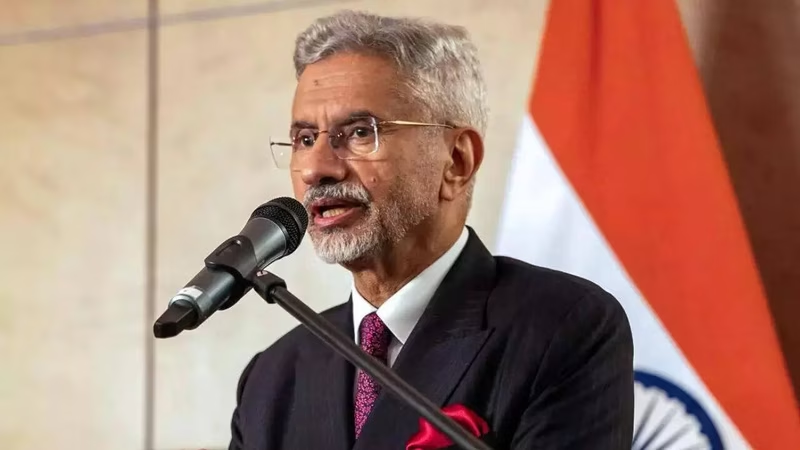
India’s top diplomat has delivered a blistering, no-holds-barred response to Western criticism, turning the tables with a simple but powerful question: “Why don’t you look at your own region?” External Affairs Minister S Jaishankar’s remarks are a clear signal that New Delhi is done playing by the old rules of diplomatic deference. In a world increasingly defined by multipolarity, India is charting its own course—and it won’t be lectured by nations with their own complex histories of intervention and violence.
Speaking on the heels of international commentary surrounding a sensitive Indian operation, Jaishankar didn’t just defend India’s actions; he exposed what he sees as a deep-seated hypocrisy in the West’s approach to global affairs. His comments on Venezuela further underscore India’s commitment to a foreign policy rooted in pragmatism and humanitarian concern, not ideological posturing.
Table of Contents
- Jaishankar’s Scathing Critique of Western ‘Free Advice’
- Understanding Operation Sindoor and the Geopolitical Context
- India’s Doctrine of Strategic Autonomy
- Jaishankar’s Concern for the People of Venezuela
- The Bigger Picture: A Multipolar World Order
- Final Thoughts: A New Era of Assertive Indian Diplomacy
- Sources
Jaishankar’s Scathing Critique of Western ‘Free Advice’
Jaishankar’s frustration was palpable. He dismissed the unsolicited guidance from certain Western capitals as “free advice” that ignores the ground realities of India’s security environment. His retort—“Why don’t you look at your own region for levels of violence?”—is a direct reference to the long and often controversial history of military interventions, drone strikes, and internal conflicts that have plagued Western nations’ own spheres of influence .
This isn’t just a defensive statement; it’s a calculated diplomatic maneuver. By pointing to the West’s own record, Jaishankar is challenging the moral high ground they often assume. He’s asserting that India, as a sovereign nation, has the right and the capability to manage its own security and foreign policy without external sermons. This directness is a hallmark of Jaishankar’s “Vasudhaiva Kutumbakam with a strong fist” approach—global citizenship backed by national strength .
Understanding Operation Sindoor and the Geopolitical Context
While official details of ‘Operation Sindoor’ remain classified, it is widely understood to be a significant counter-terrorism or national security action undertaken by India. The swift and efficient execution of such operations is a critical component of India’s strategy to protect its citizens in an increasingly volatile neighborhood.
The Western commentary likely stemmed from a place of concern, but as Jaishankar’s response makes clear, it was perceived in New Delhi as patronizing and out of touch. India’s security challenges, particularly from cross-border terrorism, are unique and require context-specific solutions, not one-size-fits-all lectures from nations with vastly different threat perceptions.
India’s Doctrine of Strategic Autonomy
A cornerstone of Jaishankar’s message was the reaffirmation of India’s independent foreign policy. “We deal with partners and adversaries differently,” he stated, a simple yet profound principle that encapsulates India’s pragmatic approach .
This means India can simultaneously deepen its Quad partnership with the US, Australia, and Japan while maintaining its historic ties with Russia and engaging constructively with China on trade. This multi-alignment strategy is not a sign of confusion but of strategic clarity. India refuses to be boxed into rigid Cold War-style blocs and instead seeks to maximize its strategic options in a complex world. This autonomy is non-negotiable for New Delhi and is a key pillar of its rising global stature.
Jaishankar’s Concern for the People of Venezuela
In the same breath, Jaishankar expressed India’s “deep concern for the safety of the people of Venezuela” amidst its ongoing political and economic crisis . This statement is significant for several reasons:
- Humanitarian Focus: It shifts the narrative from geopolitics to human welfare, aligning with India’s traditional stance of supporting the Global South.
- Non-Interventionist Principle: While expressing concern, there’s no call for regime change or external intervention, reinforcing India’s respect for national sovereignty.
- Strategic Balance: It demonstrates that India’s foreign policy is not solely focused on its immediate neighborhood or great power rivalries but is attentive to global crises.
This balanced approach stands in stark contrast to the often interventionist policies historically favored by some Western powers.
The Bigger Picture: A Multipolar World Order
Jaishankar’s comments are a microcosm of a much larger global shift. The unipolar moment is over, and the world is rapidly moving towards a multipolar order where nations like India, Brazil, and South Africa are demanding a greater say in global governance. The United Nations has long been a forum for such voices, but the real power dynamics are now shifting in regional forums and through economic partnerships like BRICS and the G20 .
India’s assertive diplomacy under Jaishankar is a direct result of its growing economic heft and strategic importance. The West’s “free advice” is increasingly seen as an anachronism from a bygone era of dominance that no longer reflects the current reality.
For a deeper analysis of India’s evolving global role, explore our feature on [INTERNAL_LINK:india-in-a-multipolar-world].
Final Thoughts: A New Era of Assertive Indian Diplomacy
S Jaishankar’s sharp rebuke to the West is more than just a one-off statement; it’s a declaration of India’s arrival as a confident, self-assured global power. His message is clear: India will protect its interests, manage its foreign relations with pragmatic independence, and speak its mind on the global stage—all without seeking permission or validation. The era of passive diplomacy is over, replaced by a firm, articulate, and unapologetically Indian voice that the world is now compelled to listen to.
Sources
S Jaishankar criticized western nations for offering unsolicited advice, telling them to “look at their own region for levels of violence.”
Jaishankar is known for his pragmatic and assertive approach to foreign policy, often emphasizing India’s civilizational state identity.
He emphasized India’s independent approach to international relations, stating they “deal with partners and adversaries differently.”
Jaishankar highlighted India’s concern for the safety of the people of Venezuela amidst the country’s ongoing crisis.
The UN and other multilateral bodies are key platforms where emerging powers like India voice their perspectives on global governance.
Original Reporting: Got ‘free advice’ during Op Sindoor: EAM targets West’s hypocrisy; what he said on Venezuela.