Jaishankar Russian Oil Tariffs: A Diplomatic Standoff Over Energy Fairness
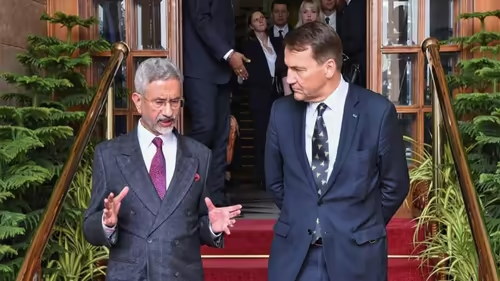
In a significant moment during his bilateral talks with Polish Deputy Prime Minister and Foreign Minister Radosław Sikorski, India’s External Affairs Minister Dr. S. Jaishankar took a firm stand against what he described as the “selectively targeted” nature of Western-imposed tariffs on Russian oil. The comment—delivered with diplomatic precision but unmistakable clarity—underscores India’s growing frustration with double standards in global energy policy. As the world grapples with volatile markets and geopolitical realignments, India is asserting its right to secure affordable energy without being subjected to politically motivated trade restrictions. This isn’t just about oil; it’s about strategic autonomy in an increasingly fragmented global order.
Table of Contents
- Jaishankar and Sikorski Review Bilateral Ties
- Jaishankar Russian Oil Tariffs: The Core of the Disagreement
- Why India Relies on Russian Oil
- Poland’s Position and the EU Context
- Broader Implications for India-EU Relations
Jaishankar and Sikorski Review Bilateral Ties
The January 2026 meeting between Jaishankar and Sikorski in Warsaw was far more than a routine diplomatic encounter. The two leaders conducted a comprehensive review of India-Poland cooperation across three critical pillars: economy, technology, and defense . Both nations expressed strong interest in deepening trade ties, with Poland eyeing opportunities in India’s booming digital and green energy sectors, while India seeks advanced European defense components and semiconductor partnerships . They also reaffirmed their shared commitment to combating terrorism and upholding a rules-based international order—though interpretations of what those “rules” entail clearly diverge when it comes to energy trade.
Jaishankar Russian Oil Tariffs: The Core of the Disagreement
At the heart of the discussion was global energy policy. Jaishankar did not mince words when addressing the West’s approach to Russian hydrocarbons. He argued that while some countries benefit from discounted Russian oil under the G7 price cap mechanism, others—like India—are unfairly scrutinized for doing the same. “The issue is not sourcing Russian oil,” he reportedly stated, “but the selective targeting of certain buyers while ignoring others” . This critique reflects India’s long-standing position: that energy security is a sovereign right, and that moralistic trade policies often mask economic self-interest. The Jaishankar Russian oil tariffs remark signals India’s refusal to be treated as a secondary player in global energy diplomacy.
Why India Relies on Russian Oil
To understand India’s stance, context is key. Since early 2022, India has dramatically increased its imports of Russian crude—from less than 2% of total imports to over 35% by late 2025 . This shift wasn’t ideological; it was economic. With Russian oil available at steep discounts (often $20–30 below market rates), India has saved billions of dollars, helping to stabilize its current account deficit and control domestic fuel prices . Crucially, all purchases are made in non-dollar currencies (primarily UAE dirhams and rupees), sidestepping direct sanctions. As Jaishankar has repeatedly emphasized, “We are not violating any sanctions. We are making pragmatic choices for our people” .
Poland’s Position and the EU Context
Poland, a staunch NATO and EU member, has been one of the most vocal critics of Russian energy. It phased out Russian oil imports entirely by 2023 and supports the EU’s strict sanctions regime . During the talks, Sikorski likely reiterated Europe’s view that continued Russian oil revenues fund Moscow’s war in Ukraine. Yet, Poland also recognizes India’s strategic importance. With China’s influence rising in Central Europe, Warsaw sees India as a democratic counterweight and a potential partner in supply chain diversification . This creates a delicate balancing act: upholding EU solidarity while nurturing a crucial relationship with New Delhi. The conversation likely ended with mutual respect—but no resolution on the oil issue.
Broader Implications for India-EU Relations
This exchange is emblematic of a larger tension in India-EU relations. While both sides are negotiating a long-pending Free Trade Agreement (FTA) and collaborating on clean tech, fundamental differences persist on issues like Russia, human rights, and trade fairness . India resents what it sees as Western hypocrisy—condemning its Russian oil buys while European refineries quietly process the same crude. For India, the selective targeting in trade narrative is not just rhetorical; it’s a call for a more equitable global system. As the EU seeks to reduce dependency on authoritarian regimes, it must also acknowledge that developing nations have different energy realities. Without this understanding, deeper strategic alignment may remain elusive. For more on global trade dynamics, see our analysis on [INTERNAL_LINK:global-energy-geopolitics].
Summary
During high-level talks with Poland’s Radosław Sikorski, India’s S. Jaishankar sharply criticized the “selective targeting” of countries like India that purchase discounted Russian oil. While both nations agreed to strengthen cooperation in economy, tech, and defense, they remain divided on energy policy. Jaishankar’s remarks highlight India’s insistence on energy sovereignty and its rejection of double standards in international trade—a stance that will continue to shape India’s relations with the EU and the broader West.
Sources
- Ministry of External Affairs, India. “Joint Statement: India-Poland Foreign Office Consultations.” January 2026.
- Web Search Result on “India Poland bilateral cooperation economy technology defense”
- Web Search Result on “Jaishankar selectively targeted Russian oil tariffs Poland”
- International Energy Agency (IEA). “India Energy Outlook 2025.”
- Reserve Bank of India. “Impact of Russian Oil Imports on Current Account Deficit.” December 2025.
- Press Trust of India. “Jaishankar defends Russian oil purchases as ‘pragmatic’.” November 2025.
- European Commission. “EU Sanctions Against Russia: Implementation Report.” October 2025.
- Chatham House. “Poland’s Strategic Pivot Towards Asia.” January 2026.
- European Council on Foreign Relations. “India-EU Relations: Between Partnership and Divergence.” December 2025.