Introduction
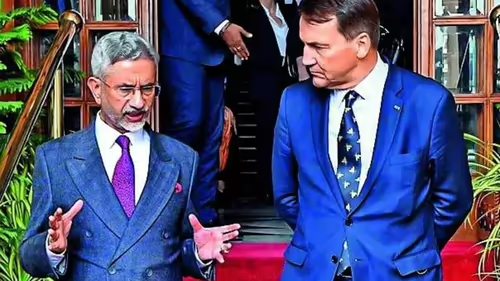
In a rare and pointed diplomatic intervention, India’s External Affairs Minister Dr. S. Jaishankar has issued a clear warning to Poland: stop enabling or tolerating terror infrastructure that threatens India’s security. Speaking during a high-level bilateral engagement, Jaishankar didn’t mince words—he called for a “zero-tolerance” approach to terrorism and expressed deep concern over entities operating from Europe that support anti-India militant networks. But that wasn’t all. The minister also took aim at what he described as “selective targeting” by European nations regarding the Russia-Ukraine conflict and India’s legitimate trade with Moscow—a stance he labeled “unfair” and “hypocritical.” This dual-pronged message signals a new assertiveness in India’s foreign policy, especially toward partners it sees as applying double standards.
Table of Contents
- What Is ‘Terror Infrastructure’—And Why Is India Concerned?
- Jaishankar’s Message to Poland: A Diplomatic Rebuke
- The Russia-Ukraine Angle: India’s Frustration with European Hypocrisy
- Poland’s Role in the Broader Geopolitical Landscape
- India’s Evolving Foreign Policy Strategy
- Conclusion: No More Silence on Terror or Double Standards
- Sources
What Is ‘Terror Infrastructure’—And Why Is India Concerned?
The term “terror infrastructure” refers to the ecosystem that supports terrorist activities—including fundraising networks, propaganda outlets, training facilitators, logistical hubs, and safe havens. While much of this infrastructure is based in Pakistan and Afghanistan, Indian intelligence agencies have long flagged the role of certain Western countries as permissive environments where these networks operate under the guise of NGOs, cultural associations, or diaspora groups .
For instance, Khalistani separatist groups have been known to hold rallies, collect donations, and even glorify assassins in parts of Canada, the UK, and increasingly, continental Europe—including Poland. These activities, though framed as “free speech,” often cross into incitement and material support for violence against Indian citizens and institutions.
Jaishankar’s warning suggests that Poland may be emerging as a new node in this transnational network—one that India can no longer ignore.
Jaishankar’s Message to Poland: A Diplomatic Rebuke
During his remarks, Jaishankar emphasized that terrorism cannot be compartmentalized or justified based on geography or ideology. “There can be no distinction between ‘good’ and ‘bad’ terrorists,” he stated, echoing India’s long-standing position . He urged Poland—a key EU and NATO member—to:
- Investigate and shut down any entities funding or promoting anti-India militant agendas.
- Deny visas and platforms to individuals linked to banned organizations like Babbar Khalsa or Sikhs for Justice (SFJ).
- Share intelligence with Indian agencies to preempt cross-border threats.
This is not merely a request—it’s a strategic signal. As India deepens defense and tech ties with Eastern Europe, it expects its partners to respect its core security red lines.
The Russia-Ukraine Angle: India’s Frustration with European Hypocrisy
Jaishankar didn’t stop at terrorism. He directly challenged Europe’s moral posturing on the Russia-Ukraine war. While Western nations condemn India for continuing energy and trade ties with Russia, they themselves maintain significant economic links—Germany imports Russian gas via third parties, and France sells arms globally without similar scrutiny.
“It is unfair to practice selective targeting,” Jaishankar said, highlighting the inconsistency. India, he argued, has maintained a balanced position—calling for dialogue, supporting Ukraine’s sovereignty, and providing humanitarian aid—while preserving its strategic autonomy and energy security .
This critique reflects a broader shift: India refuses to be lectured by nations whose own policies are riddled with contradictions.
Poland’s Role in the Broader Geopolitical Landscape
Poland has emerged as a critical U.S. and NATO ally on Europe’s eastern flank, especially after Russia’s invasion of Ukraine. It has also sought closer ties with India in defense (e.g., potential deals for BrahMos missiles) and clean energy. However, its relatively open asylum policies and active diaspora communities have made it vulnerable to exploitation by extremist groups.
Jaishankar’s comments suggest India is watching closely—and will recalibrate engagement if Warsaw fails to act decisively against terror infrastructure on its soil.
India’s Evolving Foreign Policy Strategy
This episode exemplifies India’s new diplomatic playbook under Prime Minister Modi:
- Principled Assertiveness: Speak plainly about threats, even to allies.
- Strategic Autonomy: Reject pressure to align with bloc politics on issues like Russia.
- Reciprocity: Partners must respect India’s core interests—security, sovereignty, and dignity.
For more on India’s global posture, see our analysis on [INTERNAL_LINK:india-multi-alignment-foreign-policy].
Conclusion: No More Silence on Terror or Double Standards
Jaishankar’s message to Poland is clear: India will not tolerate external support for terror infrastructure that targets its citizens, and it will call out geopolitical hypocrisy wherever it exists. As New Delhi strengthens its global partnerships, it is doing so on its own terms—demanding mutual respect, shared responsibility, and unwavering commitment to counterterrorism. The ball is now in Poland’s court: will it act as a responsible partner, or risk straining a relationship with one of Asia’s most pivotal powers?
Sources
- Times of India: EAM to Poland: Stop fuelling terror infra
- Ministry of External Affairs, India – Official Statements on Terrorism: MEA Archives
- UN Office of Counter-Terrorism – Definition of Terrorist Infrastructure: Global Framework