Introduction
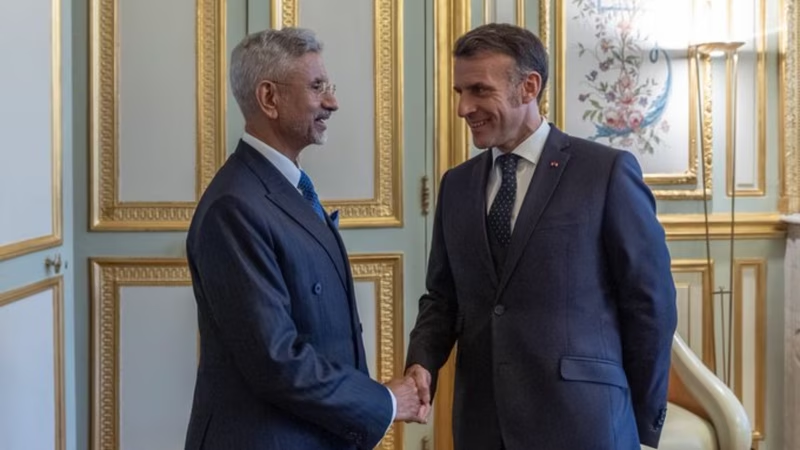
In the heart of Paris, a quiet but consequential meeting took place that could shape the future of Indo-European geopolitics. External Affairs Minister Dr. S. Jaishankar sat down with French President Emmanuel Macron for a wide-ranging discussion covering everything from defense collaboration to the war in Ukraine and Indo-Pacific stability . The meeting wasn’t just ceremonial—Jaishankar personally conveyed Prime Minister Narendra Modi’s “warm wishes” to the French leader, underscoring the personal rapport between the two heads of government .
At a time when multipolarity is replacing old-world alliances, the Jaishankar meets Macron encounter signals India’s deepening commitment to strategic autonomy through trusted partnerships. But beyond the handshakes and diplomatic niceties, what concrete outcomes emerged? And why does the India-France axis matter more than ever?
Table of Contents
- The Strategic Context of the Meeting
- Key Topics Discussed in Paris
- Defense and Technology Ties Deepen
- Climate, Energy, and Indo-Pacific Cooperation
- Modi-Macron: Personal Diplomacy That Delivers
- Why France Is India’s Most Trusted European Partner
- Conclusion: A Partnership Built on Trust, Not Transaction
- Sources
The Strategic Context of the Meeting
This meeting didn’t happen in a vacuum. It comes amid heightened global uncertainty—Russia’s war in Ukraine, China’s assertiveness in the South China Sea, and growing U.S.-China tensions. In this volatile landscape, India and France have quietly emerged as two of the most reliable democratic partners who share a vision of a rules-based, multipolar world order.
France, unlike many EU nations, has consistently supported India’s stance on issues like counter-terrorism and territorial integrity. It was the first country to sign a Joint Strategic Vision for the Indo-Pacific with India—in 2018—long before the Quad became mainstream . This shared worldview makes the Jaishankar meets Macron dialogue especially significant.
Key Topics Discussed in Paris
According to official readouts, the two leaders exchanged views on a range of pressing global and regional issues:
- Ukraine Crisis: Both emphasized the need for a peaceful resolution based on sovereignty and territorial integrity—a subtle but clear alignment against unilateralism.
- Indo-Pacific Security: Reaffirmed their commitment to a free, open, and inclusive Indo-Pacific, with freedom of navigation as a core principle.
- Counter-Terrorism: Condemned cross-border terrorism and stressed intelligence-sharing and joint operations.
- Multilateral Reform: Discussed reforming global institutions like the UN Security Council to better reflect 21st-century realities.
Defense and Technology Ties Deepen
Perhaps the most tangible area of cooperation remains defense. France is already a cornerstone of India’s military modernization—home to the Rafale fighter jets that form the backbone of the Indian Air Force’s frontline squadrons.
But the partnership goes far beyond hardware. The two nations are now collaborating on next-gen technologies:
- Scorpène Submarines: Six submarines built under Project Kalvari at Mazagon Dock Shipbuilders, with technology transfer from France’s Naval Group.
- Jet Engine Co-Development: Ongoing talks for co-producing fighter jet engines under India’s ‘Make in India’ initiative.
- Space Collaboration: ISRO and CNES (French space agency) jointly working on climate monitoring satellites like TRISHNA.
These aren’t just transactions—they’re long-term strategic integrations that build interoperability and trust.
Climate, Energy, and Indo-Pacific Cooperation
On climate action, India and France co-founded the International Solar Alliance (ISA)—now with over 120 member countries—showcasing their ability to lead global green initiatives . During the Paris talks, they likely discussed scaling up solar manufacturing and green hydrogen partnerships.
In the Indo-Pacific, both nations conduct regular naval exercises (like Varuna) and share maritime domain awareness data. France’s overseas territories in the Indian Ocean (Réunion, Mayotte) give it a unique strategic footprint—making it an invaluable partner for India’s SAGAR (Security and Growth for All in the Region) doctrine.
Modi-Macron: Personal Diplomacy That Delivers
The fact that Jaishankar carried PM Modi’s “warm wishes” isn’t just protocol—it reflects a genuine rapport between the two leaders. Modi and Macron have met multiple times since 2017, often bypassing formalities to engage in candid strategic conversations.
This personal chemistry translates into results: France has never criticized India on human rights or democracy in international forums, and it consistently backs India’s NSG membership bid. In return, India sees France as a stable, non-transactional European ally—unlike some others swayed by Beijing or Brussels.
Why France Is India’s Most Trusted European Partner
While Germany and the UK are important, France stands apart for three reasons:
- Strategic Autonomy: Like India, France champions strategic independence from U.S. hegemony.
- No Colonial Baggage: Unlike the UK, France doesn’t carry post-colonial baggage in Indian public perception.
- Consistent Support: From Kashmir to UNSC reform, France’s backing has been unwavering.
This trust allows for deeper collaboration—from nuclear energy (Jaitapur project) to AI ethics and semiconductor supply chains.
Conclusion: A Partnership Built on Trust, Not Transaction
The Jaishankar meets Macron meeting may not have produced flashy headlines, but it reinforced a quiet, resilient alliance that’s becoming central to India’s global posture. In an era of shifting allegiances, the India-France partnership—rooted in shared values, mutual respect, and strategic convergence—offers a model of how democracies can cooperate without coercion. As geopolitical fault lines deepen, expect this bond to only grow stronger. For more on India’s global outreach, explore our analysis on [INTERNAL_LINK:india-quad-alliance-explained].
Sources
- Times of India: Jaishankar meets French President Emmanuel Macron
- Ministry of External Affairs, India: Official Statements
- French Presidency (Élysée): France-India Joint Statement Archives
- International Solar Alliance: ISA Official Website
- Carnegie India: Why France Matters to India’s Strategic Vision