Table of Contents
- A Diplomatic Mission of Condolence
- The Significance of the Jaishankar Khaleda Zia Funeral Visit
- Khaleda Zia’s Complex Legacy in India-Bangladesh Ties
- Reaching Out to the BNP: A Strategic Necessity?
- What’s Next for India-Bangladesh Relations?
- Conclusion: A Carefully Calibrated Message
- Sources
A Diplomatic Mission of Condolence
On a somber Wednesday, December 31, 2025, Dhaka witnessed a moment of profound geopolitical consequence. India’s External Affairs Minister, Dr. S. Jaishankar, arrived in the Bangladeshi capital not just as a mourner, but as a high-level envoy of the Indian state . His mission: to attend the Jaishankar Khaleda Zia funeral and to personally convey the condolences of Prime Minister Narendra Modi to the late leader’s family.
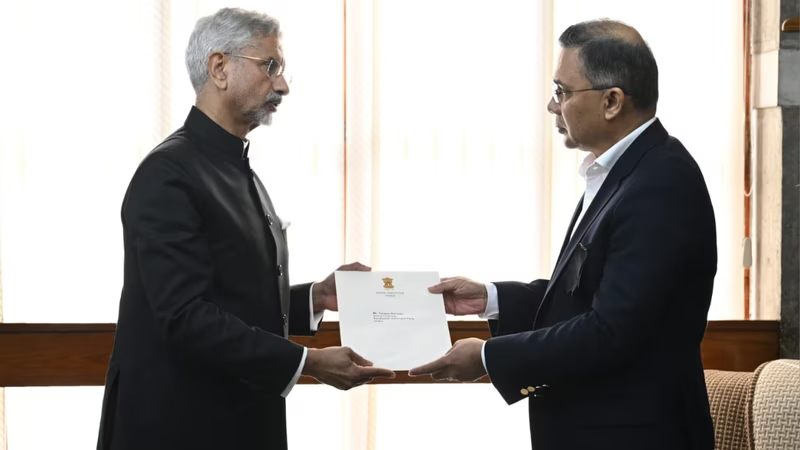
Khaleda Zia, Bangladesh’s first female Prime Minister and the long-time chairperson of the Bangladesh Nationalist Party (BNP), passed away on December 30, 2025, at the age of 80 . Her funeral, held the following day at Manik Mia Avenue, drew dignitaries from across the political spectrum . In a gesture of deep respect, Jaishankar met with Tarique Rahman, the acting chairman of the BNP and Zia’s son, to hand over a personal letter from PM Modi .
The Significance of the Jaishankar Khaleda Zia Funeral Visit
This isn’t a routine diplomatic protocol. Jaishankar’s presence is a powerful, multi-layered signal from New Delhi. His visit is the first high-level Indian engagement in Dhaka since the dramatic political upheaval in August 2025 that saw the ouster of Prime Minister Sheikh Hasina . With Bangladesh now under an interim government led by Chief Adviser Muhammad Yunus , the regional power dynamics are in flux.
By choosing to send its top diplomat, India is making it unequivocally clear that it recognizes Khaleda Zia’s immense historical stature and, by extension, is engaging directly with her political legacy and the BNP. This move is a stark departure from the past 15 years, during which India’s India-Bangladesh relations were almost exclusively cultivated with Sheikh Hasina’s Awami League government .
Why This Move Matters Now
The timing is everything. With the Awami League in disarray and the BNP poised to be a central player in Bangladesh’s next political chapter, India is proactively hedging its bets. The strategic calculus is clear:
- Rebalancing Ties: India seeks to ensure its relationship with Bangladesh isn’t hostage to a single political party. Engaging the BNP is a long-term investment in stability.
- Countering External Influence: There are concerns in New Delhi that a political vacuum in Dhaka could be filled by other regional powers, notably China . A strong Indian presence at this critical moment is a statement of intent.
- Legacy Acknowledgment: Despite a sometimes rocky relationship, Khaleda Zia’s governments also made significant contributions to bilateral ties, such as the 1992 Tin Bigha corridor agreement . Jaishankar’s visit honors that complex history.
Khaleda Zia’s Complex Legacy in India-Bangladesh Ties
Khaleda Zia’s tenure was marked by a policy of “competitive nationalism,” which often put her at odds with New Delhi on issues like water sharing and border security . Her governments were perceived as being more skeptical of deep strategic integration with India compared to the Hasina era, which saw unprecedented cooperation on trade, connectivity, and security .
However, to paint her legacy as purely adversarial is a grave oversimplification. Her first term in the early 1990s saw the resolution of the long-pending Tin Bigha corridor issue, a significant confidence-building measure. Her leadership also represented a crucial pillar of Bangladesh’s democratic history, a value India officially champions.
Reaching Out to the BNP: A Strategic Necessity?
The personal delivery of PM Modi’s condolence letter to Tarique Rahman is perhaps the most intriguing aspect of this diplomatic overture. Tarique, who has lived in exile for years, is the de facto leader of the BNP. This direct, high-level communication is a clear message that India is ready to establish a new channel of dialogue with the party.
This is a pragmatic shift. For India, the stability and friendship of its eastern neighbor are non-negotiable for its own security and economic interests in the Bay of Bengal region. Ignoring a major political force like the BNP, which commands a vast grassroots network, is no longer a viable option. This outreach is India’s attempt to build a more resilient and bipartisan foundation for its India Bangladesh relations.
What’s Next for India-Bangladesh Relations?
Jaishankar’s visit is just the opening move. The real test will be in the coming months as Bangladesh navigates its transition back to an elected government. India will be closely watching to see if its gesture of goodwill is reciprocated.
The key questions on the table include:
- Will the interim government and a future BNP-led administration be open to continuing key strategic projects initiated under Hasina?
- Can a new framework for cooperation on critical issues like counter-terrorism and trade be established that enjoys cross-party support in Dhaka?
- How will this renewed engagement impact the broader regional balance of power, especially in relation to [INTERNAL_LINK:china-south-asia-influence]?
Conclusion: A Carefully Calibrated Message
The image of S. Jaishankar at Khaleda Zia’s funeral is more than a photo-op; it’s a masterclass in strategic diplomacy. By honoring a key figure from a rival political camp, India has sent a powerful message: its commitment to Bangladesh is to the nation and its people, not to any single party or leader. This carefully calibrated move aims to secure India’s interests by fostering a more balanced, durable, and multi-faceted relationship with its crucial neighbor. In the uncertain political landscape of post-Hasina Bangladesh, this could prove to be a brilliant long-term play.
Sources
- Times of India. “EAM attends Khaleda Zia’s funeral; hands PM Modi’s letter to son Tarique.” https://timesofindia.indiatimes.com/…
- Various news sources on Khaleda Zia’s death and funeral. [[1], [2], [3], [5], [6], [7], [8], [9], [10], [11], [12], [13], [14], [15], [16]]
- Analysis on India-Bangladesh relations. [[17], [18], [19], [20], [21]]