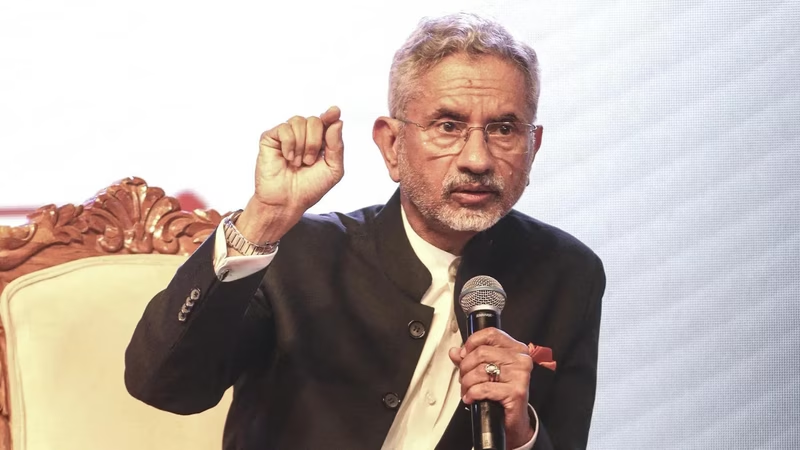
Jaishankar Draws a Line in the Sand for India’s ‘Bad Neighbours’
In a powerful and unambiguous statement that has sent ripples through South Asian geopolitics, External Affairs Minister Dr. S. Jaishankar has declared that India’s right to defend itself against persistent threats is non-negotiable. His comments, a clear shot across the bow to hostile neighbours, signal a fundamental shift in how New Delhi approaches its complex regional relationships.
Speaking on January 2nd, 2026, Jaishankar drew a sharp distinction between ‘good neighbours’ and ‘bad neighbours,’ asserting that India will invest, help, and share with the former, while taking a firm stand against the latter . This isn’t just diplomatic rhetoric; it’s a strategic doctrine with tangible consequences for regional pacts and long-standing agreements.
Table of Contents
- The Good, The Bad, and The Strategic
- India’s Right to Defend: A Doctrine of Self-Reliance
- The Indus Waters Treaty: A Casualty of Terror?
- What Jaishankar’s Statement Means for Regional Diplomacy
- Conclusion: A New Era for India’s Neighbourhood Policy
- Sources
The Good, The Bad, and The Strategic
Jaishankar’s core message is one of pragmatic realism. He stated that India’s neighbourhood policy is guided by ‘common sense’—a simple yet profound principle . With nations that are cooperative and peaceful, India is eager to deepen ties through trade, infrastructure, and mutual support. However, for those who choose a path of hostility and support for terrorism, the relationship is fundamentally different.
“You can’t ask for water and continue terrorism,” Jaishankar bluntly remarked, crystallizing the new, conditional nature of India’s regional engagement . This statement directly challenges the old paradigm where economic and security issues were often treated as separate silos. In New Delhi’s new calculus, they are inextricably linked.
India’s Right to Defend: A Doctrine of Self-Reliance
The phrase “India’s right to defend” is more than a soundbite; it’s a central tenet of the country’s evolving foreign policy. This doctrine asserts that India will not outsource its security or seek external mediation in its core disputes with neighbours. It represents a significant move towards strategic autonomy, where New Delhi makes its own decisions based on its national interests.
This principle has been operationalized in recent years through a series of cross-border counter-terrorism operations, demonstrating that India is willing to act decisively to protect its citizens . Jaishankar’s recent comments reinforce this posture, making it clear that continued acts of terror from across the border will be met with a firm response, including the potential suspension of cooperation in other areas.
The Indus Waters Treaty: A Casualty of Terror?
The most immediate and tangible consequence of this new policy framework appears to be the future of the 1960 Indus Waters Treaty (IWT). Jaishankar’s comments strongly suggest that the treaty is in jeopardy as a direct result of what India perceives as Pakistan’s persistent use of its territory for terrorist activities against India.
This is not a theoretical threat. Following the Pahalgam attack in 2025, India already took the extraordinary step of temporarily suspending the IWT on April 23, 2025, citing national security concerns . Jaishankar’s latest statement reinforces that this suspension is a direct tool of its “India’s right to defend” doctrine. The message is clear: cooperation on vital resources like water is contingent on good faith and the cessation of hostilities.
Historically, the treaty has been seen as a rare durable accord in a troubled relationship . However, India has long argued that the treaty is outdated and disproportionately favours Pakistan, and recent events have pushed the issue to a breaking point .
What Jaishankar’s Statement Means for Regional Diplomacy
Jaishankar’s speech is a definitive end to an era of one-sided generosity in India’s neighbourhood policy. The key takeaways are:
- No More Unconditional Aid: Economic and resource-based cooperation is now conditional on a neighbour’s behaviour on security issues.
- Strategic Autonomy is Paramount: India will not be pressured by external powers to compromise on its core security interests or accept third-party mediation.
- Zero Tolerance for Terrorism: The use of Indian territory as a launchpad for terror is a direct threat to the entire bilateral relationship, with all its components.
This policy provides a clear roadmap for India’s engagements not just with Pakistan, but with all its neighbours. It offers a partnership of equals to those who are willing, while serving as a stark warning to those who choose a path of confrontation. This approach is echoed in India’s growing diplomatic and economic ties with Bangladesh, Sri Lanka, and the Maldives, where mutual respect forms the bedrock of the relationship .
Conclusion: A New Era for India’s Neighbourhood Policy
S. Jaishankar’s articulation of India’s neighbourhood policy marks a decisive shift from reactive diplomacy to a proactive, principle-based strategy. By firmly establishing “India’s right to defend” as the cornerstone of its regional engagement, New Delhi is setting clear boundaries and expectations. The future of critical agreements like the Indus Waters Treaty now hangs in the balance, directly tied to the actions of its signatories. In this new era, goodwill must be earned, not assumed, and security is the non-negotiable prerequisite for any meaningful partnership.
Sources
- Times of India: ‘India has right to defend’: Jaishankar hits out at ‘bad neighbours’
- NDTV: ‘Good Neighbours, Bad Neighbours’: Jaishankar Explains India’s Neighbourhood Approach
- The Hindu: ‘You can’t ask for water and continue terrorism,’ Jaishankar
- Brookings Institution: The Indus Waters Treaty: South Asia’s most durable accord is in peril
- ORF (Observer Research Foundation): The Doval Doctrine