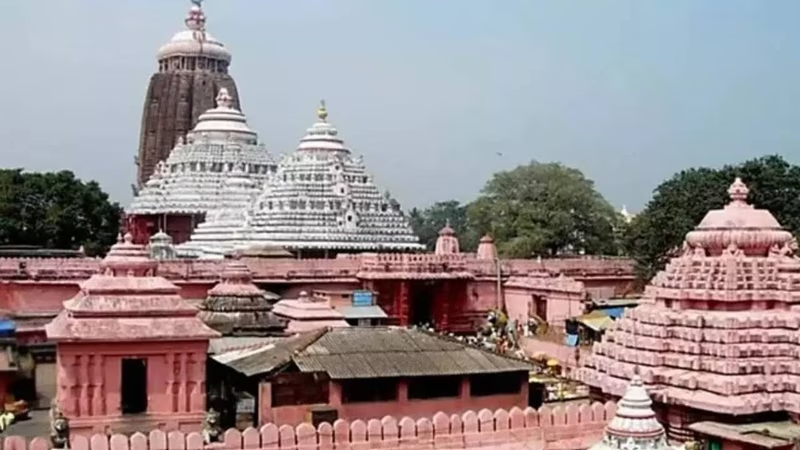
In a rare and embarrassing misstep, the revered Jagannath Temple in Puri has pulled its entire batch of 2026 calendars from circulation after devotees spotted a critical religious error: the sacred sibling deities—Lord Jagannath, Balabhadra, and Devi Subhadra—were depicted in the wrong order on the Ratna Singhasan (the jeweled throne).
For millions of Odias and Vaishnavites worldwide, the positioning of the deities isn’t just tradition—it’s divine ordinance. Balabhadra (elder brother) must stand to the left of Lord Jagannath, and Subhadra (sister) to the right. But in the now-recalled calendar, this sacred alignment was reversed, triggering immediate outrage across social media and political corridors.
The temple administration has issued a public apology, halted all sales, and launched an internal review. But the damage is done. In a state where the Jagannath cult is inseparable from cultural identity, even a printed mistake can ignite a firestorm.
Table of Contents
- The Jagannath Temple Calendar Error Explained
- Why Deity Position Matters in Puri Tradition
- Temple Administration’s Response and Apology
- Political Reactions and Public Backlash
- Rath Yatra Chariot Depiction Errors
- How the Mistake Happened: Century-Old Manuscript Blamed
- Conclusion: Faith Meets Fact-Checking in the Digital Age
- Sources
The Jagannath Temple Calendar Error Explained
The controversy centers on the main illustration of the 2026 wall calendar, which shows the three deities seated on the Ratna Singhasan inside the sanctum sanctorum. Normally, the arrangement is:
- Left: Balabhadra (white-faced, holding a plough and mace)
- Center: Lord Jagannath (dark-complexioned, with large circular eyes)
- Right: Devi Subhadra (yellow-faced, holding a lotus)
However, the printed calendar swapped Balabhadra and Subhadra—placing the elder brother on the right and the sister on the left. To the untrained eye, it may seem trivial. But in the theological framework of the Jagannath tradition, this disrupts cosmic harmony (dharma) and contradicts centuries of ritual practice.
Why Deity Position Matters in Puri Tradition
In the Jagannath cult, every detail—from the shape of the deities’ eyes to the color of their garments—is encoded with spiritual meaning. The left-right positioning reflects familial hierarchy and cosmic roles:
- Balabhadra, as the elder brother, guards the left (considered the protective side in Vedic symbolism).
- Subhadra, as the mediator between her brothers, occupies the right, symbolizing grace and auspiciousness.
This arrangement is mirrored in the famed Rath Yatra, where the three chariots follow the same left-center-right sequence. Devotees argue that altering this order is not just inaccurate—it’s disrespectful to the deities’ divine presence.
Temple Administration’s Response and Apology
The Shri Jagannath Temple Administration (SJTA) acted swiftly. Within 48 hours of the error going viral, it issued a formal statement:
“The calendar has been withdrawn from the market. The mistake was unintentional and stems from a misinterpretation of a century-old archival image. We deeply regret any hurt caused to devotees’ sentiments.”
All unsold copies have been recalled, and distribution agents instructed to return stock. The temple has also promised stricter oversight for future publications.
Political Reactions and Public Backlash
Opposition parties in Odisha were quick to capitalize on the blunder. The Congress accused the ruling BJD of “administrative negligence,” while BJP leaders called it “an insult to Odia pride.”
On the ground, temple priests and local shopkeepers expressed dismay. “This isn’t just ink on paper,” said a Puri-based pandit. “For a farmer in Ganjam or a fisherman in Konark, this calendar is a sacred object. Getting it wrong shakes their faith.”
On X (formerly Twitter), hashtags like #RespectJagannath and #PuriTempleError trended nationally, with thousands sharing corrected diagrams to educate the public.
Rath Yatra Chariot Depiction Errors
Adding to the controversy, sharp-eyed devotees also spotted inaccuracies in the calendar’s illustration of the Rath Yatra chariots:
- Lord Jagannath’s chariot, Nandighosa, was shown with 16 wheels instead of the correct 16 on the front and 16 on the back (32 total).
- Devi Subhadra’s chariot, Darpadalana, was mislabeled and depicted with the wrong canopy color (should be red, shown as yellow).
These details matter deeply during the annual festival, where millions gather to pull the chariots—a ritual believed to bestow moksha (liberation).
How the Mistake Happened: Century-Old Manuscript Blamed
According to SJTA officials, the design team referenced a rare 1920s-era manuscript from the temple archives. Over time, the illustration had faded, and during digitization, the left-right orientation was accidentally flipped—a classic case of “image mirroring” in scanning.
“No one on the team realized the theological implications,” admitted a source within the administration. “They treated it as historical art, not living liturgy.”
This highlights a growing tension in religious institutions: balancing heritage preservation with doctrinal accuracy in the digital age.
Conclusion: Faith Meets Fact-Checking in the Digital Age
The Jagannath temple calendar fiasco is more than a printing error—it’s a reminder that in today’s hyper-connected world, religious imagery is scrutinized not just by scholars, but by millions of devoted eyes. For institutions like the Puri temple, maintaining authenticity isn’t optional; it’s sacred duty. As calendars are reprinted and lessons learned, one truth remains: in the house of Lord Jagannath, even a pixel out of place can stir a storm.
Sources
- Times of India: Jagannath temple pulls 2026 calendars: Image shows deities in incorrect positions; triggers backlash
- Shri Jagannath Temple Administration: Official Website
- Odisha Culture Department: Rath Yatra and Deity Traditions
- The Hindu: Symbolism of Jagannath Deities