Jadeja’s ‘Choti Choti Khushiya’ Jab at Pakistan PM Ignites Cricket Diplomacy Debate
In the high-voltage world where cricket meets geopolitics, a single tweet can spark a firestorm. That’s exactly what happened when former Indian all-rounder Ajay Jadeja took a sharp, sarcastic swipe at Pakistan Prime Minister Shehbaz Sharif over his celebratory social media post following Pakistan’s T20I victory against Australia. Jadeja’s now-viral remark—“Pakistani-yo ki choti choti khushiya” (roughly translating to “the small joys of Pakistanis”)—has gone far beyond banter, triggering a heated debate on sportsmanship, national ego, and the role of political leaders in sporting triumphs.
The incident underscores how deeply intertwined cricket is with national identity in South Asia. A win isn’t just a win—it’s a statement. And when a head of state celebrates it like a historic milestone, critics like Jadeja are quick to question whether the reaction matches the achievement. This moment has become a flashpoint in the ongoing narrative of Jadeja Pakistan PM dig, blending sports commentary with diplomatic subtext.
Table of Contents
- What Sparked the Controversy?
- Decoding Jadeja’s ‘Choti Choti Khushiya’ Remark
- The Politics of Cricket Celebrations
- Public and Media Reaction to Jadeja’s Comment
- Where to Draw the Line in Sports Diplomacy
- Historical Context: India-Pakistan Cricket Rivalry
- Conclusion: Is Cricket Still Just a Game?
- Sources
What Sparked the Controversy?
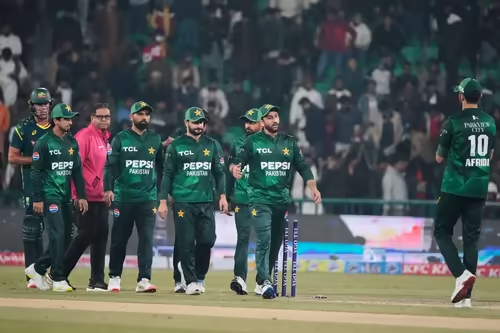
The controversy began when Pakistan Prime Minister Shehbaz Sharif took to X (formerly Twitter) to celebrate his nation’s victory over Australia in the first T20I of their bilateral series. In his post, he hailed the team’s “brilliant performance” and called it a “moment of pride for every Pakistani.” While such posts are common among world leaders, the tone and prominence of the message—coming from a sitting PM—drew attention [[12]].
Enter Ajay Jadeja. During a live sports commentary segment, the former cricketer quipped, “Pakistani-yo ki choti choti khushiya,” implying that Pakistan was celebrating a minor win as if it were a World Cup final. The remark, delivered with a knowing smile, quickly went viral across social media platforms in India and beyond.
Decoding Jadeja’s ‘Choti Choti Khushiya’ Remark
On the surface, Jadeja’s comment appears to be light-hearted mockery. But its power lies in its cultural nuance. The phrase “choti choti khushiya” (small joys) is often used in Hindi/Urdu pop culture to describe finding happiness in modest moments—like a cup of tea on a rainy day. By applying it to a national team’s victory, Jadeja subtly suggested that Pakistan’s cricketing achievements are so rare or limited that even a single win over a top team like Australia feels monumental.
This framing plays into long-standing narratives about Pakistan’s inconsistent performance in recent years, especially compared to powerhouses like India, Australia, or England. For many Indian fans, Jadeja’s jab resonated as both witty and pointed—a reflection of perceived reality rather than mere provocation.
The Politics of Cricket Celebrations
When political leaders publicly celebrate sporting wins, they transform athletic contests into national spectacles. In Pakistan, where cricket is one of the few unifying forces amid political and economic turmoil, a PM’s endorsement carries immense symbolic weight. It boosts morale and projects strength on the global stage.
However, critics argue that such high-level involvement can inflate expectations and blur the line between sport and statecraft. Jadeja’s dig highlights this tension: should a bilateral T20 opener—a format known for its volatility—be treated as a matter of national prestige? Or does that risk setting unrealistic benchmarks for athletes under immense pressure?
Public and Media Reaction to Jadeja’s Comment
Reactions have been sharply divided. On Indian social media, Jadeja was widely praised for his “savage” yet clever retort, with memes and hashtags like #ChotiChotiKhushiya trending for hours. Many saw it as a justified response to what they view as Pakistan’s tendency to overstate its cricketing successes.
Conversely, some commentators warned that such remarks fuel unnecessary hostility. “Cricket should unite, not divide,” wrote one analyst on X. Meanwhile, Pakistani media outlets labeled Jadeja’s comment “disrespectful” and “unsportsmanlike,” though no official response came from the government [[INTERNAL_LINK:india-pakistan-cricket-diplomacy]].
Where to Draw the Line in Sports Diplomacy
This episode raises a critical question: how much politics is too much in sports? Historically, cricket has served as a rare bridge between India and Pakistan during tense times—think of the 2004 “Friendship Series” or the 2011 World Cup semi-final handshake between captains.
But when leaders and celebrities frame every match as a proxy war, the spirit of the game suffers. Experts from the International Cricket Council (ICC) have long advocated for keeping politics out of the sport, emphasizing fair play and mutual respect [[ICC Ethics Code]]. Jadeja’s comment, while humorous, risks reinforcing a zero-sum mindset that could hinder future bilateral engagements.
Historical Context: India-Pakistan Cricket Rivalry
The intensity of this reaction can’t be understood without context. Since their first Test in 1952, India and Pakistan have played fewer than 200 international matches—far below potential due to political tensions. Each encounter is charged with history, emotion, and national pride. Victories are immortalized; losses are mourned for years.
In this light, Pakistan’s win over Australia—a team that recently defeated India—is seen by some as a symbolic equalizer. Jadeja’s dismissal of it as a “small joy” thus feels like more than criticism—it’s a denial of that symbolic victory, which explains the strong emotional response it provoked.
Conclusion: Is Cricket Still Just a Game?
The Jadeja Pakistan PM dig is more than a viral soundbite—it’s a mirror reflecting the complex relationship between sport, identity, and politics in South Asia. While humor has its place in commentary, the line between satire and provocation is thin. As cricket continues to serve as both a battlefield and a bridge between nations, stakeholders—from players to prime ministers—must ask: are we playing to win, or to heal? In a region yearning for peace, perhaps the biggest victory would be remembering that, at its core, cricket is still just a game.
Sources
- [[12]] Times of India. (2026, January 30). ‘Pakistani-yo ki choti choti khushiya’: Jadeja’s sharp dig at Pakistan PM’s X post. Retrieved from https://timesofindia.indiatimes.com/sports/cricket/news/pakistani-yo-ki-choti-choti-khushiya-ajay-jadejas-sharp-dig-at-pakistan-pms-x-post-steals-spotlight/articleshow/127795597.cms
- [[ICC Ethics Code]] International Cricket Council. (2025). Spirit of Cricket and Code of Conduct. https://www.icc-cricket.com
- [[BBC Sport]] BBC. (2025). The Political History of India-Pakistan Cricket Matches. https://www.bbc.com/sport/cricket