Table of Contents
- The Spark of Controversy: AR Rahman’s Explosive Claim
- Jaaferi’s Response: A Broader Perspective on Change
- Bollywood Industry Changes: The Gen Z Effect
- From Art to Algorithm: The New Business of Cinema
- Conclusion: Is There Room for Soul in the New Bollywood?
- Sources
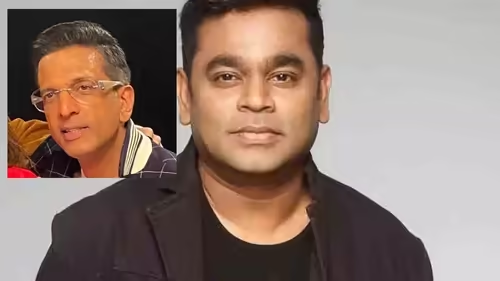
The Hindi film industry is at a crossroads, and two of its most respected voices—composer A.R. Rahman and actor Jaaved Jaaferi—are offering starkly different diagnoses for its current state. While Rahman points to a potential communal bias as a barrier to his work, Jaaferi sees a more fundamental, systemic shift driven by technology and a new generation’s psychology. This clash of perspectives has ignited a crucial conversation about the very soul of Bollywood industry changes.
The Spark of Controversy: AR Rahman’s Explosive Claim
The debate began when Oscar-winning composer A.R. Rahman made headlines with a startling admission. He suggested that his work in mainstream Bollywood had significantly dried up in recent years, attributing this decline not to a lack of talent or demand, but to a complex mix of a power shift within the industry and a possible “communal bias” . His comments, which he later clarified were not meant to be divisive but reflective of his personal experience, sent shockwaves through the entertainment world .
Rahman’s core argument was that creative decision-making power has moved away from artists and into the hands of individuals who may prioritize other factors over pure artistic merit . This claim struck a raw nerve, prompting many to question the inclusivity and fairness of the current system.
Jaaferi’s Response: A Broader Perspective on Change
While promoting his new project, ‘Mayasabha’, veteran performer Jaaved Jaaferi was asked to weigh in on Rahman’s remarks. Instead of directly confirming or denying the existence of bias, Jaaferi offered a more panoramic view of the industry’s transformation. His response was telling: “Industry & values have changed” .
Jaaferi didn’t dismiss Rahman’s experience but contextualized it within a much larger, more impersonal trend. He argued that the entire ecosystem of content creation has been upended. The focus, he suggests, is no longer solely on the art of filmmaking but on the broader “business of making projects,” which includes digital series, short films, and social media content .
Bollywood Industry Changes: The Gen Z Effect
At the heart of Jaaferi’s analysis is a fascinating and somewhat alarming statistic: the Gen Z attention span. He noted that the current generation’s ability to focus has reportedly shrunk to a mere six seconds . Whether this number is scientifically precise or a cultural shorthand, its implication is clear: the audience’s consumption habits have radically evolved.
This shift has profound consequences for the kind of stories that get told and how they are told. The era of slow-burn, character-driven epics may be giving way to fast-paced, high-impact narratives designed to grab and hold attention instantly. As one study on media consumption notes, Gen Z audiences show a strong preference for action-packed and light-hearted content that aligns with their fast-paced digital lives .
This isn’t just about entertainment; it’s about values. The transparency, authenticity, and social consciousness that Gen Z demands from brands are also being projected onto the films and shows they watch . The industry is scrambling to adapt, often prioritizing format and speed over depth and nuance.
From Art to Algorithm: The New Business of Cinema
Jaaferi’s observation that the business is now about “making projects, not just films” is perhaps the most critical insight. The traditional model of a two-and-a-half-hour theatrical release is just one piece of a sprawling puzzle. Today’s creators must think in terms of franchises, OTT (over-the-top) platform strategies, social media virality, and global streaming rights.
This new paradigm means that data and algorithms often play a larger role in greenlighting a project than a director’s vision or a composer’s genius. The focus is on what will generate clicks, views, and subscriptions in a hyper-competitive market. In this environment, even a legend like A.R. Rahman might find his unique musical style—which often requires patient listening—less aligned with the prevailing trends.
It’s a complex interplay. Is Rahman’s reduced workload a result of communal bias, as he fears? Or is it a casualty of these massive Bollywood industry changes, where the rules of engagement have been rewritten by technology and a new audience? The uncomfortable truth may lie somewhere in between, where systemic biases can easily hide behind the convenient excuse of “market forces” and “audience preferences.”
Conclusion: Is There Room for Soul in the New Bollywood?
The dialogue between Rahman’s specific grievance and Jaaferi’s sweeping observation paints a picture of an industry in flux. The challenge for Bollywood is to navigate this new landscape without losing its soul. Can it harness the energy and reach of digital platforms while still creating space for diverse voices, complex artistry, and timeless music? The answer to this question will define the next chapter of Indian cinema. For fans and creators alike, the hope is that amidst the data and the six-second hooks, there remains room for the kind of profound, unifying art that both Rahman and Jaaferi have spent their careers championing.
Sources
- Times of India: ‘Industry & values have changed’: Jaaved Jaaferi reacts to AR Rahman’s remarks
- India Today: AR Rahman says work reduced due to possible communal bias, power shift in Bollywood
- Forbes India: The rise of Gen Z: How a new generation is reshaping the Indian film industry
- Internal Link: [INTERNAL_LINK:bollywood-ott-platforms-impact]
- External Authority Link: Britannica on the History and Evolution of Bollywood