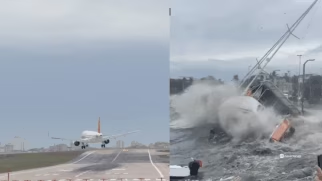
It looked like something out of a disaster movie—but it was all too real. On January 8, 2026, a powerful Istanbul storm slammed into Turkey’s largest city, unleashing gale-force winds, torrential rain, and massive waves that brought much of the region to a standstill. And the most heart-stopping moment? A passenger-captured video showing a commercial airliner violently swaying just feet above the runway before aborting its landing.
The footage, which quickly went viral on social media, shows a Pegasus Airlines flight—believed to be arriving from Ankara—struggling against extreme crosswinds at Istanbul Sabiha Gökçen International Airport. The aircraft pitches and yaws dramatically, its wings tilting precariously before the pilot executes a go-around, climbing back into the turbulent sky . Aviation experts later confirmed the maneuver was not only correct but essential for passenger safety under such conditions.
Table of Contents
- The Istanbul Storm Unleashed: Weather Data & Impact
- Istanbul storm Video: What Happened During the Landing Attempt?
- Transport Paralysis Across Western Turkey
- Infrastructure Damage and Localized Flooding
- Climate Context: Is This the New Normal for Istanbul?
The Istanbul Storm Unleashed: Weather Data & Impact
Meteorologists from Turkey’s State Meteorological Service reported wind speeds exceeding 100 km/h (62 mph) along the Marmara coast, with gusts strong enough to uproot mature trees and damage rooftops . The storm system, fueled by a deep low-pressure system moving in from the Aegean Sea, also triggered high waves of up to 4 meters (13 feet) in the Sea of Marmara.
Such intensity is rare for January, though not unprecedented. However, the timing—during peak evening commute hours—magnified the chaos, catching many residents off guard.
Istanbul storm Video: What Happened During the Landing Attempt?
The viral video, filmed by a passenger on another aircraft waiting to depart, offers a chilling perspective. As the Pegasus Boeing 737 approaches the runway, it’s visibly pushed sideways by horizontal winds. The nose dips, then rises sharply; the left wing drops alarmingly before the pilot adds full thrust and climbs away.
According to aviation safety protocols, pilots are trained to execute a “go-around” if they cannot stabilize the aircraft within strict parameters during final approach. In this case, the decision likely prevented a potential runway excursion or worse. Pegasus Airlines later confirmed the flight landed safely on its second attempt after conditions slightly improved .
Transport Paralysis Across Western Turkey
The storm’s impact extended far beyond the airport. Authorities suspended all sea transport across two of Turkey’s most critical waterways:
- Bosphorus Strait: Ferry services between Europe and Asia halted for over 6 hours.
- Dardanelles Strait: Commercial and passenger vessels ordered to remain in port.
Road traffic in Istanbul descended into gridlock as fallen trees blocked major arteries like the TEM Highway and coastal roads in Kadıköy and Beşiktaş. Public transit systems, including metro and bus lines, experienced significant delays, stranding thousands of commuters well into the night .
Infrastructure Damage and Localized Flooding
Beyond transport, the storm inflicted tangible damage. Reports from provincial governorates detailed:
- Over 200 fallen trees across Istanbul, Izmir, and Bursa provinces.
- Localized flash flooding in low-lying districts like Zeytinburnu and Bakırköy.
- Power outages affecting approximately 15,000 households due to downed lines.
- Minor structural damage to signage, awnings, and temporary construction sites.
Thankfully, no fatalities were reported, though several minor injuries were treated at local hospitals, mostly from slips or falling debris .
Climate Context: Is This the New Normal for Istanbul?
This event raises urgent questions about climate resilience. According to data from the World Meteorological Organization (WMO), the Mediterranean basin—including Turkey—is warming 20% faster than the global average, leading to more frequent and intense extreme weather events like storms, heatwaves, and droughts .
Istanbul, a megacity of over 16 million people straddling two continents, is particularly vulnerable due to its dense urban fabric, aging infrastructure, and exposure to both sea and wind. Experts warn that without significant investment in climate adaptation—from reinforced drainage systems to smarter building codes—such disruptive events will become increasingly common.
Final Summary
The Istanbul storm of January 2026 was a stark reminder of nature’s power—and the fragility of even the most advanced urban systems. From the terrifying mid-air wobble of a commercial jet to the complete shutdown of maritime traffic in the Bosphorus, the event exposed critical vulnerabilities. While emergency services responded effectively, the long-term lesson is clear: cities like Istanbul must prepare not just for storms, but for a future where such extremes are no longer exceptional, but expected.
Sources
- Times of India. (2026, January 9). Istanbul storm caught on camera; video shows plane wobbling mid-landing — video. Retrieved from https://timesofindia.indiatimes.com/world/middle-east/istanbul-storm-caught-on-camera-video-shows-plane-wobbles-mid-landing-video/articleshow/126417172.cms
- Turkish State Meteorological Service. (2026, January 8). Severe Weather Warning: Marmara Region.
- Pegasus Airlines Official Statement. (2026, January 8). Flight Operations Update During Adverse Weather.
- World Meteorological Organization (WMO). (2025). State of the Climate in the Mediterranean. Retrieved from https://public.wmo.int
- Hürriyet Daily News. (2026, January 9). Istanbul grinds to halt as storm batters city.