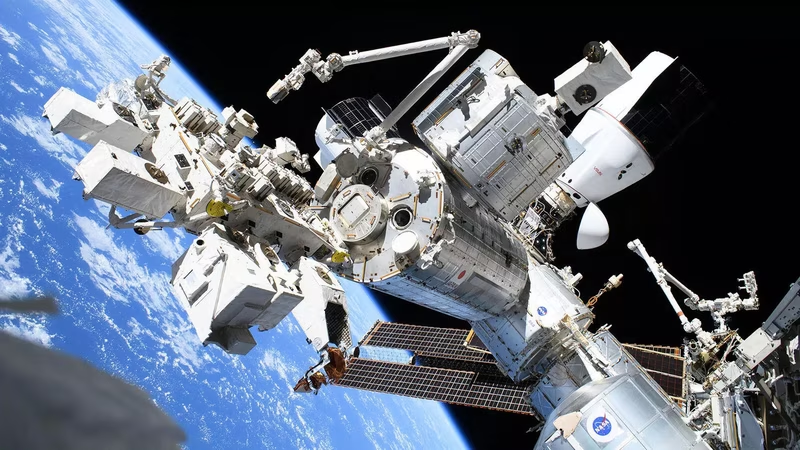
ISS Visible Over Qatar: A Celestial Gift for the Gulf
On the evening of Sunday, January 11, 2026, something extraordinary lit up the twilight sky over Doha. For nearly six uninterrupted minutes, residents gazed upward as a bright, silent, fast-moving star glided from horizon to horizon. That wasn’t a plane or a satellite—it was the ISS visible over Qatar, offering one of the longest and brightest passes the region has seen in recent memory . Social media exploded with photos and videos, but for many, the real magic was the quiet awe of watching human ingenuity orbit 400 kilometers above Earth—with nothing but their own eyes.
Table of Contents
- What Happened on January 11?
- Why Was This ISS Pass So Rare?
- How to Spot the ISS in Gulf Skies (Even If You Missed This One)
- The Science Behind the Sight: Why It Glows So Bright
- When’s the Next Chance to See the ISS Over Qatar?
- Conclusion: Look Up—You’re Part of Something Bigger
- Sources
What Happened on January 11?
Just after sunset, around 5:48 PM local time, the International Space Station emerged over the western horizon of Qatar. Traveling at a staggering 28,000 km/h, it remained clearly visible to the naked eye for approximately six minutes before fading into Earth’s shadow in the east . Unlike aircraft, it emitted no sound and had no blinking lights—just a steady, brilliant white glow that outshone even Venus. This visibility window was unusually long due to perfect orbital alignment, allowing the ISS to stay sunlit while the ground below was already dark—a sweet spot for optimal viewing.
Why Was This ISS Pass So Rare?
While the ISS orbits Earth every 90 minutes, it’s not always visible from any given location. Several factors must align:
- Timing: It must pass overhead during dawn or dusk, when the sky is dark but the station is still illuminated by the sun.
- Altitude: The higher the pass in the sky (closer to directly overhead), the longer and brighter it appears.
- Orbital Inclination: The ISS’s path doesn’t cover all latitudes equally; passes over the Gulf are less frequent than over Europe or North America.
The January 11 pass scored high on all three—reaching 78° above the horizon, lasting 6 minutes, and occurring in ideal post-sunset darkness. That combination makes it a once-in-several-months event for Qatar, which is why so many called it “rare” .
How to Spot the ISS in Gulf Skies (Even If You Missed This One)
Don’t worry if you blinked and missed it. The ISS will return—and you can be ready. Here’s how:
- Use NASA’s “Spot The Station” Service: Sign up at NASA’s official tracker to get email or SMS alerts for upcoming visible passes in your city—including Doha, Dubai, and Riyadh.
- Check Heavens-Above: This free website and app provide detailed star charts showing exactly where and when the ISS will appear [[INTERNAL_LINK:best-astronomy-apps-for-beginners]].
- Look West After Sunset: Most good passes begin in the west shortly after dusk. Find an open area with minimal light pollution.
- No Equipment Needed: The ISS is often the third-brightest object in the sky (after the Sun and Moon). Binoculars or telescopes aren’t necessary—and may even make it harder to track.
The Science Behind the Sight: Why It Glows So Bright
The ISS doesn’t produce its own visible light. Its brilliance comes from sunlight reflecting off its massive solar arrays—each wing stretching 35 meters, about the length of a basketball court. When these panels catch the sun at just the right angle relative to an observer on the ground, they create a mirror-like flash that can reach magnitude -3.9, far brighter than most stars . This reflective power is what turns a 420-ton metal laboratory into a moving beacon in our night sky.
When’s the Next Chance to See the ISS Over Qatar?
According to NASA’s prediction tools, the next highly visible pass over Doha is expected on January 25, 2026, at approximately 6:15 PM, lasting about 4 minutes and reaching 65° in the sky . While not quite as dramatic as the January 11 event, it will still be unmistakable. Mark your calendars—and set a reminder!
Conclusion: Look Up—You’re Part of Something Bigger
The ISS visible over Qatar wasn’t just a cool sky trick. It was a visceral reminder that humans live and work in space right now—conducting experiments, maintaining a fragile outpost of cooperation, and pushing the boundaries of what’s possible. In a world often focused downward at screens, moments like this invite us to look up and reconnect with wonder. Whether you saw it on January 11 or are waiting for the next pass, remember: the sky isn’t just a ceiling. It’s a window—and sometimes, through it, you can see humanity itself, shining brightly.
Sources
- Times of India: “A rare moment for Gulf skies: International Space Station visible over Qatar for 6 minutes” (January 11, 2026)
- NASA Spot The Station – https://spotthestation.nasa.gov
- Heavens-Above.com – Real-time satellite tracking data for global locations