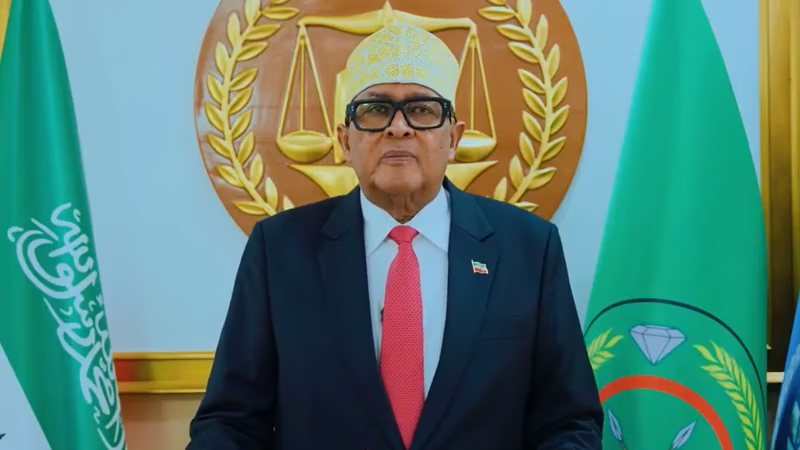
On December 26, 2025, a quiet diplomatic earthquake shook the Horn of Africa. Israel officially recognized Somaliland as an independent sovereign state, becoming the very first United Nations member to do so . This bold declaration, while celebrated in Hargeisa, sent shockwaves through diplomatic corridors from Addis Ababa to Riyadh, igniting a fierce international backlash. So, why did Israel take this unprecedented step, and why is the US refusing to follow? Let’s unpack the high-stakes gamble behind ‘Israel recognizes Somaliland’.
Table of Contents
- What is Somaliland? A Self-Governing Enigma
- Israel Recognizes Somaliland: The Historic Declaration
- Why the US is Holding Back on Recognition
- The Furious Backlash from Africa and the Middle East
- The Geopolitical Chess Game: Strategy Behind the Move
- Conclusion: A Precipice of Change or Diplomatic Isolation?
- Sources
What is Somaliland? A Self-Governing Enigma
Somaliland is a self-declared republic in the Horn of Africa that broke away from Somalia in 1991 following a devastating civil war . Despite its lack of international recognition, it has functioned as a de facto independent state for over three decades, boasting its own government, currency, military, and a remarkable record of stability and democratic elections in a volatile region .
Historically, British Somaliland gained independence on June 26, 1960, and existed as the sovereign State of Somaliland for just five days before voluntarily merging with Italian Somaliland to form the Somali Republic . The disastrous union and subsequent dictatorship led to its 1991 declaration of independence—a bid for statehood that has been ignored by the international community until now .
Israel Recognizes Somaliland: The Historic Declaration
The breakthrough came on December 26, 2025, when Israeli Prime Minister Benjamin Netanyahu and Somaliland’s President Abdirahman Mohamed Abdillahi signed a joint declaration in Jerusalem . This act formally established Israel as the first and, as of now, only UN member state to recognize the Republic of Somaliland .
In its official statement, Israel commended Somaliland’s leadership for its “role in promoting stability, peace, and counter-terrorism” in the region and extended an invitation for deeper cooperation . This move is the culmination of months of quiet diplomacy, following a direct appeal from Somaliland’s presidency to the international community in May 2025 .
Why the US is Holding Back on Recognition
While Israel has leapt, the United States is treading with extreme caution. Officially, the US has not extended formal recognition to Somaliland . The stance is driven by a complex web of strategic concerns.
First and foremost, the US maintains a critical military presence in neighboring Djibouti and has a strategic partnership with the internationally recognized Federal Government of Somalia in Mogadishu. Recognizing Somaliland could jeopardize this relationship and destabilize the fragile Somali state .
Secondly, there are internal divisions within the US administration. While some lawmakers and officials see strategic value in cultivating ties with the stable Somaliland as a counter to China’s growing influence in the region—including its major naval base in Djibouti—others fear the diplomatic fallout . Former President Donald Trump has publicly stated the US “won’t recognize Somaliland as an independent state,” reflecting the ongoing internal debate .
The Furious Backlash from Africa and the Middle East
The announcement triggered immediate and fierce condemnation.
- African Union (AU): The AU swiftly and unanimously rejected Israel’s move. The Chairperson of the AU Commission stated they “reject any recognition of Somaliland” and reaffirmed their “unwavering commitment to the sovereignty and territorial integrity of the Federal Republic of Somalia” . This stance is consistent with the AU’s long-held principle of upholding colonial-era borders to prevent a cascade of secessionist movements across the continent .
- Arab League and Gulf States: The Arab League, along with its Gulf members, joined the chorus of rejection, viewing the move as a direct affront to Somalia and a potential source of regional instability .
- Somalia: The government in Mogadishu was outraged, demanding that Israel immediately withdraw its recognition, calling it a “blatant violation of its sovereignty” .
The Geopolitical Chess Game: Strategy Behind the Move
Israel’s decision is far from altruistic. It’s a calculated strategic play in a complex geopolitical landscape.
By establishing a foothold in Somaliland, Israel gains a potential ally on the southern shore of the Red Sea and the Gulf of Aden—a critical maritime chokepoint. This could serve as a counterbalance to Iranian influence in the region and provide Israel with new intelligence and logistical options . Furthermore, it deepens Israel’s growing network of partnerships in Africa, a key foreign policy priority for decades.
For Somaliland, this recognition is a monumental diplomatic victory. It validates its three-decade-long quest for sovereignty and could pave the way for other nations to follow Israel’s lead, unlocking desperately needed foreign investment and development aid . [INTERNAL_LINK:somaliland-geopolitical-importance]
Conclusion: A Precipice of Change or Diplomatic Isolation?
The declaration that ‘Israel recognizes Somaliland‘ is a high-risk, high-reward gambit. For Israel, it’s an opportunity to expand its strategic depth in a critical region. For Somaliland, it’s a potential lifeline to international legitimacy. However, the fierce opposition from the African Union, the Arab world, and its own neighbor, Somalia, means this path is fraught with peril. The world is now watching to see if this lone act of recognition will be the first crack in the dam of international consensus or a move that leaves both Israel and Somaliland diplomatically isolated.
Sources
- Times of India: Israel approves, US does not: Why Somaliland recognition has triggered backlash
- INSS: Somaliland and Israel—Considerations Regarding Recognition
- Al Jazeera: Israel becomes first country to recognise Somaliland
- African Union: Chairperson’s Statement on Israel’s Somaliland Recognition
- The Guardian: US divided over Somaliland recognition amid China concerns