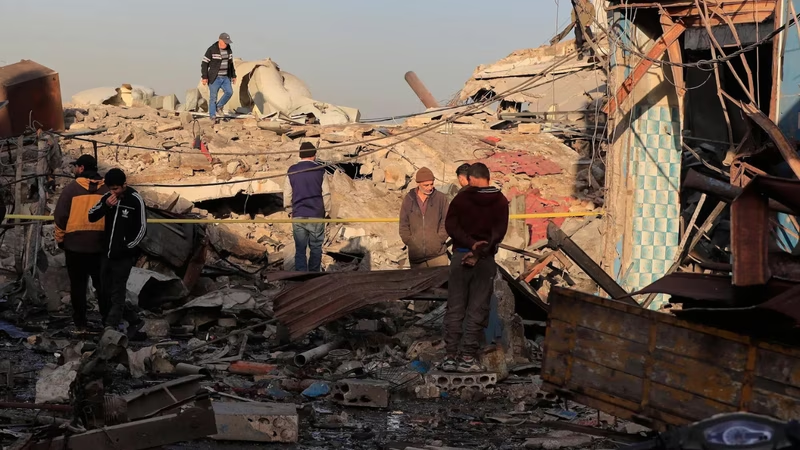
Tensions along the Israel-Lebanon border have flared anew after Tel Aviv launched a series of precision air strikes targeting Hezbollah infrastructure deep inside Lebanese territory. The attacks come just days after the Lebanese government announced a long-awaited plan to disarm the Iran-backed militant group in the south—a move Israel cautiously welcomed but deemed insufficient without concrete, verifiable action.
As plumes of smoke rose over southern Lebanon on Friday, January 9, 2026, the world watched yet another volatile chapter unfold in the decades-old Israel Hezbollah conflict. With both sides locked in a high-stakes game of deterrence and diplomacy, the risk of a wider regional war looms larger than at any point since the 2006 Lebanon War.
Table of Contents
- The Latest Escalation: Israel’s Air Strikes
- Lebanon’s Disarmament Pledge: Promises vs. Reality
- Why Israel Remains Skeptical
- Hezbollah’s Military Capacity: A Growing Threat
- Regional and Global Implications
- Pathways to De-escalation
- Conclusion: A Fragile Moment in Middle East History
- Sources
The Latest Escalation: Israel’s Air Strikes
According to Israel Defense Forces (IDF) statements, the overnight raids struck “multiple Hezbollah weapons production sites, rocket storage facilities, and command centers” across southern Lebanon . The operation, codenamed ‘Iron Resolve,’ targeted locations believed to be involved in the assembly of precision-guided missiles capable of reaching major Israeli population centers.
While no civilian casualties were immediately reported, the Lebanese National News Agency confirmed damage to infrastructure near Tyre and Nabatieh. Hezbollah has not yet claimed retaliation—but its silence is often a prelude to action.
Lebanon’s Disarmament Pledge: Promises vs. Reality
The strikes follow a surprising announcement from Beirut earlier this week: the Lebanese government declared its intent to implement UN Security Council Resolution 1701, which calls for the disarmament of all armed groups south of the Litani River—effectively targeting Hezbollah’s stronghold.
Prime Minister Najib Mikati stated that the Lebanese Armed Forces (LAF) would “gradually assume full security control” in the region, beginning with joint patrols and checkpoints. This marks a rare public challenge to Hezbollah’s parallel military authority—a move likely pressured by Western donors and Gulf allies weary of perpetual instability.
However, experts remain deeply skeptical. “Hezbollah isn’t just a militia—it’s a state within a state,” says Dr. Lina Khatib of Chatham House. “Its political wing holds cabinet seats. Disarming it requires more than a press release; it demands a fundamental shift in Lebanon’s power structure” .
Why Israel Remains Skeptical
Israel’s response to Lebanon’s announcement was measured but firm. While an IDF spokesperson called the LAF’s initial deployment “an encouraging start,” he emphasized that “full and irreversible disarmament of Hezbollah is non-negotiable.”
Tel Aviv’s skepticism stems from years of broken promises. Despite multiple ceasefires and UN resolutions, Hezbollah has not only retained its arsenal but significantly upgraded it—now boasting an estimated 150,000 rockets and missiles, including advanced systems supplied by Iran .
“We’ve seen this script before,” said Israeli Foreign Ministry official Yossi Levy. “Words are cheap. We need boots on the ground, weapons confiscated, and tunnels destroyed—not photo ops.”
Hezbollah’s Military Capacity: A Growing Threat
Over the past decade, Hezbollah has transformed from a guerrilla force into a quasi-conventional army. Its capabilities now include:
- Short-, medium-, and long-range ballistic missiles;
- Drone swarms capable of surveillance and attack;
- Underground tunnel networks along the border;
- Cyber warfare units targeting Israeli infrastructure.
This arsenal, largely funded and trained by Iran’s Islamic Revolutionary Guard Corps (IRGC), positions Hezbollah as Tehran’s most potent proxy in the region—a direct threat to Israel’s northern communities and strategic depth .
Regional and Global Implications
A full-scale Israel-Hezbollah war would have catastrophic consequences:
- Humanitarian Crisis: Over 1 million civilians live within range of Hezbollah rockets in northern Israel and southern Lebanon.
- Economic Shockwaves: Disruption to Mediterranean shipping lanes and global energy markets.
- Broader Conflict: Risk of drawing in Iran, the U.S., and other regional actors.
The Biden administration has urgently called for restraint, while France and the EU have offered to bolster the UNIFIL peacekeeping mission. Yet without trust between Beirut and Tel Aviv, diplomatic efforts may falter.
Pathways to De-escalation
De-escalation hinges on three key steps:
- Verifiable Disarmament: Independent monitors must confirm Hezbollah’s withdrawal and weapon removal.
- LAF Empowerment: The Lebanese army needs funding, training, and political backing to enforce sovereignty.
- Israeli Confidence-Building: Tel Aviv must reciprocate with reduced overflights and troop movements.
Without these, the current calm remains fragile—a temporary lull before the next storm.
Conclusion: A Fragile Moment in Middle East History
The renewed violence in the Israel Hezbollah conflict underscores a painful truth: security cannot be outsourced to declarations. Lebanon’s disarmament pledge is a necessary first step—but unless matched by irreversible action and international oversight, it risks becoming another footnote in a cycle of violence. As both sides stand at the edge of escalation, the world must act not just as observers, but as guarantors of peace. For deeper analysis, see [INTERNAL_LINK:middle-east-peace-process-challenges].
Sources
- Times of India: Israel–Hezbollah tensions: Tel Aviv launches fresh strikes across Lebanon
- United Nations Security Council Resolution 1701: Full Text
- Chatham House: Analysis on Hezbollah’s Role in Lebanon
- International Institute for Strategic Studies (IISS): Military Balance 2026: Hezbollah Capabilities
- [INTERNAL_LINK:iran-proxy-networks-middle-east]