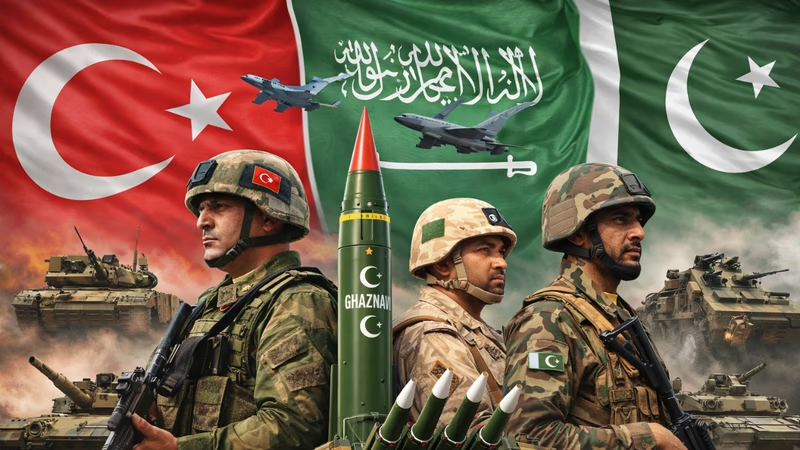
A quiet but seismic shift may be underway in global geopolitics. Reports suggest that Turkey is in advanced negotiations to join a mutual defense agreement between Pakistan and Saudi Arabia—an arrangement that some analysts are already calling an “Islamic NATO.” While the term is unofficial and provocative, the strategic logic behind it is anything but speculative. This potential alliance would fuse Saudi financial muscle, Pakistan’s nuclear deterrent, and Turkey’s battle-tested military and booming defense industry into a formidable regional bloc.
Table of Contents
- What Is the ‘Islamic NATO’?
- The Strategic Triangle: Saudi Cash, Turkish Arms, Pakistani Nukes
- Why Now? The Erosion of U.S. Reliability
- How Would the Defense Pact Work?
- Global Reactions and Regional Implications
- Challenges and Risks to the Alliance
- Conclusion: A New Axis of Power?
- Sources
What Is the ‘Islamic NATO’?
The phrase “Islamic NATO” is a media-coined label—not an official name—but it captures the ambition: a formal, collective defense framework among Muslim-majority nations, modeled loosely on Article 5 of the North Atlantic Treaty Organization (NATO), which states that an attack on one member is an attack on all.
At its core, this initiative reportedly began as a bilateral security understanding between Pakistan and Saudi Arabia, forged over decades of close political and religious ties. Turkey’s potential entry elevates it from a regional understanding to a transcontinental power axis, stretching from Anatolia through the Arabian Peninsula to South Asia.
The Strategic Triangle: Saudi Cash, Turkish Arms, Pakistani Nukes
This alliance isn’t built on symbolism—it’s anchored in hard, complementary capabilities:
- Saudi Arabia: The kingdom brings immense financial resources, energy leverage, and strategic location at the heart of the Islamic world. It has long sought security guarantees beyond its reliance on Western powers.
- Turkey: Under President Erdogan, Turkey has aggressively expanded its defense industry. From drones like the Bayraktar TB2 to indigenous fighter jet programs, Ankara now exports advanced military hardware across Africa, the Middle East, and beyond. Its NATO membership (however strained) also offers unique intelligence and operational experience.
- Pakistan: As the only Muslim nuclear-armed state, Pakistan provides the ultimate deterrent. While its conventional military is modest compared to regional giants like Iran or Israel, its nuclear arsenal is a game-changer in any collective defense calculus.
Why Now? The Erosion of U.S. Reliability
The timing of these talks is no coincidence. Across the Middle East and South Asia, traditional U.S. allies are questioning Washington’s long-term commitment. The chaotic withdrawal from Afghanistan, perceived wavering on Gulf security, and shifting priorities toward China have created a vacuum.
As one senior Gulf diplomat anonymously told The Financial Times, “We can no longer outsource our security to a superpower whose attention span is measured in election cycles.” This sentiment is echoed in Islamabad and Ankara, where leaders increasingly favor multi-alignment over dependence on a single patron.
How Would the Defense Pact Work?
While full details remain classified, sources indicate the pact would include:
- A mutual defense clause akin to NATO’s Article 5.
- Joint military exercises and intelligence sharing.
- Streamlined arms transfers and defense industrial collaboration (e.g., Turkish drones produced under license in Pakistan for Saudi use).
- Potential rapid deployment mechanisms for crises in member states.
Crucially, it would likely stop short of formal nuclear sharing—Pakistan’s arsenal would remain sovereign—but its mere existence would serve as a strategic umbrella for the alliance.
Global Reactions and Regional Implications
An emerging Islamic NATO would send shockwaves through global capitals:
- United States: Likely to view it with caution—welcoming reduced burden-sharing but wary of a bloc that could challenge its influence or align with rivals like China.
- Iran: Would see it as a direct threat, potentially accelerating its own regional alliances or nuclear ambitions.
- India: Deeply concerned about a formalized Pakistan-Saudi-Turkey axis, especially given India’s own strategic partnerships with the UAE and Israel.
- China: May quietly support the move as part of its broader strategy to foster a multipolar world order.
Challenges and Risks to the Alliance
Despite its strategic appeal, the alliance faces significant hurdles:
- Divergent Interests: Turkey’s ties with Qatar (and occasional friction with Saudi Arabia) could create internal tensions.
- Nuclear Sensitivities: Any perception of nuclear cooperation could trigger international sanctions under non-proliferation regimes.
- Operational Complexity: Coordinating militaries with different doctrines, languages, and equipment is immensely challenging.
- U.S. Pressure: Washington could discourage Turkey—a NATO ally—from deepening such a pact, fearing fragmentation of Western unity.
Conclusion: A New Axis of Power?
Whether or not it’s ever formally branded an “Islamic NATO,” the deepening defense coordination between Turkey, Pakistan, and Saudi Arabia signals a profound realignment in global security architecture. Driven by shared anxieties and complementary strengths, this trilateral axis could become a defining feature of 21st-century geopolitics—offering its members greater autonomy while challenging the established order. The world should watch closely; the age of unipolar security may be giving way to a more fragmented, yet fiercely networked, future.
Sources
[1] Times of India: “Islamic Nato in making? How Turkish arms, Saudi cash and Pak nukes could align” – https://timesofindia.indiatimes.com/world/middle-east/islamic-nato-in-making-how-turkish-arms-saudi-cash-and-pakistan-nukes-could-align-all-about-the-defence-pact/articleshow/126519303.cms
[2] NATO Official Website – https://www.nato.int/
[3] Stockholm International Peace Research Institute (SIPRI) – Defense Industry Reports
[4] The Financial Times – Geopolitical analysis on Gulf security shifts