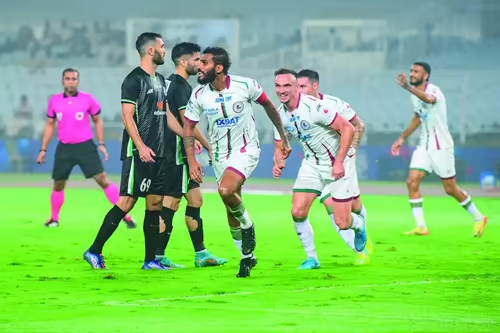
The beautiful game in India is facing an ugly financial reality. The ISL broadcast rights for the upcoming 2025–26 season remain unsold, leaving the All India Football Federation (AIFF) scrambling to secure a lifeline for the country’s premier football league. This isn’t just a business hiccup; it’s a full-blown crisis that threatens the very foundation of the Indian Super League .
Table of Contents
- The Current Crisis: A Failed Tender and a Looming Deadline
- From Boom to Bust: The Collapse of the Star Sports Deal
- Why Are There No Bidders? The Perfect Storm of Uncertainty
- The Domino Effect: How This Crisis is Crushing ISL Clubs
- Possible Solutions and the Road Ahead for Indian Football
- Conclusion: A Pivotal Moment for the ISL
- Sources
The Current Crisis: A Failed Tender and a Looming Deadline
In a desperate move to salvage the season, the AIFF has reissued its Request for Proposal (RFP) for the ISL broadcast rights for the 2025–26 campaign . The previous tender, which had a deadline of February 1, 2026, drew a complete blank—no serious broadcaster was willing to put forward a bid . The new tender comes with a host of concessions, including a drastically reduced production budget and a condensed season format, but the core problem remains: a severe lack of confidence in the league’s current commercial model .
From Boom to Bust: The Collapse of the Star Sports Deal
To understand the depth of this crisis, one must look back at the league’s golden era. For nearly a decade, the ISL enjoyed a stable and highly visible platform thanks to its partnership with Star Sports, managed by the Football Sports Development Limited (FSDL). That deal, reportedly worth ₹550 crore for a two-year period, provided the league with a massive revenue stream and consistent, high-quality nationwide coverage . However, that agreement has now expired, and the transition to a new partner has been anything but smooth .
Why Are There No Bidders? The Perfect Storm of Uncertainty
Several interconnected factors have created a perfect storm that’s scaring away potential broadcasters:
- Uncertain Fixtures and Format: The AIFF has proposed a shortened, 16-game season, which offers far less inventory for advertisers and less content for fans . This directly impacts the value proposition for any broadcaster.
- Reduced Production Quality: To cut costs, the AIFF is offering a bare-bones production package. Broadcasters are wary of airing a product that might look subpar compared to other major sports leagues, potentially damaging their own brand reputation .
- Limited Bargaining Power: With the previous deal gone and no immediate alternatives, the AIFF is in a weak negotiating position. They can’t command the high prices of the past, and potential partners know it .
- Questionable Commercial Viability: The league’s ability to generate consistent viewership and advertising revenue outside of marquee matches is still a major concern for investors .
The Domino Effect: How This Crisis is Crushing ISL Clubs
The broadcast rights fee is the single largest source of central revenue for the ISL. Without it, the entire ecosystem is under immense strain. The financial pressure is already being felt at the club level:
- Clubs are being asked to contribute a significant participation fee of around ₹2.5 crore each, a heavy burden in the current climate .
- Reports indicate that several clubs have already started to lose staff, delay player salaries, and halt recruitment activities .
- The uncertainty is making it impossible for clubs to plan for the future, leading to a general sense of instability across the league .
This situation is a stark contrast to the league’s early years, where high spending was common, but it was often not matched by sustainable revenue streams . Now, the bill has come due.
Possible Solutions and the Road Ahead for Indian Football
The path forward is fraught with challenges, but not without options. The AIFF might be forced to consider a short-term, low-value deal with a digital-first broadcaster like Viacom18, which previously held the rights, just to get the league on air . In the long term, a more fundamental restructuring is needed. This could involve:
- Granting clubs a greater say in the league’s commercial operations to align their interests with its success.
- Investing in grassroots marketing and fan engagement to build a more loyal and consistent audience base.
- Developing a more transparent and robust financial model that attracts serious, long-term investors.
For deeper insights into the league’s structural issues, see our analysis on [INTERNAL_LINK:isl-governance-model].
Conclusion: A Pivotal Moment for the ISL
The struggle to sell the ISL broadcast rights is more than a business failure; it’s a critical test of the league’s resilience and its place in the Indian sports landscape. The decisions made in the coming weeks will determine whether the ISL can emerge from this crisis stronger and more sustainable, or if it will continue its slide into a state of financial and operational chaos. The future of professional football in India hangs in the balance.
Sources
- Times of India: From Rs 275 crore to bare bones: AIFF faces a tough test to sell ISL broadcast rights
- Akshay Ramesh, Sportstar: ISL clubs question viability of shortened season
- Inside Sport: ISL to go ahead with all 14 clubs, cutting costs the primary agenda
- [INTERNAL_LINK:isl-financial-model-explained]