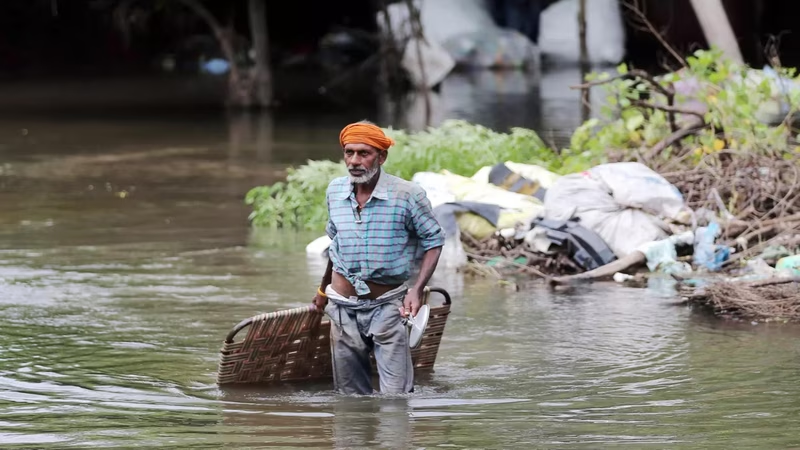
The year 2025 wasn’t just another chapter in India’s climate story—it was a stark, terrifying warning. Record-breaking heatwaves scorched more than half of the country’s districts, while relentless floods submerged vast swathes of land, displacing millions and crippling infrastructure . In this new era of escalating climate chaos, one truth stands out: disaster preparedness India isn’t just a policy goal; it’s a matter of national survival.
Yet, a persistent and dangerous imbalance remains. For every success story like the near-miraculous evacuation during Cyclone Phailin, there’s a recurring tragedy like the annual devastation in Bihar. This gap between reactive relief and proactive planning is the central challenge facing the nation today.
Table of Contents
- The 2025 Wake-Up Call: Floods, Heat, and a Nation on Edge
- The Phailin Blueprint: Success in Disaster Preparedness India
- The Bihar Paradox: Why Preparedness Falters
- The Reactive vs. Proactive Gap
- Building a Truly Resilient India
- Conclusion: Is India Ready?
- Sources
The 2025 Wake-Up Call: Floods, Heat, and a Nation on Edge
2025 served as a brutal laboratory for climate extremes in India. The data is sobering: floods accounted for 33% of all climatic disaster incidents, followed closely by heatwaves at 24% and drought at 22% . Beyond the statistics, the human cost was immense. Intense heatwaves weren’t just uncomfortable; they became a serious public health emergency, pushing health systems to their limits .
These events are no longer anomalies. They are the new normal, driven by a potent cocktail of India’s unique geography, rapid and often unplanned urbanization, and the accelerating force of global climate change . The question is no longer if the next disaster will strike, but when—and whether our systems are built to handle it.
The Phailin Blueprint: Success in Disaster Preparedness India
If there’s a gold standard for disaster preparedness India, it’s the response to Cyclone Phailin in 2013. Facing a storm of catastrophic potential, authorities executed a massive, well-coordinated evacuation of nearly one million people from Odisha’s coast .
The result was nothing short of remarkable. Despite Phailin being the strongest cyclone to hit the region in 14 years, the death toll was kept to a tragic but manageable 38, a world away from the thousands lost in previous cyclones . This success wasn’t luck; it was the direct result of meticulous planning, robust early warning systems, clear communication, and strong institutional coordination between the National Disaster Management Authority (NDMA) and state agencies .
Phailin proved that with the right investment in preparedness, India can save thousands of lives. It’s a blueprint that exists, waiting to be replicated across other disaster scenarios.
The Bihar Paradox: Why Preparedness Falters
In stark contrast to the Phailin story lies the recurring nightmare of Bihar’s floods. Year after year, the same districts are inundated, the same communities are displaced, and the same cycle of emergency relief begins anew .
Why does the Phailin model fail here? The answer is complex. It involves a lack of long-term investment in structural solutions like embankments and drainage, poor land-use planning that ignores floodplains, and a systemic focus on post-disaster aid rather than pre-emptive risk reduction . The political economy of disaster often favors visible relief efforts over the less glamorous, but far more effective, work of building resilience before the waters rise.
The Reactive vs. Proactive Gap
This is the core of India’s dilemma. The nation has significantly improved its disaster response capacity. The armed forces, NDRF, and local administrations can mobilize quickly in a crisis. However, the shift towards true preparedness—which includes risk assessment, community training, resilient infrastructure, and ecosystem-based adaptation—remains incomplete .
A truly proactive system would mean:
- Integrating climate risk into all urban planning and development projects.
- Empowering local communities with the knowledge and resources to manage their own risks.
- Moving beyond temporary shelters to permanent, safe housing solutions in vulnerable areas.
- Strengthening public health systems to cope with the surge in heatstroke and water-borne diseases.
Building a Truly Resilient India
The path forward requires a fundamental mindset shift. As the Sendai Framework for Disaster Risk Reduction advocates, the focus must move from managing disasters to managing risk . This means aligning national and state policies with a clear, funded strategy for long-term resilience.
For more on how other nations are tackling this, the World Bank’s extensive resources on climate resilience offer valuable insights [https://www.worldbank.org/en/topic/disasterriskmanagement]. Domestically, initiatives like the National Monsoon Mission are a step in the right direction, but they need to be scaled up and localized [INTERNAL_LINK:india-climate-resilience-initiatives].
Conclusion: Is India Ready?
The evidence from 2025 is clear: India is not yet fully ready for the escalating frequency and intensity of climate-driven disasters. While the legacy of Cyclone Phailin shows what’s possible with foresight and coordination, the recurring tragedies in places like Bihar expose a critical gap in our national strategy. True safety won’t come from bigger relief packages after the fact, but from smarter, bolder investments in disaster preparedness India today. The time to act is now, before the next crisis hits.