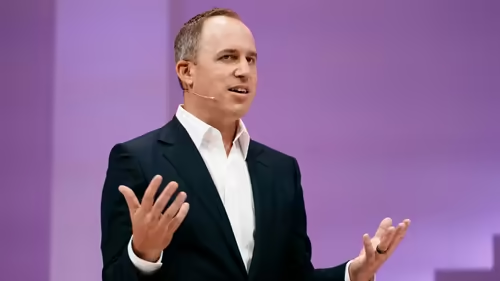
Is the AI Bubble About to Burst? OpenAI Chair Bret Taylor’s Stark Warning
The artificial intelligence gold rush has been relentless. Billions are poured into startups daily, valuations soar on promises of the future, and every company claims its AI will change the world. But now, a chilling voice from the very top is urging caution. Bret Taylor, the chairman of OpenAI’s board—the company behind ChatGPT—has just declared that the AI sector is “probably” in a bubble .
This isn’t just any market analyst talking; it’s the man steering one of the most influential AI companies on the planet. His comments, made at the World Economic Forum in Davos, have sent ripples through the tech and investment communities. So, what does this mean for the future of AI, and should we be worried?
Table of Contents
- Taylor’s Davos Declaration: A Bubble is Brewing
- The 1999 Dot-Com Ghost: A Familiar Pattern?
- The Sierra Paradox: Warning Bubbles While Building One
- What a Market Correction Means for You
- Conclusion: Navigating the AI Wave
- Sources
Taylor’s Davos Declaration: A Bubble is Brewing
Speaking with a mix of optimism and stark realism, Bret Taylor didn’t mince words. He expects a significant market correction and consolidation in the AI industry over the next few years . While he identifies himself as a long-term “AI optimist,” believing the technology will fundamentally transform the economy just like the internet did, he’s deeply concerned about the current state of affairs.
His core argument is simple: both “smart money” and “dumb money” are flooding into the sector at an unsustainable pace . This influx of capital, driven by FOMO (fear of missing out) rather than solid fundamentals, is inflating valuations far beyond what many companies can justify. The free market, Taylor believes, will eventually step in to separate the true innovators from the hype-driven pretenders.
The 1999 Dot-Com Ghost: A Familiar Pattern?
Taylor’s warning is particularly potent because he directly compared the current AI landscape to the late-1990s dot-com bubble . During that era, any company with a “.com” in its name could see its stock price skyrocket, regardless of its business model, revenue, or even a viable product. The result was a spectacular crash that wiped out trillions in market value and left a trail of failed companies.
While today’s AI boom is built on more tangible technological breakthroughs than the early internet was, the pattern of excessive speculation and inflated expectations is eerily similar. The key difference, as some analysts point out, is that today’s tech giants have real earnings and a more mature ecosystem . However, the sheer number of new AI startups with sky-high valuations and unproven paths to profitability makes Taylor’s comparison hard to ignore.
The Sierra Paradox: Warning Bubbles While Building One
Here’s where things get complicated—and perhaps a little ironic. While warning the world about an AI bubble, Bret Taylor is simultaneously the founder and CEO of his own AI startup, Sierra. And Sierra is not just any startup; it’s a $10 billion valuation powerhouse that recently closed a massive $350 million funding round .
This creates a fascinating paradox. Is Taylor trying to cool down a market that’s becoming too hot, thereby protecting his own investment by ensuring a more stable, long-term growth trajectory? Or is he simply being a responsible industry leader, calling out the dangers even as he participates in the race?
Sierra’s focus on building AI agents for customer service—a practical, enterprise-focused application—suggests Taylor is betting on companies with clear, immediate use cases to survive the coming storm. His warning might be a signal that the era of vague, general-purpose AI promises is ending, and a new era of specialized, value-driven AI is beginning.
What a Market Correction Means for You
So, what should you take away from Taylor’s warning? Whether you’re an investor, a tech professional, or just an interested observer, here’s what a potential AI market correction could look like:
- For Investors: Expect volatility. The days of easy, exponential returns on any AI-related stock may be over. Focus will shift to companies with strong fundamentals, clear revenue models, and a defensible technological edge. Diversification will be key.
- For Startups: The fundraising environment will likely tighten. Startups will need to demonstrate a clear path to profitability and a unique value proposition to attract capital. The “growth at all costs” mentality will be replaced by a focus on sustainable unit economics.
- For Consumers & Businesses: In the short term, you might see fewer flashy AI product launches. In the long term, however, a market correction is healthy. It clears out the noise and allows the best, most useful AI technologies to flourish and become integrated into our daily lives and workflows.
Conclusion: Navigating the AI Wave
Bret Taylor’s candid assessment is a crucial reality check for an industry running at full throttle. His declaration of a probable AI bubble isn’t a prediction of doom, but a call for maturity and discipline. The underlying technology of AI is revolutionary and its long-term impact is undeniable. However, the journey won’t be a straight line up.
The coming years will likely see a period of intense competition, consolidation, and a return to fundamentals. Companies that can deliver real, measurable value—not just hype—will emerge as the true winners. For everyone else, it’s a reminder to keep a cool head and a sharp eye on the horizon. The AI revolution is real, but its path will be paved with both incredible innovation and inevitable market corrections.