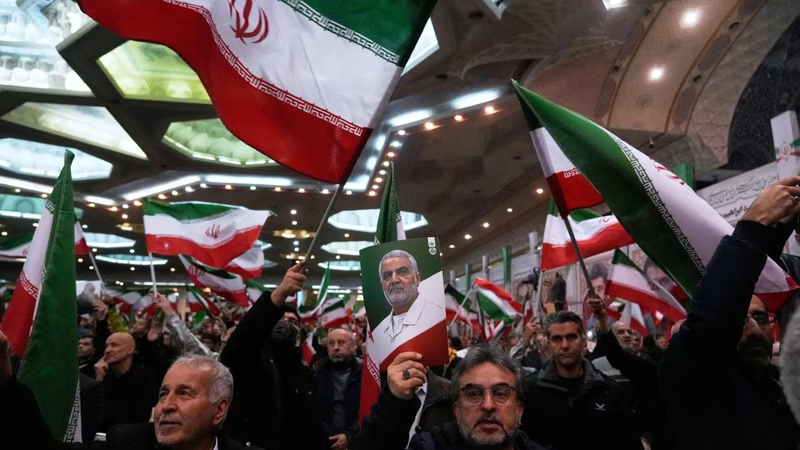
In a dramatic escalation of rhetoric that has sent shockwaves through global diplomatic circles, Iran has drawn a stark ‘red line’ in response to a direct threat from former U.S. President Donald Trump. The confrontation, centered on ongoing Iran protests, has pushed the already fraught relationship between the two nations to a new precipice.
The crisis was ignited on January 1, 2026, when Trump, in a post on Truth Social, issued a loaded warning to the Islamic Republic. “If Iran shoots and violently kills peaceful protesters, which is their custom, the United States of America will come to their rescue,” he declared . This statement, referencing the widespread demonstrations currently rocking Iran, was seen in Tehran not as a humanitarian gesture but as a brazen threat to its sovereignty.
Table of Contents
- Iran’s Stern Response and the ‘Red Line’
- The Fuel Behind the Flames: Iran’s Economic Crisis
- A Geopolitical Chess Game
- Historical Context and Future Implications
- Conclusion: A Dangerous and Unstable Path
- Sources
Iran’s Stern Response and the ‘Red Line’
Tehran’s reaction was swift and uncompromising. Iranian officials framed Trump’s comments as a direct interference in their internal affairs and a potential pretext for military intervention. In a forceful rebuttal, they issued a clear warning: any such U.S. action would be met with a “severe and regret-inducing” response . This language is a well-understood signal in the region, drawing a direct ‘red line’ that the U.S. is being dared not to cross.
The Islamic Republic’s leadership further mocked the credibility of Trump’s promise, pointing to America’s historical record of abandoning its allies when the stakes get high. They see the ‘rescue’ narrative as a hollow threat designed to embolden protesters and destabilize the government from within—a tactic they are all too familiar with. This exchange marks a significant spike in US-Iran tensions for 2026, creating a volatile atmosphere where a single miscalculation could have far-reaching consequences .
The Fuel Behind the Flames: Iran’s Economic Crisis
It’s crucial to understand that the Iran protests are not merely a political stunt but are deeply rooted in a severe economic crisis. The nation is grappling with crippling inflation, reported to be around 40%, which has devastated household incomes and led to widespread shop closures . International sanctions, particularly those linked to Iran’s nuclear program, have strangled its economy, making basic goods unaffordable for many citizens .
What began as demonstrations over the soaring cost of living and the plummeting value of the national currency has evolved into a broader expression of public frustration. Protesters are now voicing their grievances against a range of issues, from government mismanagement and political freedoms to women’s rights [[16][19]]. This groundswell of domestic discontent provides the volatile backdrop against which the Trump-Iran rhetorical battle is playing out.
A Geopolitical Chess Game
This situation is not unfolding in a vacuum. The shadow of Israel looms large over the current standoff. Iranian officials have been quick to accuse both the U.S. and Israel of actively fueling the unrest to weaken the regime . This suspicion is not unfounded, given the recent history of Israeli strikes on Iranian targets and the close alliance between Trump and Israeli Prime Minister Benjamin Netanyahu, who has openly discussed the possibility of further strikes on Iran in 2026 .
The current crisis is a classic geopolitical chess match:
For the U.S. and its allies: The protests represent an opportunity to pressure the Iranian regime, challenging its legitimacy and potentially forcing it back to the negotiating table on its nuclear program.
For Iran’s leadership: The protests are an existential threat that must be contained at all costs. They view any external support for the demonstrators as an act of war, justifying a harsh crackdown and aggressive posturing towards Washington. This perspective is reinforced by their belief that their ballistic missile capabilities and defensive posture are non-negotiable and not subject to foreign permission .
Historical Context and Future Implications
The current dynamic between the U.S. and Iran is a continuation of a decades-long cycle of hostility, sanctions, and proxy conflicts. The 2026 standoff is particularly dangerous because it intertwines a volatile internal uprising in Iran with the aggressive, transactional foreign policy style of Donald Trump.
While some reports suggest U.S. intelligence currently sees no signs of an imminent Iranian attack, the situation remains highly fluid and unpredictable . The window for diplomatic solutions to constrain Iran’s nuclear ambitions has already narrowed significantly . The current crisis threatens to slam that window shut entirely, potentially pushing the region towards a more direct and devastating conflict.
Efforts are reportedly underway to find a diplomatic off-ramp, with Iraq even attempting to arrange bilateral talks between the two adversaries in Baghdad . However, with both sides entrenched in their public positions, the prospects for a peaceful resolution appear grim.
Conclusion: A Dangerous and Unstable Path
The clash between Trump’s promise to ‘rescue’ protesters and Iran’s ‘red line’ warning has created a perilous new chapter in US-Iran relations. At its heart are the genuine and desperate Iran protests, born from a crushing economic crisis that has pushed ordinary citizens to their limits. While external powers see a strategic opportunity, for the Iranian people, this is a struggle for a better future. The world now watches with bated breath to see if this dangerous game of brinkmanship will lead to de-escalation or a catastrophic miscalculation that engulfs the entire region. For more on the complex history of this relationship, explore our deep dive on [INTERNAL_LINK:US-Iran_relations_history].
Sources
- CBS News: Trump says if Iran “kills peaceful protesters,” the U.S. will “come to their rescue”
- Times of India: ‘A red line’: Iran hits back after Donald Trump’s warning
- WBZ NewsRadio: Trump, Iran Issue Dueling Threats
- The Guardian: 2025–2026 Iranian protests
- International Viewpoint: Several killed as Iran protests over rising cost of living spread