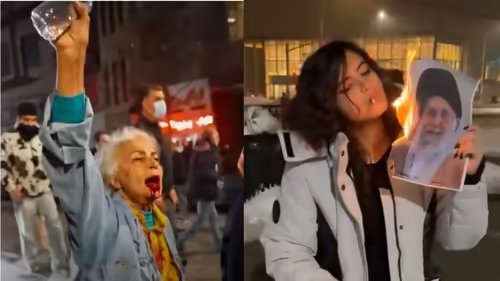
It starts with a whisper. Then a chant. Then thousands of voices rising in unison: “Jin, Jiyan, Azadi!” — “Woman, Life, Freedom!” In early 2026, this Kurdish slogan has once again become the heartbeat of Iran’s most potent social uprising since 2022. Sparked by the brutal death of 22-year-old Mahsa Amini in police custody for allegedly wearing her hijab “improperly,” the Iranian women protests have evolved from spontaneous outrage into a sustained, nationwide movement demanding nothing less than bodily autonomy, dignity, and democratic reform .
Despite internet blackouts, mass arrests, and reports of torture and executions, women—young and old, veiled and unveiled—are leading the charge. They cut their hair in public squares, burn headscarves, and stand shoulder-to-shoulder with students, workers, and even segments of the clergy. This isn’t just a protest against mandatory hijab laws; it’s a generational reckoning with a theocratic regime that has policed women’s bodies for over four decades.
Table of Contents
- What Is the ‘Woman, Life, Freedom’ Movement?
- The Spark That Ignited a Nation: Mahsa Amini
- Iranian Women Protests Resurge in 2026
- ‘Jin, Jiyan, Azadi’: More Than a Slogan
- State Crackdown and International Response
- Why This Movement Is Different
- How You Can Support Iranian Women
- Conclusion: A Revolution of Dignity
- Sources
What Is the ‘Woman, Life, Freedom’ Movement?
Originating from Kurdish feminist movements in Turkey and Syria, the phrase “Jin, Jiyan, Azadi” was adopted by Iranian protesters in 2022 as both a rallying cry and a philosophical framework. It asserts that true freedom cannot exist without women’s liberation—and that life itself is inseparable from autonomy over one’s body and choices.
Unlike past uprisings focused on economic grievances or political reform alone, the Iranian women protests place gender justice at the center. This shift has galvanized unprecedented cross-class and cross-generational solidarity, with men joining women in rejecting state-enforced morality codes.
The Spark That Ignited a Nation: Mahsa Amini
Mahsa (Jina) Amini, a young Kurdish-Iranian woman from Saqqez, was arrested by Iran’s “morality police” on September 13, 2022, for allegedly violating the country’s strict hijab law. She fell into a coma in custody and died three days later. Authorities claimed she suffered a heart attack—but leaked medical reports and eyewitness accounts suggest she was beaten .
Her funeral turned into a mass demonstration. Within days, protests erupted in all 31 provinces. Schools, universities, and bazaars shut down. Female students removed their headscarves in classrooms. Men chanted, “We are all Mahsa!” Her name became a symbol—not just of injustice, but of resistance.
Iranian Women Protests Resurge in 2026
While the world’s attention waned, the movement never died. In January 2026, fresh protests erupted after reports surfaced of increased surveillance in schools and new arrests under the revived “Hijab and Chastity Bill”—a draconian law proposing prison sentences, fines, and even travel bans for women who defy dress codes .
This time, the tactics are more decentralized and digital. Using encrypted apps like Signal and Telegram, activists share real-time updates, organize flash mobs, and document abuses. Teenage girls post videos of themselves walking to school without headscarves—a quiet act of rebellion that carries immense personal risk.
‘Jin, Jiyan, Azadi’: More Than a Slogan
The power of this phrase lies in its universality. “Woman” represents the oppressed half of society. “Life” signifies the right to exist freely—without fear of arrest, violence, or erasure. “Freedom” is the ultimate goal: not just political, but existential.
It’s now echoed from Berlin to Los Angeles, painted on murals, stitched into protest banners, and even whispered by exiled Iranian artists like [INTERNAL_LINK:shirin-neyat-films]. The slogan transcends language—it’s a declaration of humanity.
State Crackdown and International Response
The Iranian government has responded with escalating brutality. According to Amnesty International, over 500 protesters have been killed since 2022, including dozens of children. At least 20,000 have been arrested, and several activists face the death penalty .
Yet global pressure is mounting. The European Union has imposed sanctions on Iran’s morality police. The U.S. Congress passed a resolution condemning the crackdowns. And in a historic move, the UN Human Rights Council established an independent fact-finding mission on Iran—a direct result of sustained advocacy by diaspora groups and NGOs.
For verified updates on human rights violations, refer to the Amnesty International Iran page.
Why This Movement Is Different
Three factors set the current wave apart:
- Leadership by women and youth: Unlike previous uprisings led by male clerics or politicians, this is driven by Gen Z women who’ve grown up with the internet and global feminist discourse.
- Rejection of symbolic concessions: Protesters aren’t asking for “reform”—they’re demanding systemic change, including the end of the Islamic Republic’s theocratic rule.
- Digital resilience: Despite state censorship, activists use proxy servers, satellite phones, and coded language to keep the world informed.
How You Can Support Iranian Women
- Amplify their voices on social media using #WomanLifeFreedom and #MahsaAmini.
- Donate to organizations like Iran Human Rights or the Abdorrahman Boroumand Center.
- Pressure your elected officials to support targeted sanctions and asylum for at-risk activists.
Conclusion: A Revolution of Dignity
The Iranian women protests are not merely about clothing—they are about the fundamental right to self-determination. Every woman who steps outside without a headscarf, every student who chants in a classroom, every mother who mourns a lost child but still raises her fist—they are rewriting Iran’s future. As one protester in Isfahan told a smuggled camera: “They can kill us, but they can’t kill the idea of freedom.” And that idea, born in pain, is now unstoppable.
Sources
- Times of India. “Jin, Jiyan, Azadi! Struggles of Iranian women as protests return to streets.” January 24, 2026.
- Amnesty International. “Iran: Death of Mahsa Amini and the crackdown on women’s rights.” October 2022.
- Human Rights Watch. “Iran: New ‘Hijab and Chastity Bill’ Threatens Severe Penalties.” December 2025.
- United Nations Human Rights Council. “Resolution on the Situation of Human Rights in the Islamic Republic of Iran.” January 2026.