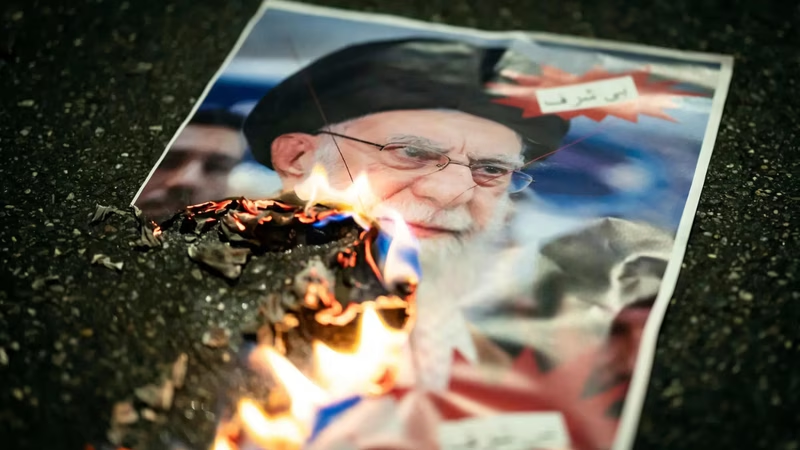
Tensions in the Middle East have flared anew as Iran issued a direct and ominous warning to Donald Trump: “Don’t repeat the same mistake.” The message comes amid a wave of deadly internal protests and Tehran’s explosive claim that Israel is behind the chaos—a narrative that risks dragging the U.S. into another volatile chapter of its fraught relationship with the Islamic Republic .
This isn’t just diplomatic posturing. With Iran closing its airspace to commercial flights—including those from Air India and IndiGo—and state media amplifying allegations of a foreign-backed “color revolution,” the stakes are alarmingly high. At the center of it all is a veiled but unmistakable reference to Trump’s 2020 decision to assassinate Iranian General Qasem Soleimani, an act that brought the two nations to the brink of war .
Table of Contents
- The Context Behind Iran’s Warning
- Iran Warns Trump and the Shadow of Soleimani
- The Alleged ‘Israeli Plot’ Explained
- Impact on Civilian Air Travel and Regional Stability
- What This Means for U.S. Foreign Policy
- Conclusion
- Sources
The Context Behind Iran’s Warning
The warning emerged during a period of intense domestic turmoil in Iran. Sporadic but violent protests have erupted in several cities, reportedly triggered by economic hardship and political repression. While the exact death toll remains disputed, Iranian authorities have blamed “foreign agents” for inciting violence.
In this charged atmosphere, senior Iranian officials have ramped up their rhetoric. A spokesperson for Iran’s Foreign Ministry explicitly stated, “We advise the United States, especially Mr. Trump, not to repeat the same mistake,” framing any potential U.S. support for the protesters as an existential threat .
This language is deliberate. It’s designed to signal both internal resolve to the Iranian public and external deterrence to Washington. By invoking Trump by name, Tehran is attempting to personalize the conflict and remind the world of the catastrophic consequences of his previous actions.
Iran Warns Trump and the Shadow of Soleimani
The “mistake” Iran refers to is almost certainly the January 2020 drone strike that killed Qasem Soleimani, the commander of the Islamic Revolutionary Guard Corps’ Quds Force. That event was a seismic moment in U.S.-Iran relations.
The assassination led to:
- A retaliatory Iranian missile strike on U.S. bases in Iraq.
- The tragic downing of a Ukrainian passenger jet by Iranian forces in a state of high alert.
- A near-total collapse of diplomatic channels between Washington and Tehran.
For Iran, Soleimani was a national hero and a symbol of its regional power. His killing was a profound humiliation and a direct challenge to the regime’s authority. Now, with protests threatening that authority from within, the regime is desperate to prevent any external actor—especially the U.S.—from exploiting the situation. The Iran warns Trump message is a clear attempt to draw a red line.
The Alleged ‘Israeli Plot’ Explained
Iran’s narrative doesn’t stop at the U.S. State-controlled media and security officials have been aggressively promoting the idea that Israel’s Mossad is the true architect of the current unrest. They claim Israeli operatives are funding, training, and directing the protesters to destabilize the Islamic Republic .
While concrete evidence for this claim is scarce, the accusation serves multiple purposes for the Iranian regime:
- Deflecting Blame: It shifts responsibility for the protests away from domestic grievances like inflation and corruption.
- Rallying Nationalism: Portraying the nation as under attack from a historic enemy can unify a fractured populace.
- Justifying Crackdowns: Labeling protesters as foreign agents provides a legal and moral justification for harsh suppression.
This tactic is a well-worn playbook for authoritarian regimes facing internal dissent, but in the context of the already-simmering Iran-Israel proxy conflict, it adds a dangerous new layer of complexity.
Impact on Civilian Air Travel and Regional Stability
The immediate fallout from this crisis is being felt far beyond the streets of Tehran. In a move that signals deep concern over potential military escalation, Iran has closed its airspace to several international carriers, including India’s Air India and IndiGo .
This decision has significant ripple effects:
- Economic Cost: Airlines face costly rerouting and delays, which are ultimately passed on to passengers.
- Safety Fears: The closure echoes the aftermath of the 2020 Soleimani strike, when the region became a no-fly zone due to fears of missile exchanges.
- Geopolitical Signal: It demonstrates Iran’s willingness to use its strategic location as leverage in a crisis.
For travelers and global logistics, this is a stark reminder of how quickly regional instability can disrupt everyday life [INTERNAL_LINK:middle-east-travel-advisories].
What This Means for U.S. Foreign Policy
As the U.S. navigates this new flare-up, it faces a delicate balancing act. On one hand, there is bipartisan support for the right of Iranians to protest peacefully against their government. On the other, there is a strong consensus to avoid any action that could be seen as direct intervention, which could trigger a wider war.
The Biden administration has so far maintained a cautious stance, condemning violence against protesters but stopping short of endorsing regime change. However, with Trump potentially returning to the White House in 2028, Tehran’s direct warning is also a strategic gambit aimed at influencing the American political discourse, painting any hawkish policy as a path to disaster.
Conclusion
The stark message from Tehran—“Don’t repeat the same mistake”—is more than just a warning; it’s a window into Iran’s state of mind. Facing internal fragility and external threats, the regime is lashing out, blaming foreign powers, and drawing hard lines to protect its survival. The Iran warns Trump narrative is a calculated effort to deter U.S. involvement and rally its base, but it also risks creating a self-fulfilling prophecy of escalation. As airspace closes and accusations fly, the world watches nervously, hoping that cooler heads will prevail before another spark ignites the region.
Sources
- Times of India: ‘Don’t repeat the same mistake’: Iran warns Trump amid deadly protests
- Council on Foreign Relations: Timeline of U.S.-Iran Relations
- BBC News: Qasem Soleimani: The Iranian general whose death escalated US-Iran tensions
- Reuters: Iran accuses Israel of fomenting unrest amid protests