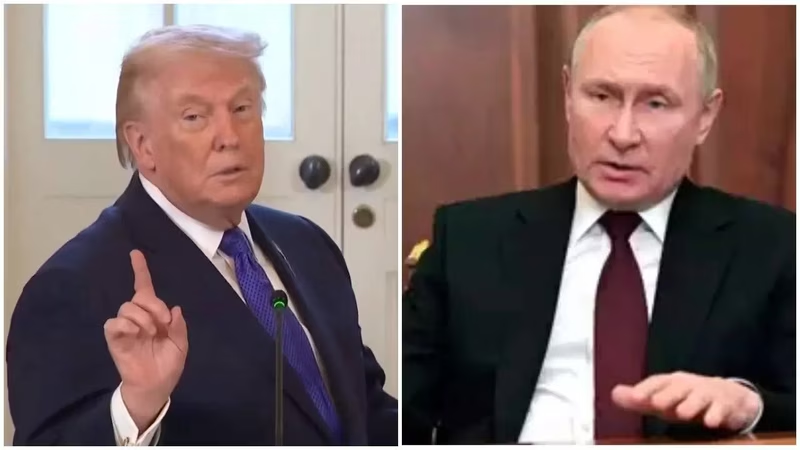
Iran Unrest Ignites a Global Power Play Between the US and Russia
The streets of Iran are burning with anger over soaring prices and slashed subsidies, but the flames of this Iran unrest are now licking at the doors of global superpowers. The crisis took a sharp geopolitical turn when former US President Donald Trump declared to Iranian protesters, “Help is on its way.” That single statement was all it took for Moscow to leap into the fray, condemning what it calls “subversive external interference” and issuing a stark warning of “disastrous consequences” . This isn’t just about internal Iranian politics anymore; it’s a proxy battle in the wider struggle for influence in the Middle East.
Table of Contents
- The Roots of the Iran Unrest: Economic Desperation
- Trump’s Message and Its Global Impact
- Russia’s Fierce Rebuke: A Strategic Warning
- The US-Russia-Iran Power Triangle: A Delicate Balance
- What This Means for the Middle East
- Conclusion: A Region on the Brink
- Sources
The Roots of the Iran Unrest: Economic Desperation
To understand the international reaction, you must first grasp the domestic fury driving the protests. The current wave of Iran unrest was triggered by the government’s decision to cut vital subsidies on essential goods like fuel and food. For a population already reeling under the weight of crippling international sanctions and rampant inflation, this was the final straw .
Protesters, many of them young and from working-class backgrounds, have taken to the streets in major cities across the country. Their core demand is simple: economic relief and a better future. However, the demonstrations have been met with a harsh crackdown by security forces, leading to reports of significant casualties. This internal turmoil has created a vacuum that external powers are eager—or wary—to fill.
Trump’s Message and Its Global Impact
Donald Trump’s social media post, telling Iranian citizens that “help is on its way,” was a classic piece of his foreign policy playbook: direct, provocative, and aimed squarely at a US adversary. While he offered no specifics on what that “help” might entail—military, financial, or merely moral support—the message itself was a powerful signal .
For the protesters, it was a morale boost, a sign that their struggle was being seen on the world stage. For the Iranian regime, it was a gift they could use to frame the entire protest movement as a foreign-backed coup attempt, thereby delegitimizing genuine domestic grievances. And for other global players, especially Russia, it was a red flag signaling potential US escalation in a region where they have their own strategic interests.
Russia’s Fierce Rebuke: A Strategic Warning
Russia’s response was swift and severe. Through its Foreign Ministry, Moscow condemned any form of “subversive external interference in the internal affairs of a sovereign state” and explicitly warned that such actions would lead to “disastrous consequences” . This language is not mere diplomatic posturing.
Russia and Iran have grown increasingly close in recent years, forming a strategic axis against Western influence. They collaborate extensively in Syria, share intelligence, and are both targets of US sanctions. By defending Iran’s sovereignty so forcefully, Russia is doing several things at once: protecting a key ally, asserting its own role as a major power in the Middle East, and sending a clear message to Washington to back off. It’s a calculated move to maintain the fragile status quo that benefits its own geopolitical agenda.
The US-Russia-Iran Power Triangle: A Delicate Balance
The current standoff is a perfect illustration of the complex three-way dynamic between these nations:
- US vs. Iran: A decades-long enmity centered on nuclear proliferation, regional influence, and human rights.
- Russia & Iran: An alliance of convenience built on shared opposition to the US and mutual economic/military needs.
- US vs. Russia: A global rivalry playing out in every corner of the world, including the Middle East.
Any shift in one relationship sends shockwaves through the others. Trump’s comments were an attempt to exploit Iran’s internal weakness, but Russia’s immediate intervention shows how tightly these three are bound together. For more on how global alliances shape regional conflicts, see our deep dive on [INTERNAL_LINK:global-alliances-and-regional-conflicts].
What This Means for the Middle East
The stakes for the region couldn’t be higher. If the Iran unrest continues to escalate and draws in more direct involvement from outside powers, it could destabilize the entire Middle East. Neighboring countries are watching closely, fearful of spillover effects. The situation also complicates efforts to revive the Iran nuclear deal (JCPOA) and could lead to a new cycle of sanctions and counter-sanctions that further impoverish the Iranian people—the very group the protests claim to represent.
Ultimately, the Iranian people are caught in the crossfire of a much larger game. Their legitimate cries for economic justice are being used as pawns in a high-stakes contest between global giants, where their own agency is often the first casualty.
Conclusion: A Region on the Brink
The convergence of domestic fury in Iran and the geopolitical chess match between the US and Russia has created a volatile and dangerous situation. While the world focuses on the war of words between Washington and Moscow, the real tragedy is unfolding on the streets of Iranian cities. The “disastrous consequences” Russia warns of may not be just for foreign powers, but for the Iranian citizens whose lives and futures hang in the balance of this escalating crisis.
Sources
- Times of India: Iran unrest: Trump tells protesters ‘help is on its way’, Russia warns of ‘disastrous consequences’
- Council on Foreign Relations (CFR): Global Conflict Tracker – Iran