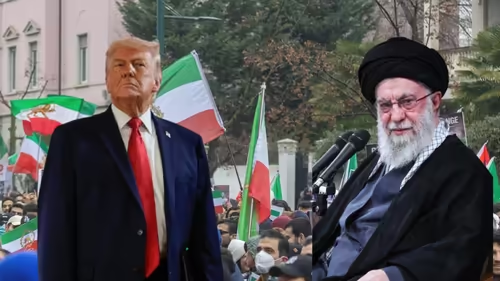
Tehran is on edge. After weeks of silence, Iran’s Supreme Leader Ayatollah Ali Khamenei has made a stunning admission: **thousands of people have been killed** during the recent wave of nationwide protests—a figure far higher than any official count previously released .
This rare acknowledgment comes amid one of the most severe domestic crises the Islamic Republic has faced in decades. What began as economic demonstrations over inflation and unemployment rapidly morphed into full-blown anti-regime uprisings, with citizens chanting “Death to the Dictator” in cities from Tabriz to Shiraz . Now, with Khamenei directly blaming the United States for orchestrating the unrest, and former U.S. President Donald Trump calling for “new leadership in Iran,” the Iran unrest has become a flashpoint in global geopolitics .
Table of Contents
- What Sparked the Iran Unrest?
- Iran Unrest: Khamenei’s Rare Admission and US Blame Game
- Trump’s Response: Calling for Regime Change
- How the Crackdown Unfolded
- International Reactions Beyond Washington
- What This Means for Iran’s Future
- Conclusion: A Nation at a Crossroads
- Sources
What Sparked the Iran Unrest?
The initial spark was economic despair. Soaring inflation—over 40% annually—coupled with widespread unemployment, especially among youth, created a tinderbox. But the real accelerant was public anger over government corruption and decades of political repression.
Protesters quickly moved beyond bread-and-butter issues. Chants targeted not just President Masoud Pezeshkian but the entire theocratic system, including Khamenei himself. Women removed their hijabs in defiance of mandatory dress laws, while university students organized mass walkouts . Social media videos showed security forces using live ammunition against unarmed crowds—a tactic that only fueled more outrage.
Iran Unrest: Khamenei’s Rare Admission and US Blame Game
In a nationally televised address on January 17, 2026, Khamenei broke his silence. “Enemies, especially the arrogant United States, have spent billions to destabilize our nation,” he declared. “They incited riots, armed thugs, and spread lies—but the Islamic Republic stands firm” .
His admission of “thousands killed” marks a significant shift. For months, Iranian officials downplayed casualties, citing only “dozens” of deaths. Independent human rights groups like Amnesty International had estimated over 1,200 killed by December 2025—but Khamenei’s own words now suggest the toll could be far higher .
By blaming foreign actors, Khamenei is employing a long-standing regime playbook: frame internal dissent as external sabotage. Yet this time, the scale of the uprising—and his own admission—makes the narrative harder to sell, even domestically.
Trump’s Response: Calling for Regime Change
From Mar-a-Lago, former U.S. President Donald Trump issued a blistering statement: “The people of Iran are suffering under a brutal, illegitimate regime. It’s time for new leadership—leaders who respect freedom, not fear it” .
While the current Biden administration has urged restraint and called for accountability, Trump’s rhetoric echoes his 2018–2020 “maximum pressure” campaign, which included crippling sanctions and the assassination of Qasem Soleimani. His latest comments signal that if he returns to the White House in 2028, regime change may once again become explicit U.S. policy.
How the Crackdown Unfolded
The Iranian government’s response has been swift and brutal:
- Internet Shutdown: Nationwide internet blackouts lasted over 10 days, isolating protesters from global media.
- Arrests: Over 15,000 people detained, including journalists, lawyers, and student activists .
- Military Deployment: The Islamic Revolutionary Guard Corps (IRGC) took control of major cities, using armored vehicles and snipers.
- Executions: At least 27 protesters sentenced to death in rushed trials, drawing global condemnation .
Despite the repression, underground networks continue to share footage of protests via Bluetooth and encrypted apps—a digital resistance that’s proving hard to extinguish.
International Reactions Beyond Washington
The global response has been mixed:
- European Union: Condemned violence but stopped short of endorsing regime change, fearing regional instability.
- Russia & China: Backed Iran’s sovereignty, accusing the U.S. of hypocrisy and interference.
- Arab Gulf States: Quietly sympathetic to protesters but publicly neutral, wary of empowering Islamist movements.
Notably, even traditional allies like Iraq and Lebanon’s Hezbollah have expressed concern over the scale of bloodshed, signaling potential cracks in Iran’s regional influence .
What This Means for Iran’s Future
The Iran unrest represents more than a protest—it’s a generational revolt. Over 60% of Iranians are under 35, and many have no memory of the 1979 revolution. They’re digitally connected, globally aware, and increasingly disillusioned with clerical rule.
While the regime may survive this wave through sheer force, its legitimacy is eroding. Economic sanctions, isolation, and internal decay could make future uprisings even more volatile. As one Tehran-based analyst noted, “You can jail thousands, but you can’t jail an idea” .
Conclusion: A Nation at a Crossroads
Iran stands at a historic juncture. Khamenei’s admission of mass deaths is both a confession of failure and a desperate attempt to rally nationalist sentiment. Meanwhile, Trump’s call for new leadership reflects a deepening U.S. divide on how to handle Tehran. One thing is clear: the status quo is unsustainable. Whether Iran moves toward reform, revolution, or further repression will shape the Middle East for decades to come.
Sources
- Times of India – Thousands killed: Khamenei blames US; Trump demands new leadership
- Amnesty International – Iran: Security Forces’ Brutal Crackdown on Protesters
- United Nations Human Rights Office – Iran Must End Violent Crackdown on Protesters