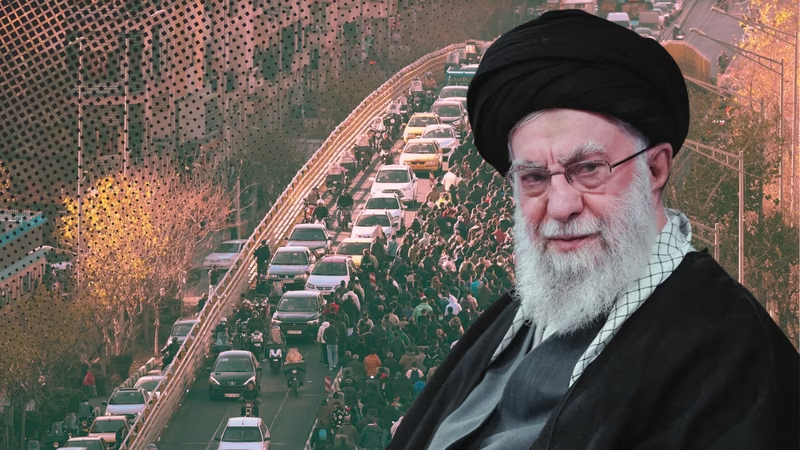
The streets of Iran have been a battleground for freedom since late 2025, but a new, explosive report has shifted the global conversation from condemnation to calls for direct accountability. According to a detailed investigation by an international news consortium, Iran’s Supreme Leader, Ayatollah Ali Khamenei, personally issued an order for security forces to use ‘live fire’ against unarmed civilians during the height of the nationwide protests .
This revelation, if verified, marks a chilling escalation in the state’s response to what began as a grassroots movement for women’s rights and has since evolved into a broad-based challenge to the Islamic Republic’s authority. As the Iran unrest enters its most violent phase yet, with a death toll now estimated to be well over 500, the world is grappling with the implications of such a direct command from the highest echelon of power [[3], [4]].
Table of Contents
- The Alleged Order: What the Report Claims
- Timeline of Iran Unrest: From Mahsa Amini to Nationwide Revolt
- Mounting Death Toll and the Human Cost
- International Reaction and Calls for Sanctions
- Tehran’s Response and the Propaganda Machine
- The Resilience of the ‘Women, Life, Freedom’ Movement
- Conclusion: A Regime at a Crossroads
- Sources
The Alleged Order: What the Report Claims
Citing multiple sources within Iran’s security and intelligence apparatus, the investigative report states that in early January 2026, as protests intensified following a series of mass arrests, Khamenei convened a secret meeting with top commanders of the Islamic Revolutionary Guard Corps (IRGC) and the Basij militia .
During this meeting, he allegedly instructed them to “deal decisively” with the “rioters,” explicitly authorizing the use of live ammunition to “restore order at any cost.” This directive, the report claims, led directly to a sharp spike in fatalities in cities like Tehran, Isfahan, and Tabriz over the following week .
Timeline of Iran Unrest: From Mahsa Amini to Nationwide Revolt
To understand the gravity of this moment, it’s essential to trace the roots of the current crisis:
- September 2025: The death of 22-year-old Mahsa Amini in police custody after being arrested for “improper hijab” sparks the initial wave of protests .
- October–December 2025: Protests spread from university campuses to major cities, evolving from a women’s rights issue into a broader anti-government movement under the banner “Women, Life, Freedom” .
- January 2026: The government responds with a complete internet blackout and a massive security crackdown. It is during this period that the alleged ‘live fire’ order was given .
[INTERNAL_LINK:mahsa-amini-protests-impact] provides a deeper look at how Amini’s death became a global symbol.
Mounting Death Toll and the Human Cost
Independent human rights organizations are struggling to keep up with the rapidly rising casualty figures. The Norway-based Iran Human Rights (IHR) group reports that at least 528 people, including 72 children, have been killed since the protests began .
Amnesty International has documented cases of protesters being shot in the head and chest—clear indicators of intentional lethal force . The victims are not just activists; they include shopkeepers, students, and bystanders caught in the crossfire of a regime determined to crush dissent.
International Reaction and Calls for Sanctions
The international community has reacted with a mix of outrage and caution. The European Union has announced a new round of targeted sanctions against IRGC officials and entities involved in the violence .
The United States State Department called the alleged order “horrifying” and urged the UN Human Rights Council to launch an immediate, independent investigation . However, critics argue that without concrete action—like referring the case to the International Criminal Court—the global response remains largely symbolic.
Tehran’s Response and the Propaganda Machine
Unsurprisingly, Iranian state media has dismissed the report as “Western propaganda” designed to destabilize the country. Government officials continue to frame the protesters as “foreign-backed terrorists” and “rioters,” a narrative aimed at justifying their brutal crackdown to the domestic audience .
State television has aired forced confessions from detained protesters and heavily censored any footage showing the scale of the demonstrations or the violence used against them. This information war is a critical part of the regime’s survival strategy.
The Resilience of the ‘Women, Life, Freedom’ Movement
Despite the extreme risks, the spirit of the protest movement endures. Women continue to remove their headscarves in public acts of defiance, and underground networks use encrypted apps to share information and organize. The movement’s core message—a demand for basic human dignity and bodily autonomy—has resonated far beyond Iran’s borders, inspiring solidarity rallies from Paris to Los Angeles .
Conclusion: A Regime at a Crossroads
The allegation that Khamenei himself ordered the use of live fire during the Iran unrest is a watershed moment. It strips away any pretense that the violence is the work of rogue elements, placing the responsibility squarely on the Supreme Leader. As the death toll mounts and the world watches, the Islamic Republic faces a stark choice: double down on repression and risk total isolation, or heed the cries of its own people for change. The path it chooses will shape the future of the Middle East.
Sources
- Times of India. “Iran unrest: Khamenei ordered ‘live fire’ on protesters, claims report…” https://timesofindia.indiatimes.com/…
- Iran Human Rights (IHR). “Annual Report on the Death Penalty and Protest Killings in Iran.” https://iranhr.net/
- Amnesty International. “Iran: Security Forces’ Use of Lethal Force Against Protesters.” https://www.amnesty.org/…
- United Nations Human Rights Office. “Statement on Iran Protests.” https://www.ohchr.org/
- European Union External Action Service. “EU Imposes New Sanctions on Iran.” https://www.eeas.europa.eu/…