Table of Contents
- A Nation on Edge: The Spark Behind Iran Unrest
- Iran Unrest Deaths and the Shift to Rural Provinces
- Economic Pressure Fuels Anger Against the Theocracy
- The Lur Ethnic Factor: Why These Provinces Are Rising
- Regime’s Response and International Silence
- Is This 2022 All Over Again—or Worse?
- Conclusion: A Crisis of Legitimacy, Not Just Bread
- Sources
A Nation on Edge: The Spark Behind Iran Unrest
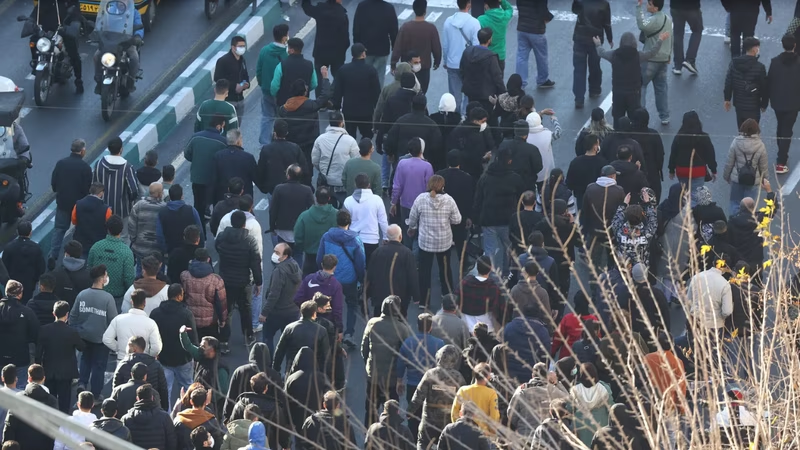
Iran is once again teetering on the brink. In early January 2026, protests erupted across multiple provinces, marking the most significant wave of civil unrest since the Mahsa Amini protests of 2022. This time, the trigger isn’t a single incident—but a slow-burning fuse of economic despair, inflation, and deepening public disillusionment with the Islamic Republic’s 45-year rule .
What began as scattered demonstrations over soaring food and fuel prices has rapidly evolved into something far more dangerous for the regime: open chants against the theocracy itself. Slogans like “Clerics, get lost!” and “No Gaza, no Lebanon, I’ll die for Iran!” echo through towns once considered politically quiet .
Iran Unrest Deaths and the Shift to Rural Provinces
At least three fatalities have been reported, with credible sources—including human rights monitors—confirming deaths in cities inhabited by the **Lur ethnic minority**, a historically marginalized group in western Iran .
Notably, while protests in Tehran have slowed due to heavy security presence, the unrest has **spread to rural and provincial centers**, including Lorestan and Ilam—regions long neglected in national discourse but now becoming flashpoints of resistance.
This geographic shift is critical. Unlike urban protests, which are easier for authorities to contain, rural demonstrations are harder to monitor, more community-driven, and often fueled by decades of economic exclusion. When combined with ethnic identity, they pose a unique threat to regime stability.
Economic Pressure Fuels Anger Against the Theocracy
Iran’s economy is in freefall. Inflation has soared above 40%, the rial has lost over 60% of its value in two years, and youth unemployment hovers near 25% . Subsidies on bread, fuel, and medicine—once a pillar of regime support—have been slashed, hitting the poor hardest.
But the public no longer blames just “bad policy.” Increasingly, the anger is directed at the **system itself**. As one protester in Khorramabad told a local contact (via encrypted message): “We don’t just want cheaper bread. We want a government that serves us—not one that sends our money to militias abroad.”
This marks a dangerous evolution: economic grievances are now explicitly **anti-theocratic**. Citizens are connecting their personal suffering to the regime’s ideological priorities—foreign adventurism, religious enforcement, and clerical privilege.
The Lur Ethnic Factor: Why These Provinces Are Rising
The Lur people, an Iranian ethnic group with distinct language and cultural traditions, have long faced systemic neglect. Their provinces—rich in oil and water—receive minimal infrastructure investment while supplying energy to Tehran and Isfahan.
Now, they’re demanding more than equity—they’re rejecting the entire framework of clerical rule. Analysts note that ethnic minorities (including Kurds, Baluch, and Ahwazi Arabs) have historically been at the forefront of anti-regime movements, but this is the first time **Lur-majority areas** are emerging as sustained centers of protest .
Regime’s Response and International Silence
So far, Iran’s response has been predictably brutal: internet throttling, mass arrests, and deployment of the Basij militia to protest zones. State media dismisses the unrest as “foreign-backed sabotage,” a tired narrative that increasingly fails to resonate domestically.
Globally, however, the reaction has been muted. With diplomatic focus on Gaza and Ukraine, and Western powers wary of triggering another migration or oil shock, there’s little appetite for intervention. The UN Human Rights Council has yet to issue a formal statement—despite clear evidence of lethal force .
For deeper context on Iran’s protest history, see our timeline on [INTERNAL_LINK:iran-protests-since-2009].
Is This 2022 All Over Again—or Worse?
The 2022 protests were largely youth-led and urban, centered on women’s rights after Mahsa Amini’s death. This 2026 wave is broader: it includes shopkeepers, farmers, teachers, and ethnic communities. It’s less about a single symbol and more about **systemic collapse**.
Crucially, the chants have changed. In 2022, “Woman, Life, Freedom” dominated. Now, it’s “Down with the Islamic Republic.” That shift—from reform to regime change—is what terrifies Iran’s leadership.
Conclusion: A Crisis of Legitimacy, Not Just Bread
The current Iran unrest isn’t just another economic protest. It’s a crisis of political legitimacy. When citizens in remote villages—once considered loyal or passive—begin openly denouncing the theocracy, the regime’s foundation cracks. Three deaths may seem small, but in Iran’s tightly controlled political landscape, they signal a dangerous escalation. If economic conditions worsen and international pressure remains absent, this could be the beginning of a far larger reckoning.
Sources
- Times of India: Iran unrest: 3 killed as protests spread
- Amnesty International: Iran: Human Rights Crisis
- Brookings Institution: Iran Analysis & Policy
- Iran Human Rights (IHR): Monitoring Civil Unrest in Iran